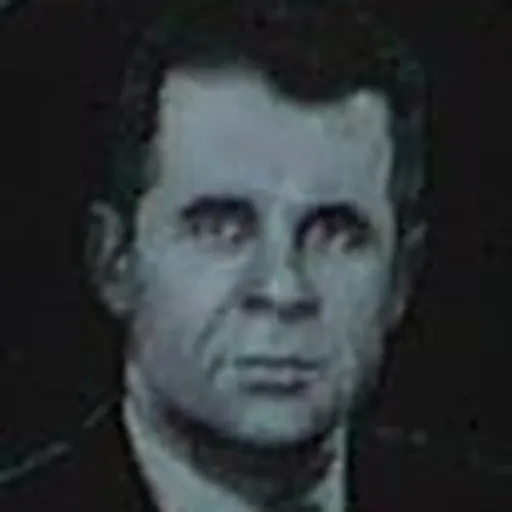
About František Mrázek
Lived 1958 – 2006 (aged 47). František Mrázek was an entrepreneur, fartsovka and gangster.
František Mrázek (1 February 1958 – 25 January 2006 in Prague) was a controversial Czech entrepreneur, often referred to as the "Godfather of Czech Organized Crime". Mrázek covertly influenced Czech politics for almost twenty years. In 2006 he was assassinated by a (still unknown) sniper. Most of the publicly available information about his criminal activities and contacts with the politicians leaked from police archives (which include wiretapping records and Mrázek's own collection of blackmail material) after his death. These sources suspect he was involved in over 30 murders.
Communist Czechoslovakia Mrázek set up a smuggling business during the communist era. He "dealt" in a variety of articles including wristwatches, Walkmans and textiles of Western origin, and even with gravestones from Czech Jewish cemeteries. He was also involved in the criminal underground of the Kolín region as his name appeared in the circles of foreign currency speculators . In 1986 Mrázek spent two months in custody and was subsequently sentenced to probation. In February 1987, Mrázek consented to cooperating with the criminal investigation department of Czechoslovak police. However, he himself was under surveillance by the Omega police team.
Post-revolution Following the Velvet Revolution of 1989 Mrázek at first focused on voucher privatization. Together with his business partners, he took the opportunity offered by the chaotic situation at the beginning of Czech economic transformation, and laundered the dirty money from the past. He later focused his business activities on real estate. Obtaining loans from Czech banks, often through a third party, Mrázek specialized in the buying and reselling of real estate. He dealt in buildings that were fraudulently overvalued, earning hundreds of millions in Czech currency. He established many similar companies owned by so-called "white horses" (bogus owners, usually with Russian names). He later transferred his assets to other firms in order to cover these fraudulent activities. The Czech police investigated his suspicions activities, however, their case was closed as inconclusive as Mrázek was not legally involved in any of the firms.
At the beginning of the 1990s, Mrázek, together with famous Czech singer Karel Gott, established the foundation Interpo, dedicated to helping children of police officers killed in the line of duty. Gott however withdrew from the collaboration when the foundation fell under suspicion of dishonest financial transactions. Gott later stated that he "hadn't noticed Mrázek's connections with organized crime".
Mrázek socialized with many controversial entrepreneurs such as Tomáš Pitr and Miroslav Provod, both later convicted for tax fraud. In 2000 the Czech public television broadcaster Česká televize aired a report on Mrázek and Provod containing information about their connections to the bankruptcy of the major Czech bank, IPB, as well as to several small banks.
Influence on Czech politics Mrázek, together with another entrepreneur Tomáš Pitr, was considered the head of the financial group which controlled large chemical conglomerate SETUZA and the oil company Český olej (Czech oil). This group attempted (not only in connection with SETUZA) to influence the discharge of the Czech government for its own benefit. He was also involved in the case of "the resolution of the Russian debt", later called "the Czech fiddle of the century". He helped to arrange meetings between Czech and Russian politicians in that case. Former Czech Minister of Finance Ivo Svoboda negotiated the sale of the debt with Austrian entrepreneur Barak Alon and also with Mrázek. He was under surveillance by the Czech anti-corruption police team many times; the largest police operation oriented to his person was called Krakatice (Giant squid), established in 1999 to investigate relations between Czech politicians and groups of organized crime. However, shortly before Czech Parliament elections in 2006 some information from a file concerning contacts between Mrázek's close collaborator Igor Šafranko and politician Vlastimil Tlustý (former Czech Minister of Finance) spread to the public. Tlustý later stated that he wasn't involved in either corruption or organized crime, and he broke his contacts with negotiator Šafranko.
On 25 January 2006, František Mrázek was shot and killed by an unknown assailant in Durychova Street, Prague 4, in front of the registered office of his firms and companies. Only one shot was fired and Mrázek died almost immediately. The investigation into his death was postponed until December 2006 and the crime remains unsolved. According to the police investigation, he was shot with a sniper rifle by a professional assassin; the assassination was carefully and professionally planned.
Post-death Jaroslav Kmenta, the chief-reporter of the Czech daily newspaper Mladá Fronta Dnes, published information on František Mrázek in three books. The reliability of his investigation was, however, questioned and on 21 November 2008 Kmenta stated: "...in agreement with the editor-in-chief, I published only absolutely verified information, derived from various sources". It is entirely possible that police and investigators worked under immense pressure and were forced to stop the investigation. However, Ivan Langer, Czech Minister of the Interior and Informatics, manifested that he would refuse his request. Tichý himself has been interrogated many times by the secret police since 1995.
Mrázek's son Michal, who inherited father's wealth, publicly warned Czech politicians that he has access to a hidden archive of compromising material collected by his father.
Law against publishing wiretapping records In February 2009, the Czech parliament amended criminal law with an explicit ban on publishing any account of police wiretapping, under penalty of a heavy fine and years of imprisonment. The law was criticised by the Czech media as an attempt by politicians to avoid future embarrassment akin to the Mrázek case.
In popular culture The Story of a Godfather (Czech: Příběh kmotra), a Czech film directed by Petr Nikolaev, is inspired by the story of František Mrázek. The movie premiered on 24 October 2013.
The character Vratislav Milota, inspired by Mrázek, appeared in the film Gangster Ka.
Mrázek appeared in television series Nineties. He was played by Albert Čuba.
Don’t just read it —
keep it.
Full-length biographies made to live with: read them, listen on the way to work, watch them tonight.
- E-book
- Audio
- Video
Instant download · yours to keep · every purchase keeps this site free
Important facts
People in František Mrázek's life
Named in this biography and alive at the same time


Related people
Same field, nearest in time





Contemporaries
People whose lives overlapped František Mrázek's


Frequently asked questions
Who was František Mrázek?
Czech entrepreneur (1958-2006)
When was František Mrázek born?
František Mrázek was born on 1 February 1958 in Český Brod.
When did František Mrázek die?
František Mrázek died on 25 January 2006 in Prague, Nový dvůr.
What was František Mrázek's occupation?
František Mrázek was an entrepreneur, fartsovka and gangster.
What nationality was František Mrázek?
František Mrázek's recorded nationality: Czech people.
Sources & further reading
Cite this page
APA: Biography.guide. (2026). František Mrázek. https://biography.guide/frantisek-mrazek/
MLA: "František Mrázek." Biography.guide, https://biography.guide/frantisek-mrazek/.
Chicago: "František Mrázek." Biography.guide. https://biography.guide/frantisek-mrazek/.
Data last updated: 2026-09-22 · Spot an error? Report a correction.
Portrait: Wikimedia Commons · author & licence
Page generated 2026-09-27 05:02 UTC