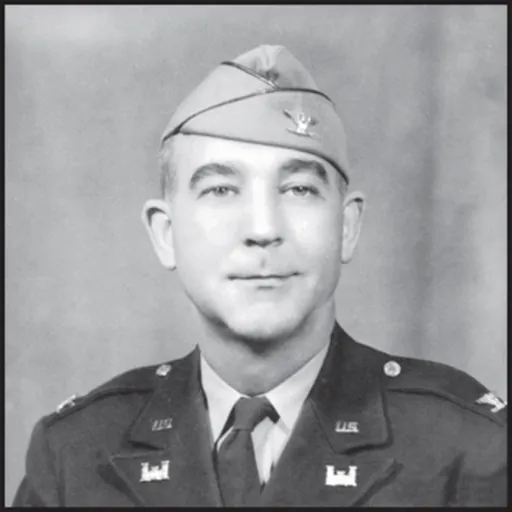
About Franklin Matthias
Lived 1908 – 1993 (aged 85). Franklin Matthias was an American physicist and civil engineer.
Franklin Thompson Matthias (13 March 1908 – 3 December 1993) was an American civil engineer who directed the construction of the Hanford nuclear site, a key facility of the Manhattan Project during World War II.
A graduate of the University of Wisconsin–Madison, Matthias joined the Tennessee Valley Authority (TVA) as a Junior Hydraulic Engineer in 1935 and worked on hydroelectric projects. In April 1941, he was called to active duty by the United States Army and joined the Construction Division of the Army Corps of Engineers. He was area engineer at the Manhattan Project's Hanford site from 1942 to 1945. As such, he supervised the enormous construction effort, which included three chemical separation plants so large that they were known as "Queen Marys", and the world's first three production-scale nuclear reactors.
After the war, Matthais went to Brazil, where he helped build a hydroelectric facility. He joined the Aluminum Company of Canada (Alcan) in 1951, and was involved in the construction of its Kemano-Kitimat hydroelectric dam and aluminum smelter project in northern British Columbia and the Chute-des-Passes project in Quebec. He was a vice president at Kaiser Engineering from 1960 to 1973.
Early life Franklin Thompson Matthias was born in Glidden, Wisconsin, on 13 March 1908, the son of Franklin Herman Matthias and Christina Thompson. He had two older brothers, Harold and Norman, and a younger brother, Carl. Franklin grew up in Curtiss, WI and graduated in 1926 from Abbotsford High School. In 1928 he became an instructor in Topographical and Hydraulic Engineering at the University of Wisconsin–Madison, from which he received his Bachelor of Science (B.S.) degree in civil engineering in 1931, and his Master of Science (M.S.) degree in civil engineering in 1933. and was a national officer of Chi Epsilon from 1931 to 1942. In 1935, he was hired by the Tennessee Valley Authority (TVA) as a Junior Hydraulic Engineer, and worked on hydroelectric and hydraulic problems and on construction, planning and plant design. He left the TVA in 1939, and spent a year working with a contractor on dredging the Tennessee River. In 1940 and 1941, he worked for the A. L. Johnson Construction Company, and on tunnels and aqueducts for the Dravo Corporation.
World War II
In April 1941, Matthias was called to active duty by the United States Army as a first lieutenant, and joined the Construction Division of the Army Corps of Engineers, where he received rapid promotion.
Because of the isolation of the site, known as the Hanford Engineer Works, Matthias exercised more administrative autonomy than the Manhattan Project's other area engineers. The number of personnel assigned to his office grew to over 500 in 1944. Construction work commenced on the site in April 1943. The size of the construction work force eventually reached 44,900 in June 1944; over 150,000 workers were employed at the site between 1943 and 1946.
The first production batch of uranium slugs were dissolved at the separation plant on 26 December 1944, and in January 1945 Matthias personally couriered the first batch of plutonium nitrate to Los Angeles, where he handed it over to another courier, who took it to the Los Alamos Laboratory. Plutonium from Hanford would be used in the Fat Man bomb used in the bombing of Nagasaki.
Later life Matthias left the Army in 1946 and went to Brazil as a project manager for the construction for a hydroelectric facility, eventually becoming the Manager of Engineering at Brazilian Traction. Late in 1951 he joined the Aluminum Company of Canada (Alcan) as the Project Manager of Engineering and Construction of the Kemano-Kitimat hydroelectric dam and aluminum smelter project in northern British Columbia. In 1956 he moved to Montreal as its Director of Engineering, and worked on the Chute-des-Passes project. In 1960 he joined Kaiser Engineering in Oakland, California, as its Vice President for heavy construction and hydroelectric engineering, and was its Vice President of transportation projects from 1970 to 1973. He retired in 1973 at the age of 65. His second wife, Mary Teresa Benderska, whom he had married on 29 October 1948, had died in 1986, and his daughter Gelen Christine had died in 1965.
Don’t just read it —
keep it.
Full-length biographies made to live with: read them, listen on the way to work, watch them tonight.
- E-book
- Audio
- Video
Instant download · yours to keep · every purchase keeps this site free
Important facts
People in Franklin Matthias's life
Named in this biography and alive at the same time

Related people
Same field, nearest in time




Contemporaries
People whose lives overlapped Franklin Matthias's


Frequently asked questions
Who was Franklin Matthias?
American nuclear engineer (1908–1993)
When was Franklin Matthias born?
Franklin Matthias was born on 13 March 1908 in Glidden.
When did Franklin Matthias die?
Franklin Matthias died on 3 December 1993 in Walnut Creek.
What was Franklin Matthias's occupation?
Franklin Matthias was a physicist and civil engineer.
What nationality was Franklin Matthias?
Franklin Matthias was American.
Sources & further reading
· Wikipedia: Franklin Matthias
Cite this page
APA: Biography.guide. (2026). Franklin Matthias. https://biography.guide/franklin-matthias/
MLA: "Franklin Matthias." Biography.guide, https://biography.guide/franklin-matthias/.
Chicago: "Franklin Matthias." Biography.guide. https://biography.guide/franklin-matthias/.
Data last updated: 2026-09-21 · Spot an error? Report a correction.
Portrait: Wikimedia Commons · author & licence
Page generated 2026-09-27 05:00 UTC