
About Frank Nicholas Meyer
Lived 1875 – 1918 (aged 42). Frank Nicholas Meyer was a Dutch and American explorer, botanist, botanical collector, scientific collector and botany.
Frank Nicholas Meyer (30 November 1875 – 2 June 1918) was a United States Department of Agriculture explorer who travelled to Asia to collect new plant species. The Meyer lemon was named in his honor.
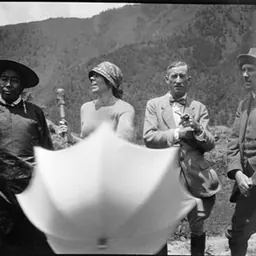
Biography He was born Frans Nicolaas Meijer in Amsterdam in 1875. For seven years Meijer was educated at the Hortus Botanicus in Amsterdam as an assistant of Hugo de Vries. Meyer was hired in 1905 by the USDA in their Office of Seed and Plant Introduction to send back to the United States economically useful plants as part of an effort, initiated in 1898, to augment United States agriculture and horticulture with plant varieties collected around the world. A particular focus of the program was to introduce drought resistant plants suitable for dry land farming, a demand driven by concentrated agricultural expansion into the Great Plains. By 1912, the program had introduced over 34,000 species. These were submitted to testing and selection at plant introduction stations, such as in Chico, California, and incorporated into then developing plant breeding programs. Through an arrangement with Charles Sprague Sargent and David Fairchild Meyer was also to send to the Arnold Arboretum trees and shrubs of ornamental value. They archived images he collected of his travels.
Meyer's 2,500 plant introductions reported that, Meyer's "notes, published in the “Inventories of Seeds and Plants Imported” of the Office of Foreign Seed and Plant Introduction, are full of suggestions to plant breeders, and, luckily, his suggestions are backed up by living material which will make it easy to provide the breeders with many of the plants which he describes.”
Meyer is also responsible for collecting specimens in China that showed that the fungus now known as Cryphonectria parasitica, responsible for the Chestnut blight disease first observed in the Bronx Zoo in 1904 and that had started killing American chestnut trees, was present on Chinese trees, confirming suspicions that it had originated from imported nursery stock.
Expeditions First Asian expedition Frank Meyer accepted David Fairchild's proposition to collect plants for the USDA in China and began preparations for the trip, arriving in Peking (now Beijing) in September 1905. The expedition would last two and a half years, taking him to the Ming Tombs Valley, Mongolia, Manchuria, Korea and Siberia. In February 1907 in Shanghai, China, Meyer had an awkward meeting with Arnold Arboretum plant explorer Ernest H. Wilson concerning collecting requirements; however, they later became good friends. Meyer concentrated on collecting seeds and scions of fruit trees and other edible plants such as the Chinese pistachio (Pistacia chinensis), wild peach trees (Prunus davidiana) and a dwarf lemon (Citrus x meyeri), as well as ornamentals such as a maple (Acer truncatum), a columnar juniper (Juniperus chinensis ‘Columnaris’) and the Amur lilac (Syringa amurensis.)
Second Asia-Europe expedition Meyer returned to the United States in the summer of 1908 and spent the next year visiting agricultural experiment stations and sorting the photographs from his expedition. In the fall of 1909, he returned to Asia by way of Europe, where he visited Kew and other botanical gardens on the continent. Meyer continued on to Crimea, where he made several significant discoveries and continued on to Azerbaidzhan, Armenia, Turkmenistan, and Chinese Turkestan (now Xinjiang), all the while collecting numerous specimens for the USDA and the Arnold Arboretum. Early 1911 found Meyer and his party exploring and collecting along the border of Mongolia and Siberia. Political unrest forced him westwards instead of continuing on into China. He journeyed up the Volga and then on to St. Petersburg and western Europe. He returned to the United States in April 1912 on the RMS Mauretania, one day behind the ill-fated Titanic.
Works Meyer, Frank Nicholas and David Fairchild. South China explorations. Typescript, July 25, 1916 – September 21, 1918. Meyer, Frank Nicholas. Letters of Frank N. Meyer. Typescript,1902-. Meyer, Frank Nicholas. Agricultural Explorations in the Fruit and Nut Orchards of China. USDA Bureau of Plant Industry - Bulletin No. 204, Issued March 25, 1911.
Legacy In recognition of his industry, the Frank N. Meyer Medal for Plant Genetic Resources was struck by his United States Department of Agriculture colleagues, funded by his bequest to the organization.
Don’t just read it —
keep it.
Full-length biographies made to live with: read them, listen on the way to work, watch them tonight.
- E-book
- Audio
- Video
Instant download · yours to keep · every purchase keeps this site free
Important facts
People in Frank Nicholas Meyer's life
Named in this biography and alive at the same time



Related people
Same field, nearest in time




Contemporaries
People whose lives overlapped Frank Nicholas Meyer's

Frequently asked questions
Who was Frank Nicholas Meyer?
Dutch American botanist (1875-1918)
When was Frank Nicholas Meyer born?
Frank Nicholas Meyer was born on 30 November 1875 in Amsterdam.
When did Frank Nicholas Meyer die?
Frank Nicholas Meyer died on 2 June 1918 in Shanghai.
What was Frank Nicholas Meyer's occupation?
Frank Nicholas Meyer was an explorer, botanist, botanical collector, scientific collector and botany.
What nationality was Frank Nicholas Meyer?
Frank Nicholas Meyer was Dutch and American.
Sources & further reading
· Wikipedia: Frank Nicholas Meyer
· DBpedia: Frank Nicholas Meyer
Cite this page
APA: Biography.guide. (2026). Frank Nicholas Meyer. https://biography.guide/frank-nicholas-meyer/
MLA: "Frank Nicholas Meyer." Biography.guide, https://biography.guide/frank-nicholas-meyer/.
Chicago: "Frank Nicholas Meyer." Biography.guide. https://biography.guide/frank-nicholas-meyer/.
Data last updated: 2026-09-22 · Spot an error? Report a correction.
Page generated 2026-09-27 05:31 UTC