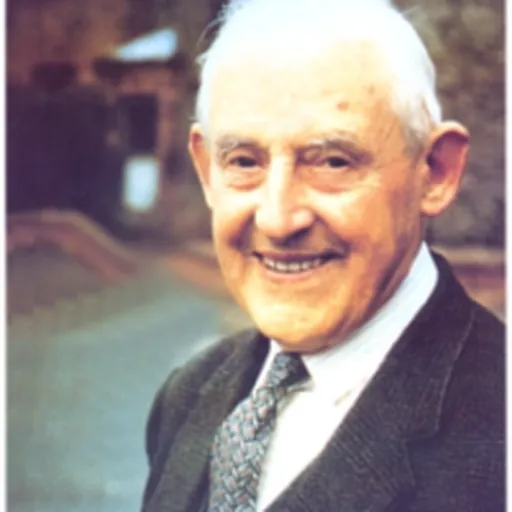
About Frank Duff
Lived 1889 – 1980 (aged 91). Frank Duff was an Irish writer, laic and catholic.
Francis Michael Duff (7 June 1889 – 7 November 1980), was an Irish lay Catholic and author known for bringing attention to the role of the Catholic laity during the Second Vatican Council of the Roman Catholic Church. Duff had previously founded the Legion of Mary in his native city of Dublin, Ireland.
Biography Early life Birthplace at 97 Phibsboro RoadHe was born in Dublin on 7 June 1889, at 97 Phibsboro Road, the eldest of seven children of John Duff (died 23 December 1918) and his wife, Susan Letitia (née Freehill, died 27 February 1950). The wealthy family lived in the city at St Patrick's Road, Drumcondra. Duff attended Blackrock College.
Early career In 1908, he entered the Civil Service and was assigned to the Irish Land Commission. In 1913, he joined the Society of St Vincent de Paul and was exposed to the real poverty of Dublin. Many who lived in tenement squalor were forced to attend soup kitchens for sustenance, and abject poverty, alcoholism, street gangs, and organized prostitution were rife in parts of Dublin. Duff joined and soon rose through the ranks to become President of the Saint Patrick's Conference at Saint Nicholas of Myra Parish. Duff, having concern for people he saw as materially and spiritually deprived, had the idea to picket Protestant soup kitchens as he considered they were giving aid in the form of food and free accommodation at hostels, in return for not attending Catholic services. Duff set up rival Catholic soup kitchens and, with his friend, Sergeant Major Joe Gabbett, who had already been working at discouraging Catholics from patronizing Protestant soup kitchens. They succeeded in closing down two of them over the years.
In 1916, Duff published his first pamphlet, Can we be Saints? where he expressed the conviction that all are called to be saints without exception, and that through Christian faith, all have the means necessary.
In 1918, a friend gifted Duff a copy of the book True Devotion to Mary by the seventeenth-century French cleric Louis de Montfort, which influenced his views on Mary. Duff was additionally influenced by the writings of John Henry Newman. The Legion of Mary was created to organise lay Catholics to perform voluntary work. Duff modelled the organisation on Roman legions. Some of the first causes the Legion pursued was to become involved with homelessness and prostitution in Dublin city. In 1922, Duff defied the wishes of the Archbishop of Dublin and the widespread Crypto-Calvinism, or Jansenism, within the Catholic Church in Ireland, which had created an intense hostility towards both prostitutes and other allegedly "fallen women". Similarly to St. Vitalis of Gaza before him, Duff began an outreach to the prostitutes living in often brutal and inhuman conditions in the "kip houses" of "the Monto", as Dublin's red-light district, one of the largest in Europe at the time, was then called. In the introduction to Kevin G. Kearns' Dublin Tenement Life: An Oral History, he comments that many of the prostitutes in the Monto were, like Philomena Lee, unwed mothers who had been disowned both by their families and by their babies' fathers. Although middle-class Dubliners dismissively viewed these women as 'whores', the impoverished but devoutly Catholic residents of the Monto tenements referred to local prostitutes as "unfortunate girls", and understood that they had often turned to prostitution as a last resort. According to Kearns, "By all accounts, the girls were typically young, attractive, and known for their generosity, especially to slum children". As part of his work, Duff established the Sancta Maria hostel, a safe house for former prostitutes whom the Legion had reached out to and persuaded to run away from their "kip keepers". Following the Irish War of Independence and Civil War, Duff also persuaded the first Catholic Commissioner of the Dublin Metropolitan Police, former Irish Army General W. R. E. Murphy, to launch a crack down and, even though Prostitution in the Republic of Ireland, rooted in human trafficking, still exists, the closure of the Monto's last "Kip-Houses" was announced on 12 March 1925.
In July 1940, an overseas club for African and Asian students studying in Dublin was also created. At that time Ireland was a popular destination for students from Asia and Africa because of its anti-colonialist cultural orientation based on centuries of Irish history. Duff personally funded the purchase of a building for the club using funds from an inheritance. The club lasted until 1976 and would facilitate many notable students, including Jaja Wachuku.
For the rest of his life, with the help of many others, Duff guided the Legion's worldwide extension.
Today, the Legion of Mary has an estimated four million active members and 10 million auxiliary members in close to 200 countries in almost every diocese in the Catholic Church.
In July 1996, the cause of Frank Duff's beatification was introduced by Cardinal Desmond Connell.
Works Can We Be Saints? Reprinted 1998
Don’t just read it —
keep it.
Full-length biographies made to live with: read them, listen on the way to work, watch them tonight.
- E-book
- Audio
- Video
Instant download · yours to keep · every purchase keeps this site free
Important facts
People in Frank Duff's life
Named in this biography and alive at the same time





Related people
Same field, nearest in time



Contemporaries
People whose lives overlapped Frank Duff's


Frequently asked questions
Who was Frank Duff?
Roman Catholic activist
When was Frank Duff born?
Frank Duff was born on 7 June 1889 in Dublin.
When did Frank Duff die?
Frank Duff died on 7 November 1980 in Dublin.
What was Frank Duff's occupation?
Frank Duff was a writer, laic and catholic.
What nationality was Frank Duff?
Frank Duff was Irish.
Sources & further reading
Cite this page
APA: Biography.guide. (2026). Frank Duff. https://biography.guide/frank-duff/
MLA: "Frank Duff." Biography.guide, https://biography.guide/frank-duff/.
Chicago: "Frank Duff." Biography.guide. https://biography.guide/frank-duff/.
Data last updated: 2026-09-22 · Spot an error? Report a correction.
Portrait: Wikimedia Commons · author & licence
Page generated 2026-09-27 05:03 UTC