
François-Vincent Raspail
French chemist, naturalist, physician, physiologist, attorney, and socialist politician
About François-Vincent Raspail
Lived 1794 – 1878 (aged 83). François-Vincent Raspail was a French chemist, politician, botanist and physiologist.
François-Vincent Raspail, L.L.D., M.D. (; 25 January 1794 – 7 January 1878 ) was a French chemist, naturalist, medical doctor, physiologist, lawyer, and socialist politician.
Biography Raspail was born in Carpentras, Vaucluse. A member of the republican Carbonari society and Freemasonry, where he met François Arago, Victor Schoelcher and Auguste Blanqui, Raspail was imprisoned during Louis Philippe's reign (1830–1848) and was a candidate for presidency of the Second Republic in December 1848. However, he was then involved in the attempted revolt of 15 May 1848 and in March 1849 was again imprisoned as a result. After Louis Napoleon's 2 December 1851 coup, his sentence was commuted to exile, from which he returned to France only in 1862. In 1869, during the liberal phase of the Second Empire (1851–1870), he was elected deputy from Lyons. He remained a popular republican during the French Third Republic after the short-term Paris Commune in 1871.
Raspail died in Arcueil.
His sons, Benjamin Raspail (1823), Camille Raspail (1827), (1831), and (1840) were also all notable figures in the Third Republic. His daughter, Marie Raspail (1837-1876), was a freethinker and republican; she was a staunch supporter of her father and died from an illness contracted while caring for him during his time as a political prisoner towards the end of his life.
Scientific achievements Raspail was one of the founders of the cell theory in biology. Raspail did not coin the phrase omnis cellula e cellula ("every cell is derived from a [preexisting] cell") stated later by Rudolf Karl Virchow, as can be confirmed reading his work "Développement de la fécule dans les organes de la fructification des céréales, et analyse microscopique de la fécule, suivie d'expériences propres à en expliquer la conversion en gomme. Annales des Sciences Naturelles, 6 (1825): 224 e 384", where this phrase is not found. However, he claimed that starch grains were the progenitors of new vesicles. He was an early proponent of the use of the microscope in the study of plants. He was also an early advocate of the use of antiseptic(s) and better sanitation and diet. His "Manuel annuaire de la santé 1834" is portrayed in the painting "Nature morte avec oignons/Still life with a plate of onions" by Vincent van Gogh (1889 Kroller-Muller).
Entry into politics After the revolution of 1830, Raspail became involved in politics. He was President of the Human Rights Society, and was imprisoned for that role. While in prison, he tended sick inmates and studied their diseases. He became convinced of the value of camphor, which he believed worked by killing extremely small parasites – a version of the germ theory of disease.
Later career
Raspail was a candidate for the Presidency of the French Second Republic in December 1848, but came in fourth, losing to Louis-Napoléon Bonaparte (later Napoleon III). He had been involved in the attempted revolt of 15 May 1848, and in March 1849 was again imprisoned as a result. In 1853, Napoleon III commuted his sentence of imprisonment to one of exile. He returned to France from exile in 1862. In 1869 he was elected deputy from Lyon and in 1875 from Marseille. He remained popular and respected during the French Third Republic. The longest boulevard in Paris, in the 7th, 6th and 14th arrondissements, was named Boulevard Raspail in his honor, after which the Raspail Métro station takes its name.
Publications Essai de chimie microscopique 1830 Nouveau système de chimie organique 1833 Manuel annuaire de la santé 1834, reissued annually Le Réformateur (newspaper, published 1834–35) Lettres sur les Prisons du Paris 1839 Histoire naturelle de la santé 1843 Manuel annuaire de la Santé, ou Médecine et Pharmacie domestiques . Selbstverl., Paris 1845 Digital edition by the University and State Library Düsseldorf
Don’t just read it —
keep it.
Full-length biographies made to live with: read them, listen on the way to work, watch them tonight.
- E-book
- Audio
- Video
Instant download · yours to keep · every purchase keeps this site free
Important facts
People in François-Vincent Raspail's life
Named in this biography and alive at the same time
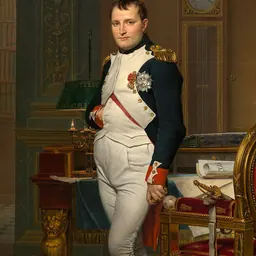

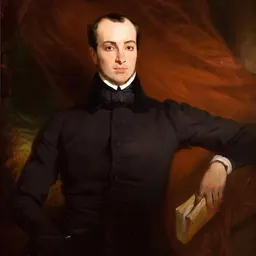
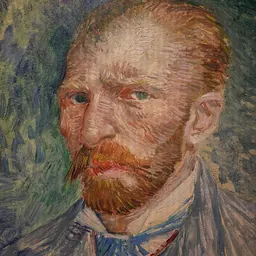

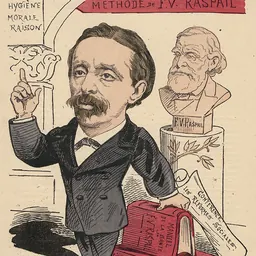
Related people
Same field, nearest in time



Contemporaries
People whose lives overlapped François-Vincent Raspail's




Frequently asked questions
Who was François-Vincent Raspail?
French chemist, naturalist, physician, physiologist, attorney, and socialist politician (1794-1878)
When was François-Vincent Raspail born?
François-Vincent Raspail was born on 25 January 1794 in Carpentras.
When did François-Vincent Raspail die?
François-Vincent Raspail died on 7 January 1878 in Arcueil.
What was François-Vincent Raspail's occupation?
François-Vincent Raspail was a chemist, politician, botanist and physiologist.
What nationality was François-Vincent Raspail?
François-Vincent Raspail was French.
Sources & further reading
· Wikipedia: François-Vincent Raspail
· DBpedia: François-Vincent Raspail
Cite this page
APA: Biography.guide. (2026). François-Vincent Raspail. https://biography.guide/francois-vincent-raspail/
MLA: "François-Vincent Raspail." Biography.guide, https://biography.guide/francois-vincent-raspail/.
Chicago: "François-Vincent Raspail." Biography.guide. https://biography.guide/francois-vincent-raspail/.
Data last updated: 2026-09-20 · Spot an error? Report a correction.
Page generated 2026-09-27 05:24 UTC