
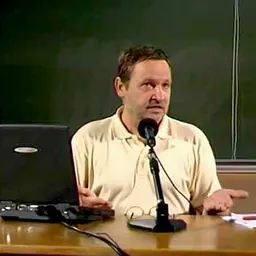
François Fages
French computer scientist
About François Fages
Born 1959. François Fages is a French bioinformatician.
François Fages (August 23, 1959) is a French computer scientist known for contributions in the areas of unification theory, rule-based modelling, logic programming, concurrent constraint logic programming, computational biology and systems biology.
Early life and education Fages was born in Paris, France. He studied Mathematics and Physics at Université Paris-Sud, Computer Science at the Université Pierre et Marie Curie and received his PhD from the Université Pierre et Marie Curie under the supervision of Gérard Huet, in 1983 at age 23.
Career Fages took a junior researcher position from CNRS at Ecole Normale Supérieure, and became in addition, part-time teacher at Ecole Polytechnique from 1985 to 1998, and part-time consultant at Thomson-CSF (now Thales Group) research center from 1985 to 1996. Since 1999, he is a senior researcher at the Institut national de recherche en informatique et en automatique (INRIA), the French national research institute on computer science and control.
He is known in unification theory for having shown the non-existence of minimal sets of unifiers in some equational theories (conjecture of Plotkin, 1972), and the decidability of associative-commutative unification in presence of several function symbols (conjecture of Stickel, 1981 ).
In rule-based modelling, he is known for having created in 1988 a reactive rule-based language at Thomson-CSF (now Thalès group), which was later industrialized by ILOG (now IBM-Ilog) and became ILOG-Rules in 1996.
This result has shown useful for implementing stable model semantics with classical propositional satisfiability solvers. This theorem has also been generalized to disjunctive logic programs.
In concurrent constraint logic programming, he has established with Paul Ruet and Sylvain Soliman the logical semantics of concurrent constraint programs in Jean-Yves Girard's linear logic. This result has been generalized to Constraint handling rules and to the asynchronous Pi-calculus.
In 2010 Fages co-ordinated a project to use mathematics to improve the packing of light bulbs and other oddly shaped products.
In 2014 Fages works in computational systems biology, coordinates the development of the Biochemical Abstract Machine (BIOCHAM) rule-based modeling and logical analysis software and studies biochemical processes in the cell cycle and in cell signaling.
In 2014, he received the Monpetit Prize from the French Academy of Sciences.
Don’t just read it —
keep it.
Full-length biographies made to live with: read them, listen on the way to work, watch them tonight.
- E-book
- Audio
- Video
Instant download · yours to keep · every purchase keeps this site free
Important facts
People in François Fages's life
Named in this biography and alive at the same time

Related people
Same field, nearest in time


Contemporaries
People whose lives overlapped François Fages's


Frequently asked questions
Who is François Fages?
French computer scientist
When was François Fages born?
François Fages was born on 23 August 1959 in Paris.
What is François Fages's occupation?
François Fages is a bioinformatician.
What nationality is François Fages?
François Fages is French.
Sources & further reading
Cite this page
APA: Biography.guide. (2026). François Fages. https://biography.guide/francois-fages/
MLA: "François Fages." Biography.guide, https://biography.guide/francois-fages/.
Chicago: "François Fages." Biography.guide. https://biography.guide/francois-fages/.
Data last updated: 2026-09-20 · Spot an error? Report a correction.
Page generated 2026-09-27 05:18 UTC