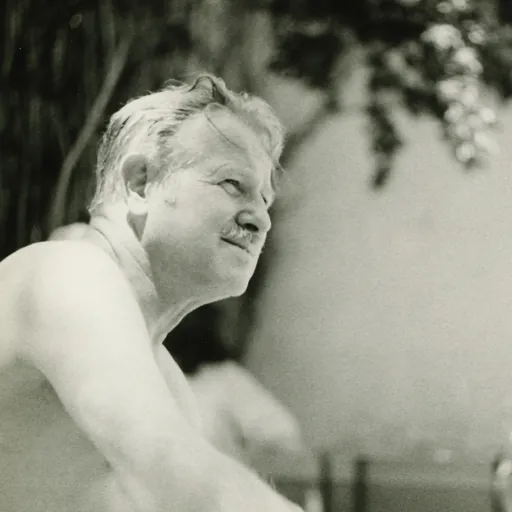
Francisco Keil do Amaral
Portuguese architect and photographer
About Francisco Keil do Amaral
Lived 1910 – 1975 (aged 64). Francisco Keil do Amaral was a Portuguese photographer, architect and painter.
Francisco Caetano Keil Coelho do Amaral, 2nd Viscount of Pedralva (Lisbon, 28 April 1910 – Lisbon, 19 February 1975), was a Portuguese architect, painter and photographer. His name was given to a street in Lisbon.
Through the 1940s and 1950s, Keil do Amaral assumed responsibility over public projects without declaring political affiliation.
Early life and education Keil do Amaral was the only son of Francisco Coelho do Amaral Reis, 1st Viscount of Pedralva by Carlos I of Portugal in 1904 (Sátão, Águas Boas, 3 August 1873 – 5 April 1938), 100th Governor of Portuguese Angola from 1920 to 1921, son of José Caetano dos Reis and wife Lucrécia Coelho do Amaral, and first wife, as her second husband, Guida Maria Josefina Cinatti Keil, daughter of Alfredo Cristiano Keil and wife Cleyde Maria Margarida Cinatti. After his mother's death his father remarried Arminda da Conceição da Silva Camacho dos Reis (– Silves, São Bartolomeu de Messines, 10 October 1935) and they had another son, Eduardo Coelho do Amaral dos Reis (Sátão, Águas Boas, 11 September 1932 –), unmarried and without issue.
Keil do Amaral completed his primary education in Canas de Senhorim. He later attended Colégio Nacional and Liceu Gil Vicente (1922-1928).
Career Keil do Amaralbegan his professional life in 1929, as an advertising "designer" (with Fred Kradolfer and José Rocha). In 1930 he enrolled in the special Architecture course at the Lisbon School of Fine Arts, but in the next year he was subject to a disciplinary process, motivated by a conflict with the professor of architecture, Arnaldo Redondo Adães Bermudes. He completes the course, as an external student, working in Carlos Ramos' studio, whose example will mark his future options and, in particular, the functionalist character and purism of his first works (Instituto Pasteur, Porto, 1933–1935).
Still a student, he participated in important exhibitions at the National Society of Fine Arts (1932, 1933). In 1936, he won the competition for the Pavilhão de Portugal at the Universal Fair in Paris, imposing a renewing taste in the official programs. He remained in Paris for one year. He visited Netherlands, where he discovered the work of Willem Marinus Dudok (a great admirer of Frank Lloyd Wright). For Keil, the fascination with Dutch architecture (and Frank Lloyd Wright) stemmed from its progressive, modern character, which reconciled evenly with traditions. "This binomial will clearly define the practice of the architect" leading him, after his return to Portugal, to demarcate aspects of his initial work, the influence of Carlos Ramos and, even more, the historicist and regionalist constraints of the official architecture of the Estado Novo. He would propose a third way, concerned above all with the well-being and happiness of the common man, where "rationalism goes hand in hand with poetry".
"When, in the middle of the Salazar dictatorship, Portuguese architecture is divided between the mentors of the regime and the desire for a functionalism of an international character, [Keil do Amaral stands out] as the figure who with more energy and lucidity defends the bases for building a different perspective of work, theoretically rational and formally linked to local identities, appealing to a simple and balanced language, inspired by the continuity and the integrative sense that seems to be a constant of Portuguese architecture ".
"From a formal point of view, Keil do Amaral's vast production in the 1940s, in addition to documenting contacts with the architecture of Northern Europe and the United States, translates a personal conception of spaces and volumes that transcends conceptual limitations of modernism. And while maintaining the basic assumptions of modern architecture, it does not ignore the experience, especially vernacular, of the past".
Between 1939 and 1949, he joined a team of young architects at the Lisbon City Council - which also included, among others, Inácio Peres Fernandes and João Faria da Costa - responsible for supporting the initiatives of the then Minister of Public Works and President of the Lisbon City Council, Duarte Pacheco, relating to urban expansion and functional re-equipping of the city. Keil do Amaral will work on equipment projects and on the rearrangement of green spaces in the capital: Edward VII Park; Large field; Monsanto Park. On the eve of the beginning of the Second World War, he travelled to Great Britain and Northern Ireland, France; Netherlands and Germany, to visit parks and deepen knowledge in that specific area.
On March 4, 1941, he was made an Officer of the Military Order of Saint James of the Sword.
"The Parque de Monsanto project is an essential work in the context of the major interventions carried out in Lisbon during the 20th century. Transferring the large park to the outskirts of the city, it reveals a new understanding of the issue of urban green spaces integrated on the larger scale. vast area of the metropolitan area and the expansion of the city ". Keil develops the general plan and equipment designs. "At the end of the 1940s, the works of the Clube de Ténis or Restaurante de Montes Claros will translate into happy moments on Keil do Amaral's journey, subtly reaching that sense of purification, of abandonment that he had been exploring since the first years. research on Dutch passion, in fact, from 1948 onwards Keil took on a greater modernity according to the codes of the Modern Movement, giving a new meaning to his production: in the Montes Claros Restaurant, he freed the floor plan, in the Clube de Ténis tears big glazing and resolves the coverage with tremendous agility".
The arrangement of the Edward VII Park was another of his important works in the context of urban structuring of the city. He planned the central, grassy lane, flanked by a Portuguese stone sidewalk; redesigned the lake; rearranged the Greenhouse and designed the entrance close to the bank. The set should be finished off, in the north, by the City Palace, to be implanted next to the viewpoint space marked by the monumental columns. To support this project, he travels to the United States of America, where he visits reference works of modern architecture, from Frank Lloyd Wright to Eliel Saarinen. Initially designed (1948) by a team that also included Hernâni Gandra and Alberto José Pessoa, the City Palace would become the subject of controversy and was never built.
In the immediate period, there was a slowdown in the public order from which he had benefited until then, but the ostracism was attenuated a few years later, with the realization of important projects, such as for the Lisbon Industry Fair, which he projects with great freedom compositional and where it is visible "the concern to merge architecture and structure with an aesthetic and economic purpose". He is also the author of several buildings for the União Elétrica Portuguesa and of the vast order that was the first phase of the Metropolitano de Lisboa, which included all stations inaugurated in 1959. In the 1960s he designed, with Carlos Manuel Ramos, Al-Shaab Stadium, Iraq, "in which a breath of renewal is felt" in its architecture that will translate into a "lightness of solution unparalleled in previous works of this type in our country".
Although he never had the opportunity to teach architecture at the School of Fine Arts in Lisbon, Keil do Amaral had an important pedagogical action, publishing books and reference articles, namely The Architecture and Life (1942), The Modern Dutch Architecture (1943), The Housing Problem (1945) or The training of architects (1948 - communication to the 1st National Architecture Congress). Also in the Revista Municipal (1939-1973) published by the Lisbon City Council, contents by him. And his studio was, in the words of José Antunes da Silva, a true "center of culture and a school of humanity", where over the years architects of successive generations have collaborated, still in the formation phase or already in maturity, namely: Alberto Pessoa, Hernâni Gandra, José Rafael Botelho, Cândido Palma de Melo, José Antunes da Silva, Pedro Botelho, José Manuel Fernandes, João Paulo Conceição.
Polemicist, researcher, pedagogue, active participant in union and political activity, frontal opponent of the regime linked to prestigious national culture personalities, his writings and reflection books on architecture and the city, contribute to the framing of a generous and intense as a professional and citizen". Diário de Notícias Award, 1960, for his work as a whole. Valmor Prize, 1962 - housing at Rua Almirante António Saldanha, n.º 44, Restelo, in Lisbon.
Don’t just read it —
keep it.
Full-length biographies made to live with: read them, listen on the way to work, watch them tonight.
- E-book
- Audio
- Video
Instant download · yours to keep · every purchase keeps this site free
Important facts
Family & relationships
People in Francisco Keil do Amaral's life
Named in this biography and alive at the same time




Related people
Same field, nearest in time


Contemporaries
People whose lives overlapped Francisco Keil do Amaral's





Frequently asked questions
Who was Francisco Keil do Amaral?
Portuguese architect and photographer (1910-1975)
When was Francisco Keil do Amaral born?
Francisco Keil do Amaral was born on 28 April 1910 in Lisbon.
When did Francisco Keil do Amaral die?
Francisco Keil do Amaral died on 19 February 1975 in Lisbon.
What was Francisco Keil do Amaral's occupation?
Francisco Keil do Amaral was a photographer, architect and painter.
What nationality was Francisco Keil do Amaral?
Francisco Keil do Amaral was Portuguese.
Sources & further reading
· Wikipedia: Francisco Keil do Amaral
· DBpedia: Francisco Keil do Amaral
Cite this page
APA: Biography.guide. (2026). Francisco Keil do Amaral. https://biography.guide/francisco-keil-do-amaral/
MLA: "Francisco Keil do Amaral." Biography.guide, https://biography.guide/francisco-keil-do-amaral/.
Chicago: "Francisco Keil do Amaral." Biography.guide. https://biography.guide/francisco-keil-do-amaral/.
Data last updated: 2026-09-20 · Spot an error? Report a correction.
Page generated 2026-09-27 05:09 UTC