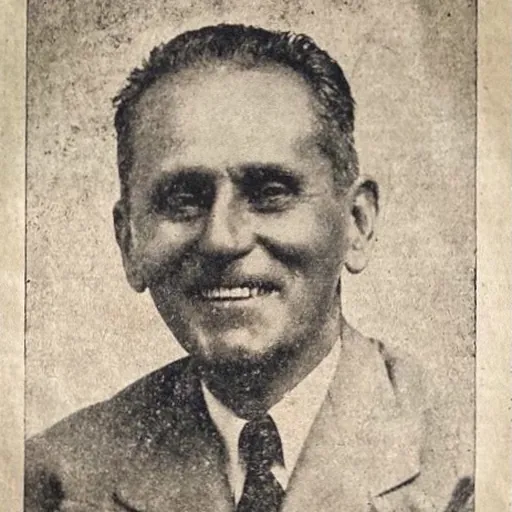
About Francisco J. Santamaría
Lived 1886 – 1963 (aged 76–77). Francisco J. Santamaría was a Mexican lexicographer, linguist, judge, historian, journalist and writer.
Francisco Javier Santamaría (September 10, 1886 in Cacaos in Jalapa Municipality, Tabasco – March 1, 1963 in Veracruz, Veracruz) was an influential Mexican writer and politician who is best remembered for his contributions to the study of Mexican literature and lexicography; he variously worked or published as a bibliographer, essayist, geographer, journalist, judge, lawyer, lexicographer, linguist, naturalist, pedagogue, philologist, and poet. He also served as a Senator of the Republic and as Governor of the State of Tabasco.
Life and work Francisco Javier Santamaría was born in 1886 in the ranchería of Cacaos, to a criollo family of modest means. He began his schooling in Macuspana and completed his studies in Villahermosa (then called San Juan Bautista) at the Instituto Juárez, where he graduated with a teaching degree. He subsequently moved to Mexico City to study law, obtaining his license in 1912.
Beginning at a young age Santamaría demonstrated a talent for composition and an appreciation for the belles-lettres which would eventually evolve into a prolific career as a writer, lexicographer and linguist; his two most often cited works are the Diccionario General de Americanismos and the Diccionario de Mejicanismos, the second of which is a continuation and completion of Joaquín García Icazbalceta's original project.
At the start of his political career Santamaría was an outspoken critic of Plutarco Elías Calles and the Partido Labortista over which he presided. He was also a close friend and political associate of General Francisco R. Serrano (an inveterate enemy of Calles's), and supported the latter's presidential campaign for the 1925-1928 term, an enterprise which would ultimately end in the murderous defeat of Serrano and his closest associates. Santamaría would be the only one on Elías Calles's hit list to not fall the night of October 2, 1927, an event known as the "Huitzilac Massacre," which resulted in the summary executions of Serrano and twenty six other generals, and which President Álvaro Obregón ordered out of fear of military rebellion. His escape and survival would, however, result in years of exile and poverty in the U.S., an account of which he gives in Crónicas del destierro: Desde la ciudad de hierro (Chronicles of Exile: From the Iron City).
After returning to Mexico Santamaría re-entered politics by joining the Institutional Revolutionary Party (PRI); eventually going on to serve as a Senator of the Republic for Tabasco from 1940 to 1946. Immediately after the conclusion of his term he was selected by the party as its candidate for the governorship of Tabasco, competed against three opponents and won handily, reportedly receiving 95% of the votes. As governor he worked to improve his state's educational system and general level of cultural and technological development, while continuing to write books and essays on a variety of subjects.
Francisco Javier Santamaría was a numerary member of the Academia Mexicana de la Lengua and held seat 23.
Published works (list not comprehensive)
El artículo 91. 1912 El periodismo tabasqueño. 1920 Americanismos y barbarismos. 1921 Ley orgánica de los tribunales del fuero común en el Distrito y territorios federales, con un apéndice que contiene la Ley de jurados, la Ley de licencias a funcionarios públicos y otras disposiciones. 1923 Un valioso hallazgo bibliográfico cervantino: la segunda parte de la edición más discutible de "El quijote". 1926 Glosa lexicográfica. 1926 Bibliografia general de Tabasco: Tomo I. 1930 Crónicas del destierro: Desde la ciudad de hierro. Diario de un desterrado mejicano en Nueva York. Recordaciones del destierro. 1933 Nuevo codigo civil para el distrito y territorios federales. 1933 Las ruinas occidentales del viejo imperio Maya: en la Sierra del Tortuguero en Macuspana, Tabasco: notas de una excursión. 1933 Código de procedimientos civiles para el Distrito Federal y territorios: expedido el 30 de agosto de 1932. 1934 Código civil para el Distrito y territorios federales (vigente desde el 1. de octubre de 1932). 1935 Diccionario del Código civil para el Distrito y territorios federales. 1935 Código civil para el Distrito y territorios federales: expedido en 30 de agosto de 1928; exposición de motivos, de la Comisión autora del Proyecto. 1935 Ley orgánica del poder judicial de la federación. 1936 Datos, materiales i apuntes para la historia del periodismo en Tabasco (1825–1935). 1936 Ensayo de crítica del lenguaje. 1941 Diccionario General de Americanismos1942 El movimiento cultural en Tabasco. 1946 El verdadero Grijalva : identificación i rectificación históricas-jeográficas, Centla, Potonchán, Santa María de la Victoria 1949 La poesía tabasqueña : antología, semblanzas literarias 1950 Documentos históricos de Tabasco. 1950-1951 Antología folklórica y musical de Tabasco 1952 Diccionario de mejicanismos: razonado; comprobado con citas de autoridades; comparado con el de americanismos y con los vocabularios provinciales de los más distinguidos diccionaristas hispanamericanos. 1959 Domingos académicos. 1959 + Francisco Javier SantamaríaGovernor of Tabasco In office January 1, 1947 - December 31, 1952 Preceded by Noé de la Flor Casanova Succeeded by Manuel Bartlett Bautista Born September 10, 1886 Birth Place Formerly Cacaos (person now its eponym), Municipality of Jalapa Tabasco Died March 1, 1963 Place of Death Veracruz, Veracruz de Ignacio de la Llave Spouse Mercedes Ortiz de Santamaría Profession Educator, lawyer, and lexicographer Political Party Partido Revolucionario Institucional (PRI)
Don’t just read it —
keep it.
Full-length biographies made to live with: read them, listen on the way to work, watch them tonight.
- E-book
- Audio
- Video
Instant download · yours to keep · every purchase keeps this site free
Important facts
People in Francisco J. Santamaría's life
Named in this biography and alive at the same time





Related people
Same field, nearest in time


Contemporaries
People whose lives overlapped Francisco J. Santamaría's




Frequently asked questions
Who was Francisco J. Santamaría?
Mexican politician
When was Francisco J. Santamaría born?
Francisco J. Santamaría was born on 10 September 1886.
When did Francisco J. Santamaría die?
Francisco J. Santamaría died in 1963 in Veracruz.
What was Francisco J. Santamaría's occupation?
Francisco J. Santamaría was a lexicographer, linguist, judge, historian, journalist and writer.
What nationality was Francisco J. Santamaría?
Francisco J. Santamaría was Mexican.
Sources & further reading
· Wikipedia: Francisco J. Santamaría
· DBpedia: Francisco J. Santamaría
Cite this page
APA: Biography.guide. (2026). Francisco J. Santamaría. https://biography.guide/francisco-j-santamaria/
MLA: "Francisco J. Santamaría." Biography.guide, https://biography.guide/francisco-j-santamaria/.
Chicago: "Francisco J. Santamaría." Biography.guide. https://biography.guide/francisco-j-santamaria/.
Data last updated: 2026-09-23 · Spot an error? Report a correction.
Portrait: Wikimedia Commons · author & licence
Page generated 2026-09-27 05:06 UTC