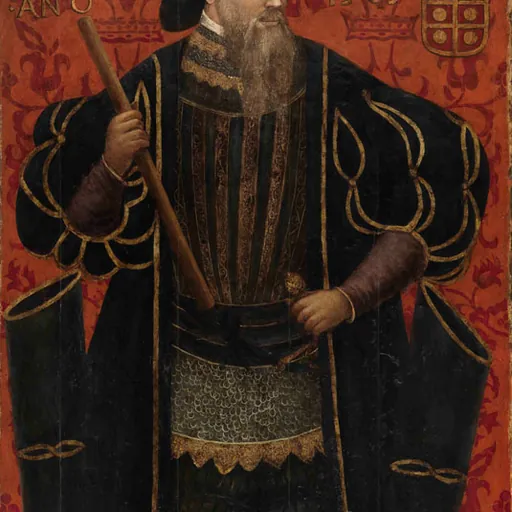
About Francisco de Almeida
Lived 1450 – 1510 (aged 59–60). Francisco de Almeida was an explorer, soldier, military personnel, politician, exploration and list of colonial heads of Portuguese India.
Dom Francisco de Almeida (; c. 1450 – 1 March 1510), was a Portuguese nobleman, soldier and explorer. He distinguished himself as a counsellor to King John II of Portugal and later in the wars against the Moors and in the conquest of Granada in 1492. In 1505 he was appointed as the first governor and viceroy of the Portuguese State of India (Estado da Índia). Almeida is credited with establishing Portuguese hegemony in the Indian Ocean with his victory at the naval Battle of Diu in 1509. Before Almeida returned to Portugal he lost his life in a conflict with indigenous people at the Cape of Good Hope in 1510. His only son Lourenço de Almeida had previously been killed in the Battle of Chaul.
Exploits as soldier Almeida was born at Lisbon. As was customary for men in his social circle, he joined the military at an early age. In 1476 he took part in the Battle of Toro. Then he fought in conflicts in different parts of Morocco and in 1492 participated in the Christian conquest of Granada on the side of the Castilians.
Mission to the east
In 1505, King Manuel I of Portugal made Almeida, then in his mid-fifties, the first viceroy of Portuguese India (Estado da Índia). With an armada of 22 ships, including 14 carracks and 6 caravels, Almeida departed from Lisbon on 25 March 1505. The armada carried a crew of 1,500 soldiers. The flagship was the carrack São Rafael captained by Fernão Soares. The mission's primary aims were to bring the spice trade under Portuguese control, build forts along the east African and Indian coasts, further Portuguese spice trade through alliances with local chieftains, and construct trading posts.
African conquest Almeida rounded the Cape of Good Hope and entered African coastal waters again at Sofala and the Island of Mozambique, whence they proceeded northwards to the coastal settlement of Kilwa. In July 1505, they employed 8 ships to attack and conquer the roughly 4,000-strong population of this harbour town. Because of the good harbour that the town provided, sufficient for anchoring ships of up to 500 tons, the Portuguese decided to build a fort here. For this purpose, Pêro Ferreira and a crew of 80 soldiers remained in the town.
In 1505, Francisco d'Almeida arrived with eleven heavily armed ships that destroyed Kilwa, Barawa, and Mombasa, a coastal port further north. The city with a population of about 10,000 was conquered in heavy combat against the troops of the local Arab sheikh. The city was plundered and torched. The Portuguese were assisted in this attack by an enemy of Mombasa, the Sultan of Melinde. The same month, a caravel of Almeida's fleet captained by John (João) Homere captured Zanzibar island and claimed it for Portugal.
Viceroy in India
On 25 March 1505, Francisco de Almeida was appointed as Viceroy of India, on the condition that he would set up four forts on the southwestern Indian coast: at Anjediva Island, Cannanore, Cochin, and Quilon. There he learnt that the Portuguese traders at Quilon had been killed. He decided to send his son Lourenço with 6 ships, who wantonly destroyed 27 Calicut vessels in the harbour of Quilon.
Afonso de Albuquerque arrived at Cannanore at the close of 1508 and immediately made known a hitherto secret commission he had received from the King empowering him as governor to replace Almeida at the end of his term as viceroy. Almeida, determined to avenge the death of his son and free the Portuguese prisoners taken at Chaul, refused to recognize Albuquerque's credentials immediately, and later arrested him.
In 1509, Almeida became the first Portuguese to arrive by ship in Bombay. He sought Meliqueaz, to whom he had written a menacing letter, and the Mameluk Mirocem, fiercely engaging them at the naval Battle of Diu on 3 February 1509 commanding a fleet of 23 ships near the port of Diu. He inflicted a decisive defeat on a joint fleet from the Mamlûk Burji Sultanate of Egypt, the Ottoman Empire, the Zamorin of Calicut, and the Sultan of Gujarat, with technical naval support from the Republic of Venice and the Republic of Ragusa (Dubrovnik), which feared for their eastern trade links.
His victory was decisive: the Ottomans and Egyptians left the Indian Ocean, enabling a Portuguese trade monopoly over Indian waters for over 100 years, into the 17th century when it was ended by the Dutch and English. Albuquerque was released after three months' confinement, on the arrival of the grand-marshal of Portugal with a large fleet, in November 1509.
Return and death
Almeida sailed for Portugal in December 1509 and reached Table Bay near the Cape of Good Hope, where the Garcia, Belém, and Santa Cruz dropped anchor in late February 1510 to replenish water. There they encountered the local indigenous people, the ǃUriǁ'aikua (recorded as "Goringhaiqua", a Khoe-speaking clan). After friendly trade with the ǃUriǁ'aikua, some of the crew visited their nearby village, situated in modern-day Observatory where they tried to steal some of the locals' cattle. Almeida allowed his captains Pedro and Jorge Barreto to return to the village on the morning of 1 March 1510. The village's cattle herd was raided with the loss of one man, while Almeida awaited his men some distance from the beach. As the flagship's master Diogo d'Unhos had moved the landing boats to a watering point, the Portuguese were left without a means of retreat. The ǃUriǁ'aikua sensed the opportunity for an attack, during which Almeida and 64 of his men perished, including 11 of his captains. Almeida's body was recovered the same afternoon and buried on the shore front of the current Cape Town. An archivist, Nicolaas Vergunst, suggested in a 2011 book that De Almeida was the victim of a plot by his own men, who intentionally cut off his retreat after the planned provocation of the ǃUriǁ'aikua
Relatives and subjects Almeida was the son of the 1st Count of Abrantes and one of a number of highly distinguished siblings including two bishops, an ambassador to the Holy See and the Portuguese head of the Order of Malta. His son, Lourenço, was killed in the battle of Chaul, but he was survived by a daughter, Leonor, who was married twice: with Dom Rodrigo de Melo, Count of Tentúgal, precursor of the Dukes of Cadaval, and with Francisco de Mendonça, of the House of the Alcaides de Mourão. He also had a bastard daughter, Susana, who married Diogo de Barbuda, Alcaide of Seia. Ferdinand Magellan (Fernão de Magalhães) accompanied Almeida to the east, but was promoted to captain and only returned in 1512 after losing that commission.
Don’t just read it —
keep it.
Full-length biographies made to live with: read them, listen on the way to work, watch them tonight.
- E-book
- Audio
- Video
Instant download · yours to keep · every purchase keeps this site free
Important facts
Family & relationships
People in Francisco de Almeida's life
Named in this biography and alive at the same time


Related people
Same field, nearest in time



Contemporaries
People whose lives overlapped Francisco de Almeida's


Frequently asked questions
Who was Francisco de Almeida?
Portuguese nobleman and soldier
When was Francisco de Almeida born?
Francisco de Almeida was born in 1450 in Lisbon.
When did Francisco de Almeida die?
Francisco de Almeida died on 1 March 1510 in Cape of Good Hope.
What was Francisco de Almeida's occupation?
Francisco de Almeida was an explorer, soldier, military personnel, politician, exploration and list of colonial heads of Portuguese India.
What nationality was Francisco de Almeida?
Francisco de Almeida's recorded nationality: Kingdom of Portugal, Portuguese people.
Sources & further reading
· Wikipedia: Francisco de Almeida
· DBpedia: Francisco de Almeida
Cite this page
APA: Biography.guide. (2026). Francisco de Almeida. https://biography.guide/francisco-de-almeida/
MLA: "Francisco de Almeida." Biography.guide, https://biography.guide/francisco-de-almeida/.
Chicago: "Francisco de Almeida." Biography.guide. https://biography.guide/francisco-de-almeida/.
Data last updated: 2026-09-22 · Spot an error? Report a correction.
Portrait: Wikimedia Commons · author & licence
Page generated 2026-09-27 05:02 UTC