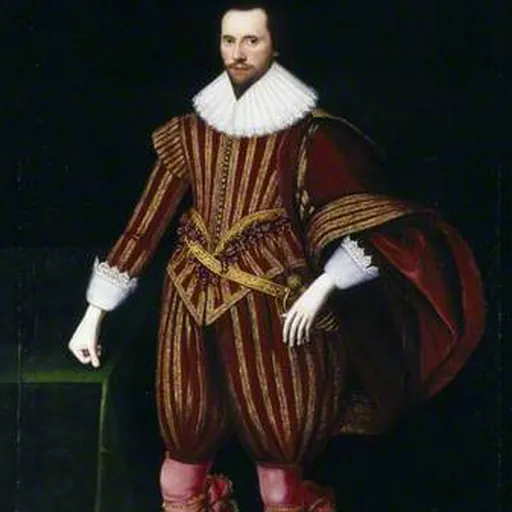
About Francis Seymour, 1st Baron Seymour of Trowbridge
Lived 1590 – 1664 (aged 73–74). Francis Seymour, 1st Baron Seymour of Trowbridge was an English politician.
Francis Seymour, 1st Baron Seymour of Trowbridge ( – 12 July 1664), of Marlborough Castle and Savernake Park in Wiltshire, was an English politician who sat in the House of Commons at various times between 1621 and 1641 when he was raised to the peerage as Baron Seymour of Trowbridge. He supported the Royalist cause during the English Civil War.
Origins Arms of Francis Seymour, 1st Baron Seymour of Trowbridge: Quarterly, 1st and 4th: Or, on a pile gules between six fleurs-de-lys azure three lions of England (special grant to his great-grandfather the 1st Duke of Somerset (died 1552)); 2nd and 3rd: Gules, two wings conjoined in lure or (Seymour). These arms concede the positions of greatest honour, the 1st & 4th quarters, to a special grant of arms to the 1st Duke of Somerset by his nephew King Edward VI, incorporating the fleurs-de-lys (with tinctures reversed) of the Royal arms of France (first quartered by King Edward III) and the lions of the royal arms of Plantagenet Seymour was the third son of Edward Seymour, Lord Beauchamp (died 1612), eldest son and heir apparent of Edward Seymour, 1st Earl of Hertford (1539–1621) (son of Edward Seymour, 1st Duke of Somerset, Lord Protector of England) whom he pre-deceased, by his wife Honora Rogers, daughter of Sir Richard Rogers of Bryanstone, Dorset. Through his paternal grandmother, he was a great-great-grandson of Mary Tudor, Queen of France and Charles Brandon, 1st Duke of Suffolk, thereby making him a direct descendant of Henry VII.
His elder brother William Seymour, 2nd Earl of Hertford (1587–1660), also a Royalist commander in the Civil War, was created Marquess of Hertford in 1640 by King Charles I and at the Restoration of the Monarchy in 1660 was restored to the Dukedom of Somerset and Barony of Seymour forfeited by their great-grandfather the first Duke, and became the 2nd Duke of Somerset and 2nd Baron Seymour.
Career In June 1611 he was accused of abetting the escape of his brother William Seymour and his wife Arabella Stuart, but protested his innocence. He was knighted by King James I at Royston on 23 October 1613. In 1612 was settled on him by his grandfather the manor of "Puriton with Downend" in Somerset, formerly one of the many possessions of his great-grandfather the 1st Duke of Somerset.
Parliamentary career In 1621 Seymour was elected Member of Parliament for Wiltshire. In May he proposed that distinctly harsh penalties should be inflicted on Edward Floyd. He was elected MP for Marlborough in 1624. In that parliament he worked hard to induce a war with Spain, but protested against any extensive military operations in continental Europe and opposed sending an army to the Palatinate on the ground of the "extreme charge". In 1625 he was again elected MP for Wiltshire. On 30 July he proposed that the grant be limited to one subsidy and one-fifteenth, about a tenth of what King Charles I required to meet his engagements. He rejected the overtures which the Duke of Buckingham made to him, and in July he refused to join in the attack on Lord-Keeper Williams because Buckingham was secretly abetting this. In August he attacked the government for conducting a continental war, inveighing against peculation in high places and the sale of offices at court. On these grounds he dissuaded the House from granting supplies. He was re-elected to the new parliament summoned in February 1626, but was made Sheriff of Wiltshire to prevent his sitting. In the following July his name was struck off the commission of the peace. Thenceforth Seymour adhered to Wentworth's policy of moderation. In 1628 he was elected MP for Wiltshire and Marlborough and chose to sit for Wiltshire. On 29 April he joined Noy and Digges when they tried to modify the Commons' Bill of Liberties, and supported Wentworth's Habeas Corpus Bill. He also advocated, with Wentworth against Eliot, a joint-committee of the two Houses on the Petition of Right. ), daughter of Sir Gilbert Prinne of Allington, Wiltshire, by whom he had children including: Charles Seymour, 2nd Baron Seymour of Trowbridge (1621–1665) Frances Seymour, daughter, who married Sir William Ducie. William Seymour, son (baptised 7 September 1626, St Peter and St Paul Church, Marlborough – ?) Secondly in 1635 he married Catherine Lee (died 1701), daughter of Sir Robert Lee by his wife Anne Lowe of Billesley, Warwickshire.
Death and burial Seymour died in 1664 at the age of about 74, and was buried in the chancel of Bedwyn Magna church, the parish church of the Seymours' ancestral seat of Wulfhall, owned by his brother.
Don’t just read it —
keep it.
Full-length biographies made to live with: read them, listen on the way to work, watch them tonight.
- E-book
- Audio
- Video
Instant download · yours to keep · every purchase keeps this site free
Important facts
Family & relationships
People in Francis Seymour, 1st Baron Seymour of Trowbridge's life
Named in this biography and alive at the same time


Related people
Same field, nearest in time

Contemporaries
People whose lives overlapped Francis Seymour, 1st Baron Seymour of Trowbridge's




Frequently asked questions
Who was Francis Seymour, 1st Baron Seymour of Trowbridge?
English politician (1590-1664)
When was Francis Seymour, 1st Baron Seymour of Trowbridge born?
Francis Seymour, 1st Baron Seymour of Trowbridge was born in 1590.
When did Francis Seymour, 1st Baron Seymour of Trowbridge die?
Francis Seymour, 1st Baron Seymour of Trowbridge died on 12 July 1664.
What was Francis Seymour, 1st Baron Seymour of Trowbridge's occupation?
Francis Seymour, 1st Baron Seymour of Trowbridge was a politician.
What nationality was Francis Seymour, 1st Baron Seymour of Trowbridge?
Francis Seymour, 1st Baron Seymour of Trowbridge was English.
Sources & further reading
· Wikipedia: Francis Seymour, 1st Baron Seymour of Trowbridge
· DBpedia: Francis Seymour, 1st Baron Seymour of Trowbridge
Cite this page
APA: Biography.guide. (2026). Francis Seymour, 1st Baron Seymour of Trowbridge. https://biography.guide/francis-seymour-1st-baron-seymour-of-trowbridge/
MLA: "Francis Seymour, 1st Baron Seymour of Trowbridge." Biography.guide, https://biography.guide/francis-seymour-1st-baron-seymour-of-trowbridge/.
Chicago: "Francis Seymour, 1st Baron Seymour of Trowbridge." Biography.guide. https://biography.guide/francis-seymour-1st-baron-seymour-of-trowbridge/.
Data last updated: 2026-09-20 · Spot an error? Report a correction.
Page generated 2026-09-27 05:10 UTC