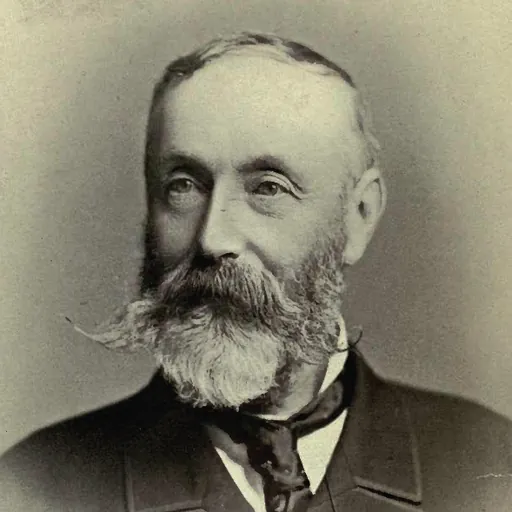
About Francis Ormond
Lived 1827 – 1889 (aged 61). Francis Ormond was an Australian politician, member of Parliament and pastoral farming, known for Philanthropy.
Francis Ormond (23 November 1827 – 5 May 1889) was a Scottish-born Australian pastoralist, member of the Parliament of Victoria and philanthropist in the areas of education and religion.
Ormond is notable for founding the Working Men's College of Melbourne, which became the Royal Melbourne Institute of Technology (RMIT), and for endowing the position of Ormond Professor of Music and donating the majority of funds towards the establishment of Ormond College, both at the University of Melbourne.
Early life and voyage to Australia Francis Ormond was born in Aberdeen, Scotland, the only son of three children to British Merchant Navy sailor, Captain Francis Ormond Sr., and Isabella (née Esson). He was educated at the Tyzack's Academy in Liverpool, England, This had led to a considerable depreciation in the pastoralism industry, with sheep once costing 35 shillings (≈ A$200 today ) being sold for 18 pence (≈ A$10 today Despite all this, he endured the physical hardships of the land and in his spare time found happiness in the study of classical literature and self-improvement. While Ormond worked to exhaustion to save some of his flock, the station and much of its grazing land were engulfed by the blaze, including the scrub which covered much of the land. When the rains followed shortly after they renewed the previously worthless scrubland into prime grazing land, which raised the value of Mopiamnum substantially. The association's annual show became an important event for the district, creating keen competition between pastoralists in the district and contributing to the widespread fame of Australian merino wool. Some time later, he read in the newspaper that the man accused had been sent to appear at the Supreme Court of Victoria in Melbourne and found guilty by a jury. After reading that the man had been sentenced to death by hanging, to take place in two days, he ordered his best horses to be saddled and hastily made the long and difficult journey to the city. With his new political status, Ormond revived his technical college proposal, which received approval in late 1882. He remarried on 1 October 1885, to Mary (née Oliphant) in London, while visiting technical colleges and music colleges in Europe to examine their methods and practices. RMIT's Francis Ormond Building (the former Working Men's College), and the Melbourne suburb of Ormond are all named in his honour.
A bronze statue of Francis Ormond stands outside RMIT's Francis Ormond Building on La Trobe Street in Melbourne.
Don’t just read it —
keep it.
Full-length biographies made to live with: read them, listen on the way to work, watch them tonight.
- E-book
- Audio
- Video
Instant download · yours to keep · every purchase keeps this site free
Important facts
People in Francis Ormond's life
Named in this biography and alive at the same time

Related people
Same field, nearest in time






Contemporaries
People whose lives overlapped Francis Ormond's






Frequently asked questions
Who was Francis Ormond?
Australian politician
When was Francis Ormond born?
Francis Ormond was born on 27 November 1827 in Aberdeen.
When did Francis Ormond die?
Francis Ormond died on 5 May 1889 in Pau.
What was Francis Ormond's occupation?
Francis Ormond was a politician, member of Parliament and pastoral farming.
What was Francis Ormond known for?
Francis Ormond was known for Philanthropy.
What nationality was Francis Ormond?
Francis Ormond was Australian.
Sources & further reading
Cite this page
APA: Biography.guide. (2026). Francis Ormond. https://biography.guide/francis-ormond/
MLA: "Francis Ormond." Biography.guide, https://biography.guide/francis-ormond/.
Chicago: "Francis Ormond." Biography.guide. https://biography.guide/francis-ormond/.
Data last updated: 2026-09-22 · Spot an error? Report a correction.
Portrait: Wikimedia Commons · author & licence
Page generated 2026-09-27 04:59 UTC