Francis of Assisi
Italian Catholic saint, friar, deacon and preacher and founder of the Franciscan Order (1181/2–1226)
About Francis of Assisi
Lived 1182 – 1226 (aged 44). Francis of Assisi was a poet, catholic deacon, religious writer, writer, preacher and missionary.
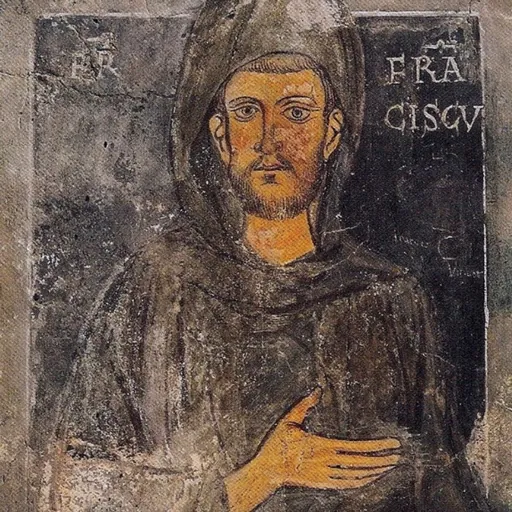
The oldest surviving depiction of Saint Francis is a fresco near the entrance of the Benedictine abbey of Subiaco, painted between March 1228 and March 1229. He is depicted without the stigmata, but the image is a religious image and not a portrait.
Giovanni di Pietro di Bernardone (3 October 1226), known as Francis of Assisi, was an Italian mystic, poet and Catholic friar who founded the religious order of the Franciscans. Inspired to lead a Christian life of poverty, he became a beggar and an itinerant preacher.
One of the most venerated figures in Christianity, Francis was canonized by Pope Gregory IX on 16 July 1228. He is commonly portrayed wearing a brown habit with a rope tied around his waist, featuring three knots symbolizing the evangelical counsels of poverty, chastity, and obedience.
In 1219, Francis went to Egypt in an attempt to convert the sultan Al-Kamil and put an end to the conflict of the Fifth Crusade. In 1223, he arranged for the first live nativity scene as part of the annual Christmas celebration in Greccio. According to Christian tradition, Francis displayed stigmata resembling the wounds on the hands and feet of crucified Christ during the apparition of a seraphic angel in a religious ecstasy in 1224. Along with Catherine of Siena, Francis was designated patron saint of Italy. He is also the namesake of the city of San Francisco. The feast of Francis' stigmatization is 17 September.
Names Francis (; ) was named Giovanni by his mother. His surname, di Pietro di Bernardone, comes from his father, Pietro di Bernardone. His father was in France on business when Francis was born in Assisi, a small town in Italy. Upon his return, Pietro took to calling his son Francesco ("Free man" or "Frenchman"), possibly in honour of his commercial success and enthusiasm for all things French.
Biography
Early life Francis of Assisi was born , one of the children of an Italian father, Pietro di Bernardone dei Moriconi, a prosperous silk merchant, and a French mother, Pica di Bourlemont, about whom little is known except that she was a noblewoman originally from Provence.
Indulged by his parents, Francis lived a high-spirited life, typical of a wealthy young man. As a youth, he became a devotee of troubadours and was fascinated with all things Transalpine.
Around 1202, Francis joined a military expedition against Perugia and was taken as a prisoner at Collestrada. He spent a year as a captive, during which an illness caused Francis to re-evaluate his life. However, upon his return to Assisi in 1203, Francis returned to his carefree life. Two years later, Francis left for Apulia to enlist in the army of Walter III, Count of Brienne. A strange vision made him return to Assisi and lose interest in worldly life. When the priest refused to accept the ill-gotten gains, an indignant Francis threw the coins on the floor.
For the next couple of months, Francis wandered as a beggar in the hills behind Assisi. He spent some time at a neighbouring monastery working as a scullion. Francis then went to Gubbio, where a friend gave him alms, the cloak, girdle and staff of a pilgrim. Returning to Assisi, Francis traversed the city, begging stones for the restoration of St. Damiano. These he carried to the old chapel, set in place himself, and rebuilt it over time. Over the course of two years, Francis embraced the life of a penitent, during which he restored several ruined chapels in the countryside around Assisi, among them San Pietro in Spina (in the area of San Petrignano in the valley about a kilometre from modern Rivotorto, on private property and once again in ruin); and the Porziuncola, the little chapel of St. Mary of the Angels in the plain just below the town. Upon entry to Rome, the brothers encountered Bishop Guido of Assisi, who had in his company Giovanni di San Paolo, the Cardinal Bishop of Sabina. The Cardinal, who was the confessor of Pope InnocentIII, was immediately sympathetic to Francis and agreed to represent Francis to the Pope. After several days, the Pope agreed to admit the group informally, adding that when God increased the group in grace and number, they could return for an official audience. The group was tonsured. This was important in part because it recognized Church authority and prevented his following from accusations of heresy, as had happened to the Waldensians decades earlier. Though a number of the pope's counsellors considered the mode of life proposed by Francis to be unsafe and impractical, following a dream in which he saw Francis holding up the Lateran Basilica, he decided to endorse Francis's order. Per tradition, this occurred on 16 April 1210 and constituted the official founding of the Franciscan Order. The group, then the "Lesser Brothers" (Order of Friars Minor also known as the Franciscan Order or the Seraphic Order), were centred in the Porziuncola and preached first in Umbria, before expanding throughout Italy. Francis was later ordained a deacon, but not a priest. He gave Clare a religious habit, a garment similar to his own, before lodging her, her younger sister Caterina, and other young women in a nearby monastery of Benedictine nuns until Francis could provide a suitable monastery. Later, he transferred them to San Damiano, to a few small huts or cells. This became the first monastery of the Second Franciscan Order, currently known as Poor Clares.
Missionary work during the Fifth Crusade In the late spring of 1212, Francis set out for Jerusalem, but was shipwrecked by a storm on the Dalmatian coast, forcing him to return to Italy. On 8 May 1213, Francis was given the use of the mountain of La Verna (Alverna) as a gift from Count Orlando di Chiusi, who described it as "eminently suitable for whoever wishes to do penance in a place remote from mankind". The mountain would become one of his favourite retreats for prayer.
During the Fifth Crusade in 1219, Francis went to Egypt where a Crusader army had been encamped for over a year besieging the walled city of Damietta. He was accompanied by Friar Illuminatus of Arce and hoped to convert the Sultan of Egypt or be martyred in the attempt. The Sultan, Al-Kamil, a nephew of Saladin, had succeeded his father as Sultan of Egypt in 1218 and was encamped upstream of Damietta. A bloody and futile attack on the city was launched by the Christians on 29 August 1219, following which both sides agreed to a ceasefire that lasted four weeks. Probably during this interlude, Francis and his companion crossed the Muslims' lines and were brought before the Sultan, remaining in his camp for a few days. Reports give no information about what transpired during the encounter beyond noting that the Sultan received Francis graciously and that Francis preached to the Muslims. He returned unharmed. No known Arab sources mention the visit.
According to some late sources, the Sultan gave Francis permission to visit the sacred places in the Holy Land and even to preach there. All that can safely be asserted is that Francis and his companion left the Crusader camp for Acre, from where they embarked for Italy in the latter half of 1220. Drawing on a 1267 sermon by Bonaventure, later sources report that the Sultan secretly converted or accepted a death-bed baptism as a result of meeting Francis.
Whatever transpired as a result of Francis' and al-Kamil's meeting the Franciscans have maintained a presence in the Holy Land almost uninterrupted since 1217 and remain there (see Custody of the Holy Land). They received concessions from the Mameluke Sultan in 1333 with regard to certain Holy Places in Jerusalem and Bethlehem and (so far as concerns the Catholic Church) jurisdictional privileges from Pope Clement VI in 1342.
Reorganization of the Franciscan Order St. Francis preaching to the birds outside of Bevagna (by Master of St. Francis) The growing order of friars was divided into provinces; groups were sent to France, Germany, Hungary and Spain and to the East. Upon receiving a report of the martyrdom of five brothers in Morocco, Francis returned to Italy via Venice. Cardinal Ugolino di Conti was then nominated by the pope as the protector of the order. Another reason for Francis' return to Italy was that the Franciscan Order had grown at an unprecedented rate compared to previous religious orders, but its organizational sophistication had not kept up with this growth and had little more to govern it than Francis' example and simple rule. To address this problem, Francis prepared a new and more detailed Rule, the "First Rule" or "Rule Without a Papal Bull" (Regula prima, Regula non bullata), which again asserted devotion to poverty and the apostolic life. However, it also introduced a greater institutional structure, though this was never officially endorsed by the pope.
Brother Peter was succeeded by Brother Elias as Vicar of Francis. Two years later, Francis modified the "First Rule", creating the "Second Rule" or "Rule With a Bull", which was approved by Pope Honorius III on 29 November 1223. As the order's official rule, it called on the friars "to observe the Holy Gospel of our Lord Jesus Christ, living in obedience without anything of our own and in chastity". In addition, it set regulations for discipline, preaching and entering the order. Once the rule was endorsed by the pope, Francis withdrew increasingly from external affairs. In 1221 and 1222, he crossed Italy, first as far south as Catania in Sicily and afterwards as far north as Bologna.
Stigmata, final days and sainthood Francis considered his stigmata part of the Imitation of Christ. by Cigoli, 1699
While Francis was praying on the mountain of Verna, during a 40-day fast in preparation for Michaelmas (29 September), he is said to have had a vision on 17 September 1224, three days after the feast of the Exaltation of the Cross, following which Francis displayed stigmata resembling the wounds on the hands and feet of crucified Christ. Brother Leo, who had been with Francis at the time, left a clear and simple account of the event, the first definite account of the phenomenon of stigmata. "Suddenly he saw a vision of a seraph, a six-winged angel on a cross. This angel gave him the gift of the five wounds of Christ." The apparent stigmata have been thought to be due to purpura on the hands and feet, a known complication of the quartan malaria Francis is thought to have suffered from. In the end, he was brought back to a hut next to the Porziuncola. Here, Francis spent his last days dictating his spiritual testament. Francis died on the evening of Saturday, 3 October 1226, singing Psalm 141, "Voce mea ad Dominum". On 16 July 1228, Francis was declared a saint by Pope Gregory IX (the former cardinal Ugolino di Conti, a friend of Francis and Cardinal Protector of the Order). The next day, the pope laid the foundation stone for the Basilica of St. Francis in Assisi. Francis was buried on 25 May 1230, under the Lower Basilica, but his tomb was soon hidden on orders of Brother Elias to protect it from Saracen invaders. Francis' burial place remained unknown until it was rediscovered in 1818. Pasquale Belli then constructed a crypt for the remains in the Lower Basilica. It was refashioned between 1927 and 1930 into its present form by Ugo Tarchi. In 1978, the remains of Francis were examined and confirmed by a commission of scholars appointed by Pope Paul VI and put into a glass urn in the ancient stone tomb. His skeleton was put on public display for the first time in 2026.
In 1935, Edward Frederick Hartung concluded that Francis had probably contracted trachoma while in Egypt, and had died, aged 45, of quartan malaria. This interpretation was published in the Annals of Medical History.
Character and legacy
Francis' character
Francis set out to replicate Christ and literally to carry out his work. This is important in understanding Francis' character, his affinity for the Eucharist, and his respect for the priests who carried out the sacrament. Francis preached: "Your God is of your flesh, He lives in your nearest neighbour, in every man."
Francis and his followers celebrated and even venerated poverty, which was so central to his character that in his last written work, the Testament, Francis said that absolute personal and corporate poverty was the essential lifestyle for the members of his order. Pope Leo XIV identifies several dimensions in which Francis' life embodied a "self-emptying" approach: "from the palace to the leper, from eloquence to silence, from possession to total gift".
Francis believed that nature itself was the mirror of God. He called all creatures his "brothers" and "sisters"; he even preached to the birds, and supposedly persuaded a wolf in Gubbio to stop attacking some locals if they agreed to feed the wolf. Francis' deep sense of brotherhood under God embraced others and he declared that "he considered himself no friend of Christ if he did not cherish those for whom Christ died".
Francis's visit to Egypt and attempted rapprochement with the Muslim world had far-reaching consequences, long past his own death, since after the fall of the Crusader Kingdom, it would be the Franciscans, of all Catholics, who would be allowed to stay on in the Holy Land and be recognized as "Custodians of the Holy Land" on behalf of the Catholic Church.
At Greccio near Assisi, around 1220, Francis celebrated Christmas by setting up the first known presepio or crèche (Nativity scene). His nativity imagery reflected the scene in traditional paintings. Francis used real animals to create a living scene so that the worshipers could contemplate the birth of the child Jesus in a direct way, making use of the senses, especially sight.
Nature and the environment
Francis preached the Christian doctrine that the world was created good and beautiful by God but suffers a need for redemption because of human sin. As someone who saw God reflected in nature, "St. Francis was a great lover of God's creation ..." In the Canticle of the Sun, he gives God thanks for Brother Sun, Sister Moon, Brother Wind, Water, Fire and Earth, all of which he sees as rendering praise to God.
Many of the stories that surround the life of Francis say that he had a great love for animals and the environment. The Fioretti ("Little Flowers") is a collection of legends and folklore that sprang up after Francis' death. One account describes how one day, while Francis was travelling with some companions, they happened upon a place in the road where birds filled the trees on either side. Francis told his companions to "wait for me while I go to preach to my sisters the birds."
Some modern commentators and animal rights advocates have mistakenly portrayed Francis as a vegetarian. However, historical records indicate that he did consume meat, and his earliest biographers make no mention of Francis adhering to a meatless diet. Francis' favourite dish was shrimp pie.
On 29 November 1979, Pope John Paul II declared Francis the patron saint of ecology. On 28 March 1982, John Paul II said that Francis' love and care for creation was a challenge for contemporary Catholics and a reminder "not to behave like dissident predators where nature is concerned, but to assume responsibility for it, taking all care so that everything stays healthy and integrated, so as to offer a welcoming and friendly environment even to those who succeed us." The same Pope wrote on the occasion of the World Day of Peace, 1 January 1990, that Francis "invited all of creation – animals, plants, natural forces, even Brother Sun and Sister Moon – to give honour and praise to the Lord. The poor man of Assisi gives us striking witness that when we are at peace with God we are better able to devote ourselves to building up that peace with all creation which is inseparable from peace among all peoples."
In 2015, Pope Francis published his encyclical letter Laudato si, about the ecological crisis and "care for our common home", which takes its name from the Canticle of the Sun, which Francis of Assisi composed. It presents Francis as "the example par excellence of care for the vulnerable and of an integral ecology lived out joyfully and authentically". This inspired the birth of the Laudato Si' Movement, a global network of nearly 1000 organizations promoting the Laudato si''' message and the Franciscan approach to ecology.
Feast day
Francis' feast day is observed on 4 October. A secondary feast in honor of the stigmata received by Francis, celebrated on 17 September, was inserted in the General Roman Calendar in 1585 (later than the Tridentine calendar) and suppressed in 1604, but was restored in 1615. In the New Roman Missal of 1969, it was removed again from the General Calendar, as something of a duplication of the main feast on 4 October and left to the calendars of certain localities and of the Franciscan Order. Wherever the Tridentine Missal is used, however, the feast of the Stigmata remains in the General Calendar.
Francis is honoured in the Catholic Church, the Evangelical Lutheran Churches, the Anglican Communion (with a Lesser Festival in the Church of England, the Anglican Church of Canada, and the Episcopal Church USA) and the Old Catholic Churches, among other churches and religious communities on 4 October.
The Feast Day of Francis of Assisi marks the conclusion of the season of Creationtide in various Christian Churches that begins on the Feast of Creation (1 September). It is a popular practice on Francis' feast day for people to bring their pets and other animals to church for a blessing.
Papal name On 13 March 2013, upon his election as Pope, Archbishop and Cardinal Jorge Mario Bergoglio of Argentina chose Francis as his papal name in honour of Francis of Assisi, becoming Pope Francis.
At his first audience on 16 March 2013, Pope Francis told journalists that he had chosen the name in honour of Francis of Assisi because of his concern for the poor. He recounted that Cardinal Cláudio Hummes had told him, "Don't forget the poor", right after the election; that made Bergoglio think of Francis. It is the first time a pope has taken the name.
Patronage
On 18 June 1939, Pope Pius XII named Francis a joint patron saint of Italy along with Catherine of Siena with the apostolic letter "Licet Commissa". Pope Pius also mentioned the two saints in the laudative discourse he pronounced on 5 May 1949, in the Church of Santa Maria sopra Minerva.
Francis is the patron of animals and ecology.
He is also considered the patron against dying alone; against fire; patron of the Franciscan Order and Catholic Action; of families, peace and needleworkers, and a number of religious congregations.
Pilgrimage routes and the Year of St. Francis (2026) Numerous pilgrimage routes lead to the tomb of St. Francis in Assisi, including Via di Francesco (St. Francis' Way), Cammino Francescano della Marca (Franciscan Way of the Marches), and Cammino di Assisi (Assisi Way). In Umbria, St. Francis' Way leads to Assisi from Florence or Rome. The routes are created through cooperation between local authorities and the Franciscans and usually begin in places associated with his life, such as Gubbio. The network of St. Francis' Ways (known also as Francesco's Ways) has been developed since the 1990s, mostly in Italy, to encourage people to follow his footsteps and visit churches, monasteries, universities, and other facilities founded by the Franciscans.
Logo used since 2026 for local Ways of St. Francis in Poland In 2025, to commemorate the 800th anniversary of the Canticle of the Sun and 10th anniversary of Laudato si', the first local Way of St. Francis was created in Poland, in the Old Town of Poznań: the Poznań Way of St. Francis . It connects two Franciscan churches: at Bernardyński Square and Franciszkańska Street. He is the patron saint of peace-makers, so the route's description suggests spiritual tasks based on the Way of Peace in Rogalin near Poznań (one of Rogalin Ways), which are available in Polish, English, Russian, and Ukrainian. The tasks include prayer to the Holy Spirit, contemplation of nature, care for other people and wildlife, and promote a simpler, healthier lifestyle.
The first environmental pilgrimage on this new Polish trail took place on 18 January 2026, so it initiated the celebration of the Year of St. Francis, proclaimed by Pope Leo XIV a week earlier to commemorate the 800th anniversary of Francis' death. Since spring, other local Ways of St. Francis have been created to encourage a change in the way we look at everyday matters, nature, and our hearts.
A U.S.-founded order within the Anglican world communion is the Seattle-founded order of Clares in Seattle (Diocese of Olympia), The Little Sisters of St. Clare.
The Anglican church retained the Catholic tradition of blessing animals on or near Francis' feast day of 4 October, and more recently Lutheran and other Protestant churches have adopted the practice.
Protestantism
Several Protestant groups have emerged since the 19th century that strive to adhere to the teachings of St. Francis.
There are also some small Franciscan communities within European Protestantism and the Old Catholic Church. There are some Franciscan orders in Lutheran Churches, including the Order of Lutheran Franciscans, the Evangelical Sisterhood of Mary and the Evangelische Kanaan Franziskus-Bruderschaft (Kanaan Franciscan Brothers).
Orthodox churches Francis is not officially recognized as a saint by any Orthodox Church and the Orthodox Church has not pronounced any official view on the stigmata. The Orthodox saint, bishop and theologian Ignatius Brianchaninov referred to a particular hagiographer of Francis of Assisi as being in delusion:
"As an example of a book written in the state of delusion called opinion, we cite the following: 'When Francis was caught up to heaven,' says a writer of his life, 'God the Father, on seeing him, was for a moment in doubt to as [sic] to whom to give the preference, to His Son by nature, or to His son by grace-Francis.' What can be more frightful or madder than this blasphemy, what can be sadder than this delusion?".
Francis of Assisi received limited veneration by Orthodox Christians in the Middle Ages, and there are Orthodox icons of him at the Church of Panagia Kera at Kritsa, in Crete.
Francis' feast is celebrated at New Skete, an Eastern Orthodox monastic community in Cambridge, New York, United States, founded by Catholic Franciscans in the 20th century.
Joseph the Hesychast had Francis as his baptismal name, with the Greek tradition requiring a saint's name to be taken at baptism.
The Romanian Orthodox priest, iconographer and saint Arsenie Boca painted an icon of saints in Draganescu Church, which included Francis of Assisi.
The interreligious spiritual community of Skanda Vale in Wales also takes inspiration from the example of Francis and models itself as an interfaith Franciscan order.
Main writings
Canticum Fratris Solis or Laudes Creaturarum; Canticle of the Sun, 1224 Oratio ante Crucifixum, Prayer before the Crucifix, 1205 (extant in the original Umbrian dialect as well as in a contemporary Latin translation) Regula non bullata, the Earlier Rule, 1221 Regula bullata, the Later Rule, 1223 Testament, 1226 Admonitions, 1205 to 1209 For a complete list, see The Franciscan Experience.
Francis is considered the first Italian poet by some literary critics. He believed commoners should be able to pray to God in their own language and often wrote in Umbrian rather than Latin.
The anonymous 20th-century prayer "Make Me an Instrument of Your Peace" is widely attributed to Francis, but there is no evidence for it.
In art The Franciscan Order promoted devotion to the life of Francis from his canonization onwards, and Francis appeared in European art soon after his death. The order commissioned many works for Franciscan churches, either showing him with sacred figures or episodes from his life. There are large early fresco cycles in the Basilica of San Francesco d'Assisi, parts of which are shown above.
There are countless seventeenth- and eighteenth-century depictions of Saint Francis of Assisi and a musical angel in churches and museums throughout western Europe. The titles of these depictions vary widely, at times describing Francis as "consoled", "comforted", in "ecstasy" or in "rapture"; the presence of the musical angel may or may not be mentioned.
Media
Statue of St. Francis in front of the Catholic church of Chania
Films The Flowers of St. Francis, a 1950 film directed by Roberto Rossellini and co-written by Federico Fellini. Francis was played by Nazario Gerardi, a Franciscan friar from the monastery Nocera Inferiore. Francis of Assisi, a 1961 film directed by Michael Curtiz, based on the novel The Joyful Beggar by Louis de Wohl, starring Bradford Dillman as Francis. Dolores Hart, who plays Clare, later became a Benedictine nun. Francesco di Assisi, a 1966 made-for-television film directed by Liliana Cavani, starring Lou Castel as Francis. The Hawks and the Sparrows, a 1966 film directed by Pier Paolo Pasolini Brother Sun, Sister Moon, a 1972 film by Franco Zeffirelli, starring Graham Faulkner as Francis. Francesco, a 1989 film by Liliana Cavani, contemplatively paced, follows Francis of Assisi's evolution from a rich man's son to a religious humanitarian, and eventually to a full-fledged self-tortured saint. Francis is played by Mickey Rourke. St. Francis, a 2002 film directed by Michele Soavi, starring Raoul Bova as Francis. Clare and Francis, a 2007 film directed by Fabrizio Costa, starring Maria Palma Petruolo and Ettore Bassi Pranchiyettan and the Saint, a 2010 satirical Indian Malayalam film Finding St. Francis, a 2014 film directed by Paul Alexander L'ami – François d'Assise et ses frères (The friend – Francis of Assisi and his brothers), a 2016 film directed by Renaud Fely and Arnaud Louvet starring Elio Germano The Sultan and the Saint, a 2016 film directed by Alexander Kronemer, starring Alexander McPherson Sign of Contradiction, documentary featuring Franciscan friars and others The Letter: A Message for our Earth, a 2022 film on YouTube Originals by Nicolas Brown, telling the story of Saint Francis and the encyclical 'Laudato Si'.
Music
Franz Liszt: Cantico del sol di Francesco d'Assisi, S.4 (sacred choral work, 1862, 1880–81; versions of the Prelude for piano, S. 498c, 499, 499a; version of the Prelude for organ, S. 665, 760; version of the Hosannah for organ and bass trombone, S.677) St. François d'Assise: La Prédication aux oiseaux, No. 1 of Deux Légendes, S.175 (piano, 1862–63) Gabriel Pierné: Saint François d'Assise (oratorio, 1912) William Henry Draper: All Creatures of Our God and King (hymn paraphrase of Canticle of the Sun, published 1919) Mario Castelnuovo-Tedesco: Fioretti (voice and orchestra, 1920) Gian Francesco Malipiero: San Francesco d'Assisi (soloists, chorus and orchestra, 1920–21) Hermann Suter: Le Laudi (The Praises) or Le Laudi di San Francesco d'Assisi, based on the Canticle of the Sun, (oratorio, 1923) Amy Beach: Canticle of the Sun (soloists, chorus and orchestra, 1928) Paul Hindemith: Nobilissima Visione (ballet 1938) Leo Sowerby: Canticle of the Sun (cantata for mixed voices with accompaniment for piano or orchestra, 1944) Francis Poulenc: Quatre petites prières de saint François d'Assise (men's chorus, 1948) Seth Bingham: The Canticle of the Sun (cantata for chorus of mixed voices with soli ad lib. and accompaniment for organ or orchestra, 1949) William Walton: Cantico del sol (chorus, 1973–74) Olivier Messiaen: St. François d'Assise (opera, 1975–83) Święty Franciszek z Asyżu (oratorio for soprano, tenor, baritone, mixed chorus and orchestra, 1976) Peter Janssens: Franz von Assisi, Musikspiel (Musical play, text: Wilhelm Wilms, 1978) Michele Paulicelli: (musical theater, 1981) John Michael Talbot: Troubador of the Great King (1981), double-LP composed in honor of the 800th birthday of St. Francis of Assisi. Karlheinz Stockhausen: Luzifers Abschied (1982), scene 4 of the opera Samstag aus Licht Libby Larsen: I Will Sing and Raise a Psalm (SATB chorus and organ, 1995) Sofia Gubaidulina: Sonnengesang (solo cello, chamber choir and percussion, 1997) Steve Heitzeg: "Lord, Make Me an Instrument of Your Peace" from Blessed Are the Peacemakers (SATB chorus and orchestra, 1997) Balada de Francisco (voices accompanied by guitar, 1999) Angelo Branduardi: L'infinitamente piccolo (album, 2000) Lewis Nielson: St. Francis Preaches to the Birds (chamber concerto for violin, 2005) Peter Reulein (composer) / Helmut Schlegel (libretto): Laudato si' (oratorio, 2016) Daniel Dorff: Flowers of St. Francis (solo for Bass Clarinet, 2013) Mel Hornyak & Elliot Valentine Lee: Litany of the Martyrs, appears in Adamandi (musical number, 2022)
Selected biographical books Hundreds of books have been written about him. The following suggestions are from Franciscan friar Conrad Harkins (1935–2020), director of the Franciscan Institute at St. Bonaventure University.
Paul Sabatier, Life of St. Francis of Assisi (Scribner's, 1905). Johannes Jørgensen, St. Francis of Assisi: A Biography (translated by T. O'Conor Sloane; Longmans, 1912). Arnaldo Fortini, Francis of Assisi (translated by Helen Moak, Crossroad, 1981). Nikos Kazantzakis, Saint Francis (Ο Φτωχούλης του Θεού, in Greek; 1954) John Moorman, St. Francis of Assisi (SPCK, 1963) John Moorman, "The Spirituality of St. Francis of Assisi" (Our Sunday Visitor, 1977). Erik Doyle, St. Francis and the Song of Brotherhood (Seabury, 1981). Raoul Manselli, St. Francis of Assisi (translated by Paul Duggan; Franciscan, 1988).
Other
In Rubén Darío's poem "Los Motivos del Lobo ("The Reasons of the Wolf") St. Francis tames a terrible wolf only to discover that the human heart harbours darker desires than those of the beast. In Fyodor Dostoevsky's The Brothers Karamazov, Ivan Karamazov invokes the name of "Pater Seraphicus", an epithet applied to St. Francis, to describe Alyosha's spiritual guide Zosima. The reference is found in Goethe's Faust, Part 2, Act 5, lines 11,918–25. In Mont Saint Michel and Chartres, Henry Adams' chapter on the "Mystics" discusses Francis extensively. Francesco's Friendly World was a 1996–97 direct-to-video Christian animated series produced by Lyrick Studios that was about Francesco and his talking animal friends as they rebuild the Church of San Damiano. Rich Mullins co-wrote Canticle of the Plains, a musical, with Mitch McVicker. Released in 1997, it was based on the life of St. Francis of Assisi, but told as a Western story. G. K. Chesterton's book St. Francis of Assisi, a biographical and philosophical explanation of St. Francis
Elizabeth Goudge, the Twentieth century Church of England author, wrote a biography, My God and my all; the life of St. Francis of Assisi (Coward-McCann, New York, 1959); also known as, Saint Francis of Assisi (Gerald Duckworth, London, 1963)
Don’t just read it —
keep it.
Full-length biographies made to live with: read them, listen on the way to work, watch them tonight.
- E-book
- Audio
- Video
Instant download · yours to keep · every purchase keeps this site free
Important facts
People in Francis of Assisi's life
Named in this biography and alive at the same time



Related people
Same field, nearest in time




Contemporaries
People whose lives overlapped Francis of Assisi's



Frequently asked questions
Who was Francis of Assisi?
Italian Catholic saint, friar, deacon and preacher and founder of the Franciscan Order (1181/2–1226)
When was Francis of Assisi born?
Francis of Assisi was born on 24 June 1182 in Assisi.
When did Francis of Assisi die?
Francis of Assisi died on 3 October 1226 in Portiuncula, Assisi.
What was Francis of Assisi's occupation?
Francis of Assisi was a poet, catholic deacon, religious writer, writer, preacher and missionary.
Sources & further reading
· Wikipedia: Francis of Assisi
Cite this page
APA: Biography.guide. (2026). Francis of Assisi. https://biography.guide/francis-of-assisi/
MLA: "Francis of Assisi." Biography.guide, https://biography.guide/francis-of-assisi/.
Chicago: "Francis of Assisi." Biography.guide. https://biography.guide/francis-of-assisi/.
Data last updated: 2026-09-23 · Spot an error? Report a correction.
Portrait: Wikimedia Commons · author & licence
Page generated 2026-09-27 05:06 UTC