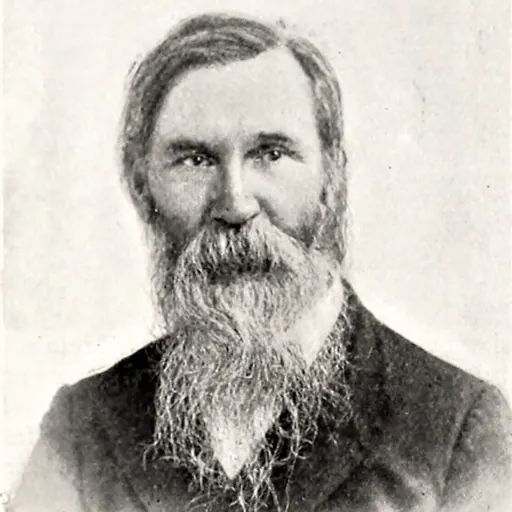
About Francis March
Lived 1825 – 1911 (aged 85). Francis March was an American lexicographer, linguist, writer, classical philologist and philologist.
Francis Andrew March (October 25, 1825 – September 9, 1911) was an American polymath, academic, philologist, and lexicographer. He is considered the principal founder of modern comparative linguistics in Old English.
Also known as the "Grand Old Man of Lafayette", March was the first individual to hold the title "Professor of English Language and Literature" anywhere in the United States or Europe. March is predominantly recognized for performing his duties as "Professor of the English Language and Comparative Philology" at Lafayette College, where he taught for 56 years. This prepared him for high school, where March became a clever and active participant in his classes and activities. He became a writer, read on a wide range of subjects, performed in school plays, and even wrote plays himself. March was the first to hold the title of "Professor of English Language and Literature" anywhere in the United States or Europe.
March had a significant career at Lafayette College and remained loyal to the school, often turning down offers from larger universities as his published work and teaching style became more well-known. March helped improve Lafayette by using his wisdom and insight to bring the college to a new stage. He was devoted to both increasing the analysis of English literature in higher institutions, as well as in growing the college's academics. In addition to English, March also taught French, German, Greek, Latin, botany, "mental philosophy", political economy, critical examination of the US Constitution, public law and Roman law.
March brought a new outlook to teaching English by introducing a detailed examination of linguistic and rhetorical pieces. By applying the methods of studying Latin and Greek classics towards the study of English literature, he led the way for the first scientific study of the English language. March is also said to be the first person to include one of Shakespeare's plays on his course syllabus. General Peyton C. March was chief of staff of the United States Army during the First World War. Meanwhile, Thomas Stone March became a superintendent of schools in Greensburg, Pennsylvania; Alden March became a Sunday editor of The New York Times;and John Lewis March became a professor of modern languages at Union College in Schenectady, New York.
Death
Francis A. March died on September 9, 1911, at the age of 85 in his home on Lafayette College's campus.
Legacy Francis A. March Elementary School, named in March's honor, in the Easton Area School District March worked at Lafayette College for more than fifty years, passing up opportunities at other institutions Beyond his professional impact, colleague James A. Bright, also commented on how March personally shaped the Lafayette College community. Bright spoke highly of the way in which March built relationships with faculty and served as a mentor to students.
Achievements and honorary degrees Francis A. March's monumental works have been highly recognized in academia. March was the first to hold the title of "Professor of English Language and Literature" in both the United States and Europe.
On October 21, 1881, March was elected into the American Antiquarian Society. Members are elected by their colleagues for their tremendous contributions and discoveries within academia.
Don’t just read it —
keep it.
Full-length biographies made to live with: read them, listen on the way to work, watch them tonight.
- E-book
- Audio
- Video
Instant download · yours to keep · every purchase keeps this site free
Important facts
People in Francis March's life
Named in this biography and alive at the same time

Related people
Same field, nearest in time


Contemporaries
People whose lives overlapped Francis March's





Frequently asked questions
Who was Francis March?
American classical philologist (1825–1911)
When was Francis March born?
Francis March was born on 25 October 1825 in Millbury.
When did Francis March die?
Francis March died on 9 September 1911 in Easton.
What was Francis March's occupation?
Francis March was a lexicographer, linguist, writer, classical philologist and philologist.
What nationality was Francis March?
Francis March was American.
Sources & further reading
Cite this page
APA: Biography.guide. (2026). Francis March. https://biography.guide/francis-march/
MLA: "Francis March." Biography.guide, https://biography.guide/francis-march/.
Chicago: "Francis March." Biography.guide. https://biography.guide/francis-march/.
Data last updated: 2026-09-22 · Spot an error? Report a correction.
Portrait: Wikimedia Commons · author & licence
Page generated 2026-09-27 05:01 UTC