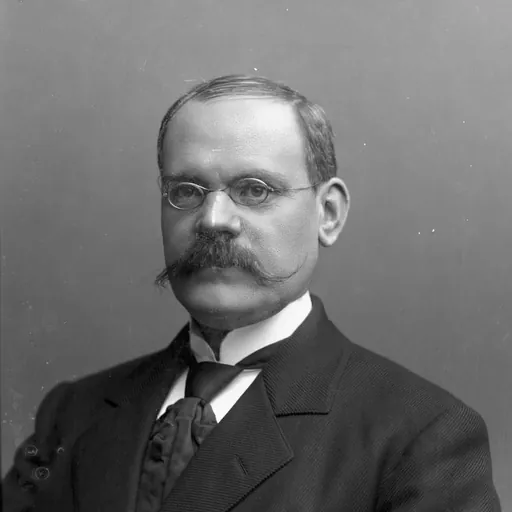
About Francis Hagerup
Lived 1853 – 1921 (aged 68). Francis Hagerup was a Norwegian politician, professor, diplomat and jurist.
George Francis Hagerup (22 January 1853 – 8 February 1921) was a Norwegian law professor, diplomat, politician for the Conservative Party and women's rights advocate. He was the prime minister of Norway from 1895 to 1898 and from 1903 to 1905, and leader of the Conservative Party from 1899 to 1902. As a legal scholar, he is known for his contributions to the development of public international law, and was chairman of the Institut de Droit International. He was his party's most active supporter of women's suffrage, and was a co-founder, board member and honorary member of the Norwegian Association for Women's Rights.
Biography Francis Hagerup grew up at Horten in Vestfold, Norway. He was a son of admiral and cabinet minister Henrik Steffens Hagerup (1806–1859) and Nicoline Christine Jenssen (1808–1862). He graduated with the cand.jur. degree at the Royal Frederick University in 1876, received a grant to study abroad (which he did at the universities of Leipzig, Munich and Paris) and became a research fellow at the Royal Frederick University in 1879. He obtained the dr.juris degree in 1885, and was professor of law at the Royal Frederick University from 1887 to 1906. He was minister of justice in the Second cabinet Stang from 2 May 1893 to 14 October 1895. In August 1895 he was Finance minister. He was a member of the Storting from 1901 to 1906.
Hagerup was passionately involved in the development of public international law. From 1897 he was member of the Institut de Droit International, of which he became the chairman in 1912. In 1907 he headed the Norwegian delegation at the second peace conference in The Hague. He was also delegate at international conferences regarding admiralty law. In 1920 he led the Norwegian delegation when the League of Nations convened for the first time in Geneva. The same year he was elected to the Law committee under the League council. In 1888, he founded Tidsskrift for Retsvidenskab (Journal of Jurisprudence), and served as its editor until his death.
Hagerup was also member of the Norwegian Nobel Committee from 1 January 1907 until his death in 1921.
Hagerup was the most prominent Conservative Party politician to support women's suffrage and was active in the women's rights movement. In 1884 he was a co-founder of the Norwegian Association for Women's Rights and he was also a member of the first board of the association. In 1914 he became an honorary member of the association.
Personal life He was married in 1880 to Frederikke Dorothea Bødtker (1853-1919). He died in Kristiania (now Oslo) and was buried at Vår Frelsers gravlund.
Don’t just read it —
keep it.
Full-length biographies made to live with: read them, listen on the way to work, watch them tonight.
- E-book
- Audio
- Video
Instant download · yours to keep · every purchase keeps this site free
Important facts
People in Francis Hagerup's life
Named in this biography and alive at the same time

Related people
Same field, nearest in time






Contemporaries
People whose lives overlapped Francis Hagerup's





Frequently asked questions
Who was Francis Hagerup?
7th Prime Minister of Norway (1853–1921)
When was Francis Hagerup born?
Francis Hagerup was born on 22 January 1853 in Horten.
When did Francis Hagerup die?
Francis Hagerup died on 8 February 1921 in Christiania.
What was Francis Hagerup's occupation?
Francis Hagerup was a politician, professor, diplomat and jurist.
What nationality was Francis Hagerup?
Francis Hagerup was Norwegian.
Sources & further reading
Cite this page
APA: Biography.guide. (2026). Francis Hagerup. https://biography.guide/francis-hagerup/
MLA: "Francis Hagerup." Biography.guide, https://biography.guide/francis-hagerup/.
Chicago: "Francis Hagerup." Biography.guide. https://biography.guide/francis-hagerup/.
Data last updated: 2026-09-22 · Spot an error? Report a correction.
Portrait: Wikimedia Commons · author & licence
Page generated 2026-09-27 05:01 UTC