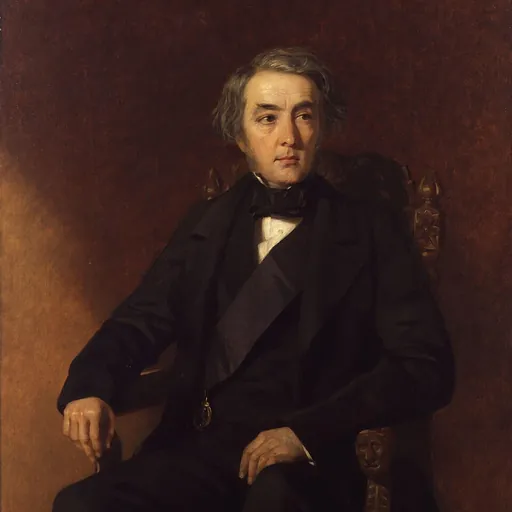
Francis Egerton, 1st Earl of Ellesmere
British politician, writer, traveller and patron of the arts
About Francis Egerton, 1st Earl of Ellesmere
Lived 1800 – 1857 (aged 57). Francis Egerton, 1st Earl of Ellesmere was a British politician, writer, statesperson, translator, poet and philanthropist.
Francis Egerton, 1st Earl of Ellesmere (1 January 1800 – 18 February 1857), known as Lord Francis Leveson-Gower until 1833, was a British politician, writer, traveller and patron of the arts. Ellesmere Island, a major island (10th in size among global islands) in Nunavut, the Canadian Arctic, was named after him.
Background and education Ellesmere was born at 21 Arlington Street, Piccadilly, London, on 1 January 1800, the third son of George Leveson-Gower (then known as Lord Gower) and his wife, Elizabeth Gordon who was 19th Countess of Sutherland in her own right. He was educated at Eton and Christ Church, Oxford, and then held a commission in the Life Guards, which he resigned on his marriage. In October 1803 his father became Marquess of Stafford, having shortly before inherited the considerable wealth (but not the titles) of Francis Egerton, 3rd Duke of Bridgewater, whose will provided that the Bridgewater estates should next pass to Francis, rather than his elder brother George.
Political career Lord Francis Leveson Gower, MP Egerton entered Parliament in 1822 as member for the pocket borough of Bletchingley in Surrey, "
In politics he was a Conservative who – as he later said – 'worshipped' Wellington; on specific policies his views usually led him to support Sir Robert Peel; the most obvious exception being his support of the Ten-Hour movement. In 1823, he was a junior member of the mission of FitzRoy Somerset sent by Wellington to Madrid. In 1825 he was chosen to move the Loyal Address; (In doing so, he said "Our commerce is now happily in the progress of being freed from many restrictions, which, bottomed upon false principles, impeded its free course.) Those absurd enactments are now expunged from the text-book of the political economist." Egerton's obituary in the Times says "twenty years before Sir Robert Peel adopted the policy of free trade, that measure had been strenuously advocated by Lord Francis Egerton in his place in parliament". The Loyal Address endorses government policy, and the rest of the debate gives the contemporary context (abolition of import duties on silk and cotton, repeal of the Navigation Acts), with even Brougham advocating no more than a reduction and equalisation of the import duties on wine. If Egerton did go beyond his Loyal Address platitudes in the 1820s, it would appear to have gone unrecorded by Hansard and contemporary newspapers; nor does he ever seem to have been twitted on it by his opponents (who did point out his past speeches and votes on Catholic relief) during his subsequent opposition to repeal of the Corn Laws. The Times obituary contains a number of errors, some of which seem to have found their way into the DNB article Appointed a Lord of the Treasury in 1827, he was promoted to Under-Secretary of State for War and the Colonies in February 1828 at the request of William Huskisson, having first to overcome the opposition of his father. When Huskisson resigned in May 1828, Egerton's father insisted upon Egerton's resignation; on Egerton's subsequent account because he thought the Wellington cabinet had lost its more enlightened elements and would now take a hard line against Catholic Relief. Egerton, however, was convinced that Wellington intended some measure of relief and soon rejoined the government; (Again - according to Egerton; Lord Ellenborough thought 'family ambition' the explanation Sutherland was a pocket county of his family and when in 1831 his father supported parliamentary reform but Francis did not, his father presented the seat to a supporter of reform: in 1833 his father was made Duke of Sutherland.)
The Bridgewater trust His father, however, died within the year, and the estates he had inherited from Francis Egerton, 3rd Duke of Bridgewater passed to Francis, who then took, by royal licence, the surname of Egerton. The Bridgewater estates were held under trust and gave an annual income reported to be £90,000, It was reported in 1842 that there had been 101 persons killed and injured in them in the previous three years One of the staff of the 1833 Factory Commission had noted that the Worsley mine "was said to be the best mine in the place" but concluded from what he saw that "the hardest labour in the worst-conducted factory is less hard, less cruel, and less demoralizing than the labour in the best of coal-mines"
One trustee lived in Worsley Old Hall and was the effective manager of the estates, but after he resisted inspection of the books by Egerton's auditor and man of business James Loch MP he was forced out and replaced by Loch. Egerton then made Worsley New Hall one of his principal residences, but soon demolished it and replaced it with a larger hall in Elizabethan style. He set about making Worsley a model estate village; within ten years a national newspaper, deploring the 'ignorance of the collier class' claimed "What may be done by a proprietor, what should be done by every proprietor, is illustrated in the case of Lord Francis Egerton and the Worsley colliers". Until Egerton had taken up residence at Worsley it had been "imperfectly provided with the means of moral and intellectual improvement for the people" but now "The population is nearly 6,000. For their use, two churches have been built, and a third is now in course of erection. Five clergymen have been provided, in addition to the one original incumbent. Seven-day schools have been established, with trained masters and mistresses, fully supplied with the best books and apparatus. A reading-room has been opened, containing the best periodicals of the day, and a considerable circulating library. The room is provided with fire and lights; is open every evening; and is much frequented by the labouring people, as an agreeable resort after their day's work. A large field, of not less than sixty acres, has been set apart as a recreation ground… Cricket, quoits, and other athletic games are encouraged; and the private band occasionally attends there on pay-days. In the centre, an ornamental building has been erected, in which the wages of all the labourers on that part of the estate are paid fortnightly. There are few public-houses and no beer-shops on the estate. The houses built for the workmen are convenient; most of them have four rooms and a pantry, back-yard and garden, at a rent of about £3 per annum, including rates"
Worsley Hall served as a suitable base for royal visits to Manchester (the first occurring in 1851) but Egerton had little influence in Manchester; when his name was put forward for presidency of the Manchester Athenaeum, Richard Cobden was brought forward as an alternative candidate, and duly elected. Egerton's politics (Tory and protectionist) were not those of (Reform and Free Trade) Manchester, and his association with the Bridgewater trust also told against him.
The Bridgewater canal The canal was highly profitable, and owed much of its profitability to price-fixing agreements with its rivals; this led to resentment in both Liverpool and Manchester of its wealth and influence (and hence that of Egerton). After 1810, when they had agreed to charge identical rates, The Liverpool and Manchester Railway had been promoted to allow greater volumes of traffic between the two towns, and to bring down transport costs. The shares had been inherited, not by Egerton, but by his brother, the 2nd Duke of Sutherland; Loch was also auditor and principal steward for the Duke, as well as personally holding shares in the railway. When the railway opened, the rates charged by two previous carriers settled down just below the maximum (ten shillings a ton) the railway was allowed to charge by its act of Parliament. When the Old Quay Company later significantly reduced its freight charges, they were bought out by Egerton personally (1843) and the previous charges reinstated: the Bridgewater trust then bought the company from him (for over half a million pounds) once they had obtained the requisite powers. After the railway was absorbed into the London and North Western Railway, there was a brief period of fierce competition for goods traffic, with the rate for transport of cotton from Liverpool to Manchester dropping by two-thirds.
Hence, although Egerton offered on succeeding to the Bridgewater estate to pay for a large statue of the Duke of Bridgewater in Manchester if the town authorities would identify a suitable site for it the offer was never taken up.
The Right Honourable Lord Francis Egerton, MP The Bridgewater estate was commercially important in South Lancashire; its landholdings and associated tenant farmers also made it a major power in South Lancashire parliamentary elections and Egerton's succession of his Whig father as beneficiary changed the political arithmetic of the constituency. At the 1835 general election, he and another Conservative candidate defeated the two sitting pro-Reform MPs; Egerton topped the poll. At the 1837 election, the Manchester Guardian pointed out that Egerton had voted in only twenty-seven of the 171 divisions in the preceding session of the Commons: nonetheless, Egerton again headed the poll, with his Conservative colleague second. In 1841, his election address claimed he was guided by the interests of manufacturing rather than agriculture: "I presume that the man who is in the centre of a strictly rural population will look to its wishes and apparent interests. I shall do likewise: and if he looks to his ricks I shall look to my chimnies and those of my neighbours"
He opposed repeal of the Corn Laws but thought it time for a 'full careful and dispassionate' revision of the current 'sliding scale'. He was returned unopposed and his victory speech put less stress on the need for revision, but deprecated cries of 'No surrender' on the Corn Law question; it was not a constitutional issue.
Egerton was Major commanding the Duke of Lancaster's Yeomanry, who were called out to support the civil power during the Plug Plot riots of 1842; Egerton and a troop of yeomanry served in Preston in the aftermath of the riot and fatal shootings there. He later intervened in a Commons debate to defend the conduct of the Preston magistrates and of the military whilst noting that Preston was an exceptional case: in the Lancashire disturbances there had been a "general absence of a sanguinary disposition, or a spirit of wanton violence" and he built a gallery to which the public were allowed free access. Lord Ellesmere served as president of the Royal Geographical Society and as president of the Royal Asiatic Society (1849–1852), and he was a trustee of the National Gallery. a daughter of Charles Greville (1762–1832), a great-great-granddaughter of the 5th Baron Brooke. The Archbishop of York officiated and the Duke of Wellington (whose private secretary was a brother of the bride) was one of the witnesses.
They had eleven children, including: George Egerton, 2nd Earl of Ellesmere (15 June 1823 – 19 September 1862); Hon. Francis Egerton (15 September 1824 – 15 December 1895), who became an admiral, and was a Member of Parliament for two constituencies; he married in 1865 (Lady) Louisa Caroline née Cavendish, daughter of the 7th Duke of Devonshire (by marriage); they had issue; Hon. Algernon Fulke Egerton (31 December 1825 – 14 July 1891), who was a Member of Parliament for three constituencies, and married in 1863 Hon. Alice Louisa Cavendish, a niece of the 7th Duke of Devonshire; they had issue; Hon. Arthur Frederick Egerton (6 February 1829 – 25 February 1866), who became Lieutenant-Colonel, and married in 1858 Helen Smith, daughter of Martin Tucker Smith and his wife, Louisa Ridley; they had issue; Lady Alice Harriet Frederica Egerton (10 October 1830 – 22 December 1928), who married George Byng, 3rd Earl of Strafford in 1854; they had no issue; Lady Blanche Egerton (22 February 1832 – 20 March 1894), who married John Montagu, 7th Earl of Sandwich in 1865 as his second wife; they had no issue; Hon. Granville Egerton (baptised 28 October 1834 – 1851), who was killed by the bursting of his gun when shooting in California - at the time he was a midshipman on HMS Maeander returning from the East India station via California to collect treasure; unmarried, seemingly no issue.
In 1846 he was raised to the peerage as Earl of Ellesmere, of Ellesmere in the County of Salop, with the subsidiary title Viscount Brackley, of Brackley in the County of Northampton. Viscount Ellesmere and Baron Brackley had been subsidiary titles of the Earls of Bridgewater until the extinction of that title in 1829.
When in town, the family lived at Bridgewater House, St. James' Park; their country seats were Oatlands, which Egerton rented until 1843; Worsley, (from 1837) where Egerton later replaced the existing hall (described as neither commodious for the family, nor agreeable to his Lordship's taste ) at a cost of £100,000. After leaving Oatlands, their Surrey seat was Hatchford Park, Cobham, Surrey, where Lady Ellesmere laid out the gardens. Her mother, Lady Charlotte Greville (née Cavendish-Bentinck) died at Hatchford Park on 28 July 1862, aged 86.
Francis died on 18 February 1857 at Bridgwater House, St. James' Park; and was succeeded by his first son, George. On the extinction of the senior line of the Dukedom of Sutherland in 1963, his great-great-grandson, the fifth Earl, succeeded as 6th Duke of Sutherland.
Don’t just read it —
keep it.
Full-length biographies made to live with: read them, listen on the way to work, watch them tonight.
- E-book
- Audio
- Video
Instant download · yours to keep · every purchase keeps this site free
Important facts
more
Francis Leveson-Gower, [1st] Earl of Ellesmere, Viscount Brackley Egerton, Egert FamilyFamily & relationships
People in Francis Egerton, 1st Earl of Ellesmere's life
Named in this biography and alive at the same time





Related people
Same field, nearest in time

Contemporaries
People whose lives overlapped Francis Egerton, 1st Earl of Ellesmere's






Frequently asked questions
Who was Francis Egerton, 1st Earl of Ellesmere?
British politician, writer, traveller and patron of the arts (1800-1857)
When was Francis Egerton, 1st Earl of Ellesmere born?
Francis Egerton, 1st Earl of Ellesmere was born on 1 January 1800 in London.
When did Francis Egerton, 1st Earl of Ellesmere die?
Francis Egerton, 1st Earl of Ellesmere died on 18 February 1857 in London.
What was Francis Egerton, 1st Earl of Ellesmere's occupation?
Francis Egerton, 1st Earl of Ellesmere was a politician, writer, statesperson, translator, poet and philanthropist.
What nationality was Francis Egerton, 1st Earl of Ellesmere?
Francis Egerton, 1st Earl of Ellesmere was British.
Sources & further reading
· Wikipedia: Francis Egerton, 1st Earl of Ellesmere
· DBpedia: Francis Egerton, 1st Earl of Ellesmere
Cite this page
APA: Biography.guide. (2026). Francis Egerton, 1st Earl of Ellesmere. https://biography.guide/francis-egerton-1st-earl-of-ellesmere/
MLA: "Francis Egerton, 1st Earl of Ellesmere." Biography.guide, https://biography.guide/francis-egerton-1st-earl-of-ellesmere/.
Chicago: "Francis Egerton, 1st Earl of Ellesmere." Biography.guide. https://biography.guide/francis-egerton-1st-earl-of-ellesmere/.
Data last updated: 2026-09-24 · Spot an error? Report a correction.
Portrait: Wikimedia Commons · author & licence
Page generated 2026-09-27 05:08 UTC