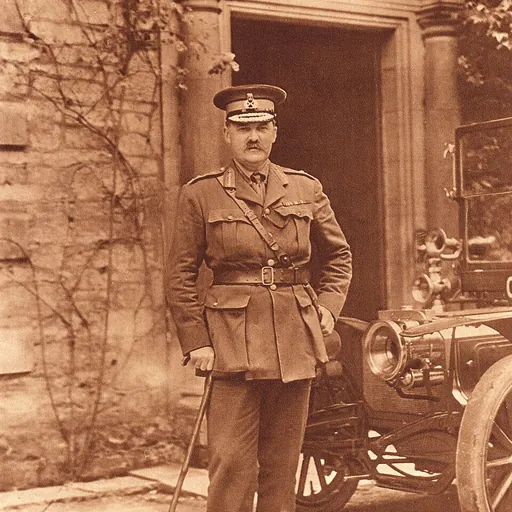
About Francis Davies
Lived 1864 – 1948 (aged 83). Francis Davies was a British military personnel and art collector.
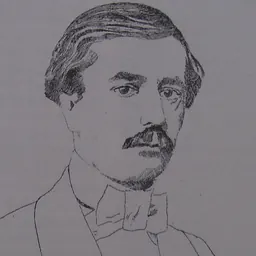
General Sir Francis John Davies, (3 July 1864 – 18 March 1948) was a senior British Army officer who commanded the 8th Division during the First World War.
Early life and education Davies was born in London, the son of Lieutenant General Henry Fanshawe Davies and his wife, Ellen Christine Alexandra Hankey. His grandfather was General Francis John Davies (brother and heir of Thomas Henry Hastings Davies, MP for Worcester) and his great-grandfather was Admiral of the Fleet Sir Thomas Byam Martin. The family seat was Elmley Castle, Pershore, Worcestershire. His younger brother was Major General Henry Rodolph Davies. He was educated at Eton College. He transferred from the Worcesters to a Regular Army commission in the Grenadier Guards, the same regiment in which his father and grandfather had served, as a lieutenant in May 1884.
He attended the Staff College, Camberley from 1890–1891. He became adjutant to the 2nd Battalion of his new regiment in August 1893. Promoted to captain in October 1895, he was, in 1897, posted to South Africa where he became a deputy assistant adjutant general (DAAG) for the Cape of Good Hope, and received a further promotion to major in July 1899.
Davies returned to the United Kingdom in 1902 and was temporarily employed in the intelligence department until he became deputy assistant quartermaster general (DAQMG) at the War Office on 7 September 1902. He was then appointed assistant director of military operations, for which he was raised to the brevet rank of colonel on 1 April. He was the British delegate to the International Conference on Wireless Telegraphy in Berlin in 1906 and then, promoted to lieutenant colonel while serving on half-pay, assistant quartermaster general for Western Command in 1907. and made a Companion of the Companion of the Order of the Bath in the 1907 Birthday Honours in June. After serving as a general staff officer, grade 1 from January 1908, he was then promoted to the temporary rank of brigadier general in November 1909 and made general officer commanding (GOC) of the 1st (Guards) Brigade, taking over from Arthur Henniker-Major.
Managing to retain his temporary rank, he then took over as brigadier general, general staff (BGGS) of Aldershot Command, in succession to Brigadier General William Robertson, in August 1910. He was promoted to major general in May 1913 and, in October of that year, became director of staff duties at the War Office.
First World War
In October 1914, two months after the British entry into World War I, Davies was appointed as GOC of the 8th Division, which had been created only recently from Regular Army units scattered around the British Empire. The division, along with its GOC, was soon sent to the Western Front, where the rest of the British Expeditionary Force (BEF) was already serving, and where the division would remain for the rest of the war. The 8th, serving under the command of Lieutenant-General Sir Henry Rawlinson's IV Corps, saw major action for the first time in 1915 at the Battle of Neuve Chapelle in March and later in the Battle of Aubers Ridge, two months later, both of which resulted in heavy casualties.
Towards the end of July Davies was posted away from the fighting in France and Belgium to take over the command of VIII Corps, then heavily engaged in the Gallipoli campaign, from Lieutenant-General Aylmer Hunter-Weston. Davies, promoted to the temporary rank of lieutenant-general, took over as its GOC on 8 August from Major-General William Douglas, GOC 42nd (East Lancashire) Division, who in turn was in temporary command of the corps as well as his own division. He held this post until after the end of the war, finally relinquishing to Lieutenant General Sir Philip Chetwode in June 1919.
Eighteen Old Etonian generals revisit Eton, May 1919. Lieutenant General Davies stands in the middle row, second from the right.
Postwar and final years Later that year, Davies was appointed general officer commanding-in-chief (GOC-in-C) of Scottish Command in June 1919, taking over from Lieutenant General Frederick McCracken. After being promoted to the rank of full general in July 1921, and after serving as lieutenant of the Tower of London, which he had been appointed to in June 1923, he retired from the army in April 1926. He had been appointed an aide-de-camp general to King George V in April 1922.
Freemasonry From 1919 until his death in 1948, Davies served as Provincial Grand Master of Freemasons in Worcestershire. During his time in office, 50 new masonic lodges were dedicated and he personally participated at 41 of these. From 1935 to 1947 he also held the position of Deputy Grand Master of the United Grand Lodge of England, paying official visits to numerous Provinces in this country and to many Grand Lodges overseas.
Don’t just read it —
keep it.
Full-length biographies made to live with: read them, listen on the way to work, watch them tonight.
- E-book
- Audio
- Video
Instant download · yours to keep · every purchase keeps this site free
Important facts
People in Francis Davies's life
Named in this biography and alive at the same time




Related people
Same field, nearest in time
Contemporaries
People whose lives overlapped Francis Davies's
Frequently asked questions
Who was Francis Davies?
British Army general (1864–1948)
When was Francis Davies born?
Francis Davies was born on 3 July 1864 in London.
When did Francis Davies die?
Francis Davies died on 18 March 1948 in Pershore.
What was Francis Davies's occupation?
Francis Davies was a military personnel and art collector.
What nationality was Francis Davies?
Francis Davies was British.
Sources & further reading
· DBpedia: Francis Davies (British Army officer)
Cite this page
APA: Biography.guide. (2026). Francis Davies. https://biography.guide/francis-davies-military-personnel/
MLA: "Francis Davies." Biography.guide, https://biography.guide/francis-davies-military-personnel/.
Chicago: "Francis Davies." Biography.guide. https://biography.guide/francis-davies-military-personnel/.
Data last updated: 2026-10-01 · Spot an error? Report a correction.
Portrait: Wikimedia Commons · author & licence
Page generated 2026-10-04 14:38 UTC