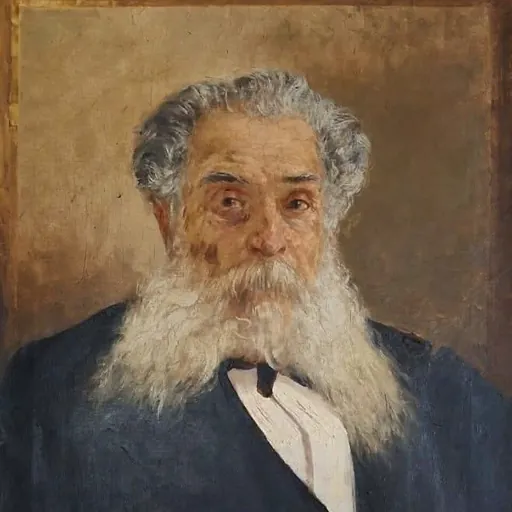
About Francesco Di Bartolo
Lived 1826 – 1913 (aged 86–87). Francesco Di Bartolo was an Italian printmaker and painter.
Francesco Di Bartolo (17 January 1826 – 2 February 1913) was an Italian engraver and painter, active in Naples, Rome and Catania, mainly in the field of intaglio printmaking. Biography Giuseppe Gandolfo, Portrait of Giuseppina Consoli, mother of Francesco Di Bartolo, c. 1850
Born in Catania to the jurist Antonino Di Bartolo and Giuseppina Consoli (1794–1877), he received his early education in his native city. He was a nephew of Giacomo Di Bartolo, known as Bartulu, a patriot, soldier, orator and tribune of Catania who played a prominent role in the city's public life during the Risorgimento. Calcedonio Reina described Francesco as the “nephew of the celebrated leader of the people”. The celebrated surgeon Euplio Reina, a family friend, recognized his abilities and supported the beginning of his professional career, obtaining for him his first commission in burin engraving, the Santa Marta, intended for the hospital of the same name in Catania, where Reina worked as physician and benefactor.
Francesco Di Bartolo, portrait of Tommaso Aloysio Juvara Later, after obtaining, thanks to the Santa Marta, an annual subsidy of 288 ducats from the Decurionate of Catania, subsequently renewed on account of his merit in 1854, the young Di Bartolo enrolled at the Academy of Fine Arts of Naples, in the class directed by Tommaso Aloysio Juvara, who, sharing the chair with Francesco Pisante, taught the "great genre", that is, classical burin engraving, but also the "different methods", that is, alternative techniques of printmaking. Here Di Bartolo produced his first important burin engraving, the emperor Charles V after Jovita Garavaglia, and became especially devoted to etching, which he found freer and more congenial to his own inspiration. Tommaso Aloysio Juvara created a class rich in talent, a true school, which also included Saro Cucinotta and Gaetano Micale. In the same context, Di Bartolo took part in the workshop of the San Carlo Borromeo, after Giuseppe Mancinelli, assisting his master, working in burin engraving and completing the work, which was published in 1875.
Di Bartolo's intaglio production, after he completed his academic studies in 1860, met with considerable approval, and the artist remained in Naples. Between academy and anti-academy, he formed friendships with artists of the Neapolitan school such as Filippo Palizzi, Domenico Morelli and Edoardo Dalbono, was one of the first members of the Società Promotrice di Belle Arti of Naples and produced some of his best-known etchings, also intended for subscribing members, such as La leggenda delle sirene after Dalbono. thumb Francesco Di Bartolo, portrait of Domenico Morelli After Palizzi he translated lively animal scenes, and after Morelli, in particular, Tasso and Princess Eleonora d'Este and The Iconoclasts, commissioned by the House of Savoy. thumb
In 1864 the royal house also commissioned him to engrave the portrait of King Victor Emmanuel II, on the occasion of the transfer of the capital from Turin to Florence. With these works, Di Bartolo entered the circuit of official commissions, in which engraved translation also assumed a function of dynastic and state representation. At the same time, however, concerned that the advent of photography might "bring about the collapse of the art" of reproductive engraving, in 1863 he had submitted the burin engraving of Saint Agatha and three etchings after Palizzi to the celebrated engraver Luigi Calamatta, director of the Brera Academy, "in order to obtain an opinion", receiving appreciation and encouragement to continue with etching rather than with burin engraving. Di Bartolo then worked in etching with renewed energy. The practice of engraving continued for a long time to retain strength, prestige and continuity. thumb The two volumes of de Bourcard, private collectionThis fact is all the more significant when one considers that Di Bartolo also entered the system of Neapolitan illustrated publishing, taking part in the enterprise of Usi e costumi di Napoli e contorni descritti e dipinti by Francesco de Bourcard, in two volumes, 1857 and 1866, one of the most important illustrated publishing works of the nineteenth-century Neapolitan milieu, in which engraving continued to perform a decisive function of translation, dissemination and circulation of images. He illustrated two chapters with two etchings, later also hand-coloured, after original drawings by Teodoro Duclère: "Il castagnaro" and "Il paludano", in the second volume, published in 1866.
His work brought him fame and also earned him the post of honorary professor "with salary" at the Neapolitan Academy of Fine Arts, where he had studied. and Margherita of Savoy,Queen Margherita, who granted him numerous honours, and of various illustrious men of his time, including Camillo Benso, Count of Cavour and the ministers Cesare Correnti and Salvatore Majorana Calatabiano.
In 1872 he moved from the Academy of Fine Arts to the Royal State Calcography in Rome, following his master Aloysio Juvara, who had been called there by the Minister of Public Education Cesare Correnti for the reorganization and reform of the Institute and had then been appointed co-director together with Paolo Mercuri. There Di Bartolo worked on important ministerial commissions, and therefore on his most significant burin engravings, such as Sacred and Profane Love after Titian, the Madonna and Child after Murillo and the Madonna of the Harpies after Andrea del Sarto.thumb
He remained there even when, because of internal problems and rivalries within the Institute, his master Aloysio Juvara took his own life in 1875, continuing to struggle and work in an often hostile environment, producing graphic masterpieces such as the drawing of Michelangelo's Last Judgement, which he was not allowed to translate into an etching.
In the spring of 1876, during his years at the Royal State Calcography in Rome, Di Bartolo was in Catania, where he received Pedro II d'Alcantara, Emperor of Brazil, as a guest in his own home. Di Bartolo had also portrayed the emperor in a work that is currently untraced. He accompanied Pedro II to the university, where the emperor attended incognito a lecture by Mario Rapisardi on the final book of Dante's De Monarchia, and also accompanied him on excursions to Mount Etna.
Di Bartolo also portrayed the Bey of Tunis and received him as a guest in his home in Catania. He therefore appeared there not only as an exhibiting artist, but as a figure entrusted with representing Italian expertise in the field of applied arts and artistic industries. The appointment placed him at the heart of the Italian organization of the event; he entered the state machinery of juries, classifications, reports and national representations through which the young Kingdom of Italy presented its artistic and industrial image to Europe. from the Universal Exposition of Paris of 1867, where he presented The Iconoclasts after Morelli; from the First Italian Exhibition of Fine Arts in Parma in 1870, where he obtained another silver medal; thumb Francesco Di Bartolo, portrait of Camillo Benso, Count of Cavour from the Universal Exposition of Vienna of 1873, where the works he sent were awarded a bronze medal; from the Promotrice of Palermo in 1876, where the Portrait of the Count of Cavour won him the gold medal; and from the Exhibition of Messina in 1882. At the Vatican World Exhibition in Rome in 1888 he obtained the gold medal with the copper engraving of the Pope, Il S. Padre Leone XIII.
For his works he was appreciated in France, Germany and England, and numerous academies elected him an honorary member. A significant part of his graphic production is also documented in the collections of the British Museum, which preserves eleven sheets connected with his corpus, including engraved portraits of Tommaso Aloysio Juvara, Filippo Palizzi, Domenico Morelli, Giulio Monteverde, Eleuterio Pagliano, Stefano Ussi, Francesco Saverio Altamura, Giovanni Dupré and Cesare Correnti, as well as The Legend of the Sirens after Edoardo Dalbono. Francesco Di Bartolo, portrait of sculptor Giulio MonteverdeIn Russia, the Imperial Academy of Saint Petersburg appointed him honorary professor. he returned definitively to Catania at the end of the century, to the villa in the district of Cibali, where he maintained relations with Mario Rapisardi, Calcedonio Reina, Giovanni Verga, Gaetano Ardizzoni and many others, not only from Catania. The Casalotto system continues to operate in the Catania area. Giacomo married Anna Carnazza Puglisi, daughter of the jurist and patriot Gabriello Carnazza Puglisi.
Francesco habitually signed his engravings “F. di Bartolo”, using a lower-case initial for the particle. According to family tradition, this practice reflected the genealogical continuity of the name and, in particular, the memory of the Sienese di Bartolo family, beginning with Taddeo di Bartolo.
The heraldic and genealogical papers collected by Francesco were dispersed following a theft from the family’s villa at Cibali in 1959. The reconstruction therefore relies on family memory transmitted by his descendants and on evidence found in historical reference works.
The Legend of the Sirens, after Edoardo Dalbono, etching.
Cat's head, original etching.
San Carlo Borromeo, after Giuseppe Mancinelli, burin engraving signed together with his master Juvara.
The Iconoclasts, after Domenico Morelli, etching.
The Venetians at the announcement of the Peace of Villafranca, after Nicola Parisi, etching.
H. M. Victor Emmanuel II, etching.
Official portrait of Camillo Benso, Count of Cavour, full-length figure, etching.
Sacred and Profane Love, after Titian, burin engraving.
Madonna and Child, after Murillo, burin engraving.
The Last Judgement after Michelangelo, charcoal drawing, 1883–1884.
Madonna of the Harpies, after Andrea del Sarto, burin engraving.
Queen Margherita of Savoy, etching.
Portraits of Tommaso Aloysio Juvara, Ussi, Altamura, Palizzi, Eleuterio Pagliano, Domenico Morelli, Monteverde, Dupré, Correnti, Salvatore Majorana Calatabiano, Dusmet and many others, all etchings with burin retouching.
Fully finished drawings, including Michelangelo's Last Judgement.
Paintings: Neapolitan landscapes and numerous still lifes.
Honours
Don’t just read it —
keep it.
Full-length biographies made to live with: read them, listen on the way to work, watch them tonight.
- E-book
- Audio
- Video
Instant download · yours to keep · every purchase keeps this site free
Important facts
People in Francesco Di Bartolo's life
Named in this biography and alive at the same time



Related people
Same field, nearest in time

Contemporaries
People whose lives overlapped Francesco Di Bartolo's



Frequently asked questions
Who was Francesco Di Bartolo?
Italian engraver and painter
When was Francesco Di Bartolo born?
Francesco Di Bartolo was born in 1826 in Catania.
When did Francesco Di Bartolo die?
Francesco Di Bartolo died in 1913 in Catania.
What was Francesco Di Bartolo's occupation?
Francesco Di Bartolo was a printmaker and painter.
What nationality was Francesco Di Bartolo?
Francesco Di Bartolo was Italian.
Sources & further reading
· Wikipedia: Francesco Di Bartolo
· DBpedia: Francesco Di Bartolo
Cite this page
APA: Biography.guide. (2026). Francesco Di Bartolo. https://biography.guide/francesco-di-bartolo/
MLA: "Francesco Di Bartolo." Biography.guide, https://biography.guide/francesco-di-bartolo/.
Chicago: "Francesco Di Bartolo." Biography.guide. https://biography.guide/francesco-di-bartolo/.
Data last updated: 2026-09-20 · Spot an error? Report a correction.
Page generated 2026-09-27 05:09 UTC