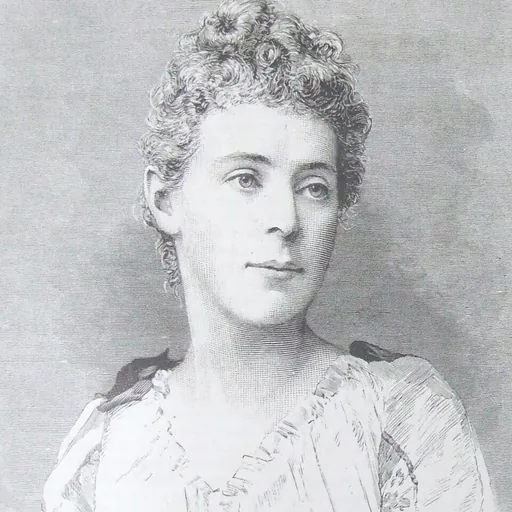
About Florence Maybrick
Lived 1862 – 1941 (aged 79). Florence Maybrick was an American writer.
Florence Elizabeth Chandler Maybrick (3 September 1862 – 23 October 1941) was an American woman convicted in the United Kingdom of murdering her husband, cotton merchant James Maybrick.
Early life The Chandler Mansion in Mobile, Alabama, birthplace of Florence Chandler. Florence Maybrick was born Florence Elizabeth Chandler in Mobile, Alabama. She was the daughter of William George Chandler, a one-time mayor of Mobile and a partner in the banking firm of St. John Powers and Company, and Caroline Chandler Du Barry, née Holbrook. Florence's father had died before her birth. Her mother married in 1872 her third husband Baron Adolph von Roques, a cavalry officer in the Eighth Cuirassier Regiment of the German Army.
Marriage While travelling by ship to the United Kingdom, Florence met James Maybrick, a cotton merchant from Liverpool.
Florence made quite an impression on the social scene in Liverpool, and the Maybricks were usually to be found at the most important balls and functions, the very picture of a happy, successful couple. But Maybrick, a hypochondriac, was a regular user of arsenic and patent medicines containing poisonous chemicals bottle that was afterwards found to contain a half-grain of arsenic. Florence later testified that her husband had begged her to administer it as a pick-me-up. However, he never drank its contents.
Maybrick died at his home in Aigburth on 11 May 1889. In her memoir, Mrs. Maybrick's Own Story: My Fifteen Lost Years, Florence describes the following, as she knelt down by her late husband's bedside:
Murder charge His brothers, suspicious as to the cause of death, had his body examined. It was found to contain slight traces of arsenic, but not enough to be considered fatal. It is uncertain whether this was taken by Maybrick himself or administered by another person. In April 1889, Florence Maybrick was accused of using flypaper containing arsenic from a local chemist's shop and later soaked in a bowl of water. After an inquest held in a nearby hotel, Florence was charged with his murder and stood trial at St George's Hall, Liverpool, before Mr. Justice Stephen, where she was convicted and sentenced to death.
Some newspaper articles characterized her trial as a miscarriage of justice, also claiming the prosecution evidence was unpersuasive. After the verdict, crowds of supporters staged protests in Florence's support.
After a public outcry, Henry Matthews, the Home Secretary, and Lord Chancellor Halsbury concluded 'that the evidence clearly establishes that Mrs Maybrick administered poison to her husband with intent to murder, but that there is ground for reasonable doubt whether the arsenic so administered was in fact the cause of his death'. The death sentence was commuted to life imprisonment as punishment for a crime with which she was never charged. During the 1890s, new evidence was publicized by Florence's supporters, but there was no possibility of an appeal, and the Home Office was not inclined to release her in spite of the strenuous efforts of Lord Russell of Killowen, the Lord Chief Justice. intended as a comprehensive study of Jack the Ripper (James was posthumously identified as a possible Ripper suspect). Robinson makes a case that Florence and her husband were the victims of her brother-in-law, Michael, whom Robinson claims was actually the Ripper.
Incarceration
Following the commutation of Florence's sentence, she was transported to Woking District Female Convict Prison, where she remained until 1896 when she was moved to Aylesbury Prison. Florence spent her first nine months in solitary confinement before being moved to a different cell but remaining under the strictures of the silent system, whereby silence was enforced at all times. Her memoirs reveal the physical and mental toll that solitary confinement had on her. She dubbed the practice 'by far the most cruel feature of English penal servitude' and emphasised the 'desolation and despair' that the 'hopeless monotony' of confinement led her to feel. During her time at Woking, Florence suffered from insomnia and frequent ill health caused, she claimed, by the frequent shrieking and destruction of the content of cells during the night by weak-minded inmates, which left her with 'quivering nerves' and unable to sleep.
Having passed through the first stages of solitary confinement and a probationary period, Maybrick then entered a third stage of hard labour whereby she was permitted to leave her cell during the day to assist in carrying meals from the kitchen. Her day commenced at 6.00 a.m. and ended at 5.30 p.m., during which she had, according to her memoirs, to wash ten four-quart cans, scrub one twenty-foot table and two twelve-foot dressers, clean knives, wash a sack of potatoes, assist in serving the dinners and scrub a piece of floor twenty by ten feet. During 1896, Maybrick entered into the prison infirmary for two weeks, suffering from a 'feverish cold' caused, she claimed, by the inadequate clothing, bedding and draughty cells. It was at the end of her time in the infirmary on 4 November 1896 that she was transferred to Aylesbury prison.
Maybrick did speak well of the warders she encountered during her incarceration, describing their 'patience, civility, and self-control'.
Release
After detention in Woking and Aylesbury prisons, Florence was released in January 1904, having spent more than 14 years in custody. Although she had lost her U.S. citizenship when she married her British husband, it was restored when she returned to her home country. Initially she earned a living on the lecture circuit, speaking on prison reform and protesting her innocence.
Soon after her release, Florence wrote a book about her experiences, Mrs. Maybrick's Own Story: My Fifteen Lost Years, which is available online. A rare copy is still held by Liverpool City Libraries.
Books and pamphlets Boswell, Charles, and Lewis Thompson. The Girl with the Scarlet Brand (1954). Christie, Trevor L. Etched in Arsenic (1968). Colquhoun, Kate. Did She Kill Him?: A Victorian Tale of Deception, Adultery and Arsenic (2014). Daisy Bank Print. and Pub. Co. Full Account of the Life & Trial of Mrs. Maybrick: Interesting Details of her Earlier Life (ca. 1901). Densmore, Helen. The Maybrick Case (1892). Graham, Anne E. and Carol Emmas. “ The Last Victim : The extraordinary life of Florence Maybrick” (1999). Irving, Henry B. Trial of Mrs. Maybrick (Notable English Trials series, 1912). Irving, Henry B. "Mrs. Maybrick", in James H. Hodge (ed.), Famous Trials III (Penguin, 1950) pp. 97–134 J.L.F. The Maybrick Case: A Treatise Showing Conclusive Reasons for the Continued Public Dissent from the Verdict and "Decision." (1891). L.E.X. Is Mrs. Maybrick guilty?: A Defence Shewing that the Verdict of Guilty is not Founded on Fact, and is Inconsistent with the Presence of a Strong Element of Doubt; with Reasons for Mrs. Maybrick's Release (1889). Levy, J. H. The Necessity for Criminal Appeal: As Illustrated by the Maybrick Case and the Jurisprudence of Various Countries (1899). MacDougall, Alexander. The Maybrick Case (1891 and 1896). Mason, Eleanor. Florie Chandler: or, The Secret to the Maybrick Poisoning Case (1890). Maybrick, Florence E. Mrs. Maybrick's Own Story: My Fifteen Lost Years (1904). Morland, Nigel. This Friendless Lady (1957). Robinson, Bruce They All Love Jack: Busting the Ripper (Fourth Estate, 2015) Ryan Jr., Bernard. The Poisoned Life of Mrs. Maybrick (1977). Tidy, Charles Meymott and Rawdon Macnamara. The Maybrick Trial: A Toxicological Study (1890). Hutto, Richard Jay, "A Poisoned Life: Florence Chandler Maybrick, the First American Woman Sentenced to Death in England," McFarland Publishers (2018). www.poisonedlife.com
Dramas and broadcasts
The Maybrick case was dramatised on the radio series The Black Museum in 1952 under the title of "Meat Juice".
The 1952 film noir, A Blueprint for Murder, mentions Florence Maybrick, along with other alleged poison murderesses Madeleine Smith and Lyda Trueblood.
The case featured as an episode of the 1970 six-part ITV series Wicked Women with Florence played by Nicola Pagett.
The BBC Radio series John Mortimer Presents Sensational British Trials featured an episode about the Maybrick case, entitled "The Case of the Liverpool Poisoner".
Maybrick was played by Fiona Clarke and as an older woman by Margaret Robertson in a BBC radio drama about the case, by David Goodland and entitled The Voice of Angels, which was first broadcast on BBC Radio 4 in 2003.
Maybrick is mentioned in an episode of television show Law & Order: Criminal Intent called "Sound Bodies" from season 3, episode 8 about an arsenic poisoning at a church.
The case was re-examined in the BBC programme Murder, Mystery and My Family (series 4, episode 2) and revisited in Case Closed? (Series 4, episode 1).
The case is discussed in the chapter "Murder revisited: the guilt of Florence Maybrick", in "The Elements of Murder" by John Emsley. He finds the evidence against her convincing.
Fictional adaptations Ackroyd, Peter. Dan Leno and the Limehouse Golem (1994). Sayers, Dorothy L. Strong Poison (1930). Shearing, Joseph. Airing in a Closed Carriage (1943).
Don’t just read it —
keep it.
Full-length biographies made to live with: read them, listen on the way to work, watch them tonight.
- E-book
- Audio
- Video
Instant download · yours to keep · every purchase keeps this site free
Important facts
Family & relationships
People in Florence Maybrick's life
Named in this biography and alive at the same time




Related people
Same field, nearest in time




Contemporaries
People whose lives overlapped Florence Maybrick's





Frequently asked questions
Who was Florence Maybrick?
Wrongfully convicted of murder in Britain
When was Florence Maybrick born?
Florence Maybrick was born on 3 September 1862 in Mobile.
When did Florence Maybrick die?
Florence Maybrick died on 23 October 1941 in Connecticut.
What was Florence Maybrick's occupation?
Florence Maybrick was a writer.
What nationality was Florence Maybrick?
Florence Maybrick was American.
Sources & further reading
· Wikipedia: Florence Maybrick
Cite this page
APA: Biography.guide. (2026). Florence Maybrick. https://biography.guide/florence-maybrick/
MLA: "Florence Maybrick." Biography.guide, https://biography.guide/florence-maybrick/.
Chicago: "Florence Maybrick." Biography.guide. https://biography.guide/florence-maybrick/.
Data last updated: 2026-09-22 · Spot an error? Report a correction.
Portrait: Wikimedia Commons · author & licence
Page generated 2026-09-27 05:01 UTC