
Florence Griffith Joyner
American track and field athlete
About Florence Griffith Joyner
Lived 1959 – 1998 (aged 38). Florence Griffith Joyner was an American sprinter, athletics competitor and athlete.
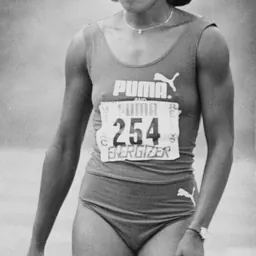
Career Griffith attended CSUN, and was on the track team coached by Bob Kersee. This team, which included Brown and Jeanette Bolden, won the national championship during Griffith's first year of college. In 1983, Griffith graduated from UCLA with her bachelor's degree in psychology. In the next year, she qualified for the Olympics in the 200-meter distance with the second-fastest time at the United States Olympic trials, held in Los Angeles. Evelyn Ashford, another UCLA alumna and early favorite to medal, dropped out of the 200-meter due to injury. She did not compete at the 1985 U.S. National Championship. That same year, she returned to working at a bank and styled hair and nails in her spare time. Four months later, at the 1987 World Championships in Rome, Griffith Joyner finished second in the 200-meter sprint. Her success during the 1987 season resulted in being ranked second in Track and Field News' 1987 world rankings. She ran the 100 meters in 10.96 seconds at the 1987 Cologne Grand Prix Track and Field Meet, a personal best but the mark was not even in the top 40 of all time. A week before the trials she ran a tune-up race in 10.99 in Santa Monica.
In the first race of the quarterfinals of the U.S. Olympic trials, she stunned her colleagues when she sprinted 100 meters in 10.49 seconds, a new world record by a margin of 0.27s over the previous record held by Evelyn Ashford.
The 100-meter record was by far the largest improvement in the world record time since the advent of electronic timing, and still stands. This extraordinary result raised the possibility of a technical malfunction with the wind gauge which read at ±0.0 m/s—a reading at odds with the windy conditions on the day, with high wind speeds being recorded in all other sprints before and after this race as well as the parallel long jump runway at the time of the Griffith Joyner performance. All scientific studies commissioned by the IAAF and independent organizations have since found there was an illegal tailwind of between +5.0 m/s and +7.0 m/s at the time. The IAAF has not annulled the result, but since 1997 the International Athletics Annual of the Association of Track and Field Statisticians has listed it as "probably strongly wind assisted, but recognized as a world record." The fastest non-wind-assisted performance would then be Griffith Joyner's 10.61s in the final the next day. This mark was equaled by Elaine Thompson-Herah in the 2020 Olympic Final before being surpassed by Thompson-Herah at the post-Olympics Eugene Diamond League meeting in August 2021.
Following the Olympic trials, in late July 1988, Griffith Joyner left coach Kersee saying she wanted a coach able to provide more personal attention. Another contributing factor was her unhappiness with the lack of sponsorship and endorsement opportunities. In addition to being her coach, Kersee was Griffith Joyner's manager, as he required all the athletes he coached to use his management services too. This was her first internationally rated 4 × 400 m relay. She left the games having won four Olympic medals, three gold and one silver. At the time, her medal haul was the second most for female track and field athlete in history, behind only Fanny Blankers-Koen who won four gold medals in 1948. She cited her new business opportunities outside of sprinting. Griffith Joyner also won the 1988 World Athletics Award for women.
Comeback attempt and other activities Griffith Joyner's success at the 1988 Olympics led to new opportunities. In the weeks following the Olympics, she earned millions of dollars from endorsement deals, primarily in Japan. She also signed a deal with toy maker LJN Toys for a Barbie-like doll in her likeness. She served as co-chair of President's Council on Physical Fitness between 1993 and 1998. Her reason was that she had already set world marks in both the 100 m and 200 m events, with the 400 m world record being her goal. She trained steadily leading up to the U.S. Olympic trials in June. However, tendinitis in her right leg ended her hopes of becoming a triple-world-record holder.
Style Beyond her running prowess, Griffith Joyner was known for her bold fashion choices. She appeared at the World Championships in 1987 in Rome wearing a hooded speed skating body suit. Before the 1988 track and field season, her best time in the 100-meter sprint was 10.96 seconds (set in 1987). In 1988, she improved that by 0.47 seconds. Her best time before 1988 in the 200 meters was 21.96 seconds (also set in 1987). In 1988, she improved that time by 0.62 seconds to 21.34 seconds. Griffith Joyner's "increased musculature" in 1988 also led to questions about whether she had used performance-enhancing drugs.
In a 1989 story for which he was purportedly paid $25,000, Darrell Robinson, a former teammate of Griffith Joyner, claimed that he sold her 10 mL of growth hormone for $2,000 in 1988. He said Joyner told him that "if you want to make $1 million, you've got to invest some thousands."
Griffith Joyner denied that she had ever used performance-enhancing drugs. Neither Robinson nor Lewis provided evidence for their allegations; in addition, Robinson was shunned by the athletics community, leading to the premature end of his career. Griffith Joyner was repeatedly tested during competition and passed every test.
In late February 1989, four months after the closing ceremony of the 1988 Olympics and just days before the scheduled March 13, 1989 vote by The Athletic Congress (now known as USA Track & Field) that approved the introduction of mandatory random year-round drug testing, claimed that Griffith Joyner was singled out for extra, rigorous drug testing during the 1988 Olympic Games following rumors of steroid use. De Merode told The New York Times that Manfred Donike, who was at that time considered to be the foremost expert on drugs and sports, failed to discover any banned substances during that testing. The World Anti-Doping Agency was created in the 1990s, removing control of drug testing from the IOC and De Merode. De Merode later stated: "We performed all possible and imaginable analyses on her. We never found anything. There should not be the slightest suspicion."
Personal life and death Griffith's nickname among her family was "Dee Dee". Griffith and Joyner had one daughter together, Mary Ruth Joyner, born November 15, 1990.
Griffith Joyner's family's motto was "if you try, try again". This motto motivated Joyner to keep going. She eventually created her own motto: "Believe, Achieve, Succeed". Mary Joyner has described her mother as a calm spirit, stating "when she enter[ed] a room, you would feel this aura of calmness and happiness. She brought everybody together."
Death On September 21, 1998, Griffith Joyner died in her sleep at home in the Canyon Crest neighborhood of Mission Viejo, California, at the age of 38. The unexpected death was investigated by the Orange County Sheriff-Coroner's office, which on September 22 declared the cause of death to be suffocation during a severe epileptic seizure.
Griffith Joyner was found to have had a cavernous hemangioma, a congenital vascular brain abnormality that made her predisposed to seizures. According to a family attorney, she had a tonic–clonic seizure in 1990 and had been treated for seizures in 1993 and 1994. According to the Sheriff-Coroner's office, the only drugs in her system when she died were small amounts of two common over-the-counter drugs, acetaminophen and the antihistamine Benadryl.
Legacy
USA Track & Field inducted her into its Hall of Fame in 1995. In 2000, the 102nd Street School in Los Angeles was renamed Florence Griffith Joyner Elementary School. Griffith Joyner had attended the school as a child. Griffith Joyner was also an artist and painter. Her work has been on display as part the Art of The Olympians (AOTO). She is one of two posthumous members of AOTO, the other being the founder and Olympian, Al Oerter. In Time 2020 list of the most influential women of the past century, she was named Woman of the Year for 1988.
Statistics Olympic Games and trials results Source: Race Venue Date Round Time Wind WR 100 m Indianapolis July 16, 1988 Qualifying heat 10.60w +3.2 100 m Indianapolis July 16, 1988 Quarter-final 10.49 ±0.0 WR 100 m Indianapolis July 17, 1988 Semi-final 10.70 +1.6 100 m Indianapolis July 17, 1988 Final 10.61 +1.2 100 m Seoul September 24, 1988 Qualifying heat 10.88 +1.0 100 m Seoul September 24, 1988 Quarter-final 10.62 +1.0 100 m Seoul September 25, 1988 Semi-final 10.70w +2.6 100 m Seoul September 25, 1988 Final 10.54w +3.0 200 m Indianapolis July 22, 1988 Qualifying heat 21.96 +0.6 200 m Indianapolis July 22, 1988 Quarter-final 21.77 −0.1 200 m Indianapolis July 23, 1988 Semi-final 21.90w +2.4 200 m Indianapolis July 23, 1988 Final 21.85 +1.3 200 m Seoul September 28, 1988 Qualifying heat 22.51 200 m Seoul September 28, 1988 Quarter-final 21.76 +0.7 200 m Seoul September 29, 1988 Semi-final 21.56 +1.7 WR 200 m Seoul September 29, 1988 Final 21.34 +1.3 WR 100 m relay ( 4 × 100 m relay ) Seoul October 1, 1988 Semi-Final (team time 42.12) 100 m relay ( 4 × 100 m relay ) Seoul October 1, 1988 Final (team time 41.98) 400 m relay split ( 4 × 400 m relay ) Seoul October 1, 1988 Final 48.08(team time 3:15.51)
International competitions
Season's bests Year 100 meters 200 meters 400 meters 1982 11.12 22.39 — 1983 11.06 22.23 50.94 1984 10.99 22.04 — 1985 11.00 22.50 50.89 1986 11.42 23.51 — 1987 10.96 21.96 — 1988 10.4921.34 52.50
Don’t just read it —
keep it.
Full-length biographies made to live with: read them, listen on the way to work, watch them tonight.
- E-book
- Audio
- Video
Instant download · yours to keep · every purchase keeps this site free
Important facts
People in Florence Griffith Joyner's life
Named in this biography and alive at the same time







Related people
Same field, nearest in time


Contemporaries
People whose lives overlapped Florence Griffith Joyner's

Frequently asked questions
Who was Florence Griffith Joyner?
American track and field athlete (1959-1998)
When was Florence Griffith Joyner born?
Florence Griffith Joyner was born on 21 December 1959 in Los Angeles.
When did Florence Griffith Joyner die?
Florence Griffith Joyner died on 21 September 1998 in Mission Viejo.
What was Florence Griffith Joyner's occupation?
Florence Griffith Joyner was a sprinter, athletics competitor and athlete.
What nationality was Florence Griffith Joyner?
Florence Griffith Joyner was American.
Sources & further reading
· Wikipedia: Florence Griffith Joyner
· DBpedia: Florence Griffith Joyner
Cite this page
APA: Biography.guide. (2026). Florence Griffith Joyner. https://biography.guide/florence-griffith-joyner/
MLA: "Florence Griffith Joyner." Biography.guide, https://biography.guide/florence-griffith-joyner/.
Chicago: "Florence Griffith Joyner." Biography.guide. https://biography.guide/florence-griffith-joyner/.
Data last updated: 2026-09-20 · Spot an error? Report a correction.
Page generated 2026-09-27 05:30 UTC