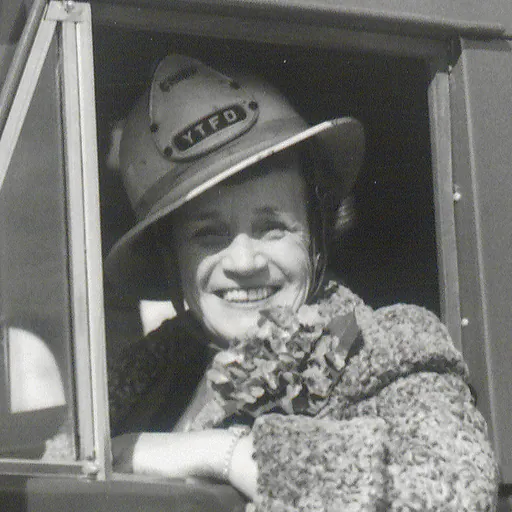
Florence Gell
Canadian civic leader
About Florence Gell
Lived 1906 – 2001 (aged 94). Florence Gell was a Canadian community leader.
Florence Ellis Gell (hard , , née Bailey, 1906–2001) was a prominent civic leader and a well-regarded municipal politician in the former City of York, Ontario, Canada. Gell was known to be a very active member of her community and was the first woman to serve in a number of public positions. She received local and provincial honours for her extensive public service, including York's Citizen of the Decade award.
Background Florence Gell was born in 1906 to Annie Reed and George Arthur Bailey in Lachute Mills, Quebec. She moved with her family at a young age to Sault Ste. Marie, Ontario, where she lived until 1919. Gell was living independently of her parents and was in full-time employment in Toronto, Ontario, by late 1920. She married George William Gell in 1930 in Toronto before moving to the Lambton Park neighbourhood of York in 1932, where they had two sons, Robert (1937) and John (1940). George Gell served with the Royal Canadian Air Force and was killed in Germany in April 1945. she was elected Chair of the York Board of Education (Jan 1953) She was the first woman to hold each of the positions of York Board Chair, Municipal Councillor, and Deputy Reeve, as well as the only woman on the York Council during her thirteen-year tenure.
Florence Gell inspired Gayle Christie to enter York politics. Gell was Christie's heroine. Christie followed in Gell's political footsteps and was elected Mayor of York (1978). Gell was also an important inspiration to Frances Nunziata, who was also elected Mayor of York (1994). Christie and Nunziata were the only women to be elected Mayor of York, which included holders of the equivalent position of Reeve on the old Township Council.
Municipal Council of the Township of York During her time (1954–1966) on the York Township Council, Florence Gell was involved in all of its functions: health & welfare, traffic, housing, parks & recreation, library services, finance, planning, etc. She took a hands-on approach to all aspects of her work. Gell commonly engaged in direct, personal consultations with her constituents. She kept a list of every person who phoned her with their concerns.
Gell was a well-regarded representative and was re-elected by large margins . In 1956, the Township Council established at the request of a group of her constituents, the Warren Park Ratepayers' Association.
In her 1964 testimony before an Ontario Royal Commission, Florence Gell strongly supported a system of small civic departments organized by lower-tier municipalities within the greater Municipality of Metropolitan Toronto. She held that smaller municipal departments, under the supervision of local elected representatives, were more efficient and better able to meet local needs.
In September 1965, the Commissioner (head) of the York Parks and Recreation Department accused Gell of repeated interference in its operations, which significantly reduced its efficiency. Many people and community organizations publicly supported the Commissioner, who, along with several other employees, resigned in 1966 over the Gell matter and other administrative obstructions imposed by the York Council.
The controversies surrounding the erection of numerous apartment buildings and the administration of the Parks and Recreation Department contributed to Florence Gell's electoral defeat in December 1966 (see Table below). The Warren Park Ratepayers' Association had actively campaigned against her.
Electoral results
Election 1953 1954 1955 1956 1958 1960 1962 1964 Gell's Share
Candidates
Position
(Source: City of Toronto Archives, York Council Minutes, Fonds 211, Series 646, Files 42–45, 47, 49, 51, & 53. Official election results prefixed in each bound volume.) Re: December 1966 election for the new Borough of York — Gell finished third with 17.9% in a field of five candidates for the two positions of Controller on the Council of the new Borough of York. The respective vote shares were 30.3%, 28.1%, 17.9%, 17.4%, and 6.4%. The Toronto Star reported that Gell was one of two York veterans that had been "swept under in the 'anti-vote' ". The editor of the Weston Times described these two losses as "the greatest surprise" of the York election.
Gell also served on the governing boards of the following organizations: Metropolitan Toronto and Region Conservation Foundation (1973–1990); Northwestern General Hospital (1974–c.1978); Osler School of Nursing (1970–1973); Runnymede Hospital (c.1967–1974+); St. Hilda's Towers Foundation (1987–1992+); St. Hilda's Towers, Inc. (affordable rental housing for seniors, with assisted living services and recreational activities) (1975, then 1980–1994+); York Township (1967 Borough of York) Housing Company (public Beech Hall Apartments for low-income seniors), Director (1954–1967, 1971–1983), President (1957–1967), Vice-President (1976–1983). and Fred Wade (1971)†, Ontario's first Chief Conservation Engineer and Director of its Conservation Branchefn-ua|The purpose of the provincial Conservation Branch was to promote, co-ordinate, direct, and technically guide and advise the locally administered conservation authorities.
In February 1957, Florence Gell was appointed to the Toronto Conservation Authority by the Municipality of Metropolitan Toronto. During her time (1957–1984) at the Conservation Authority, Gell served on its Information and Education Advisory Board, first as Vice-Chair (1957) and then as Chair (1967), prior to becoming the Vice-Chair (1975) and then Chair (1983) of the entire Authority. The latter two positions made her an ex officio member of all advisory boards.
Conservation education Florence Gell's presence on the Information and Education Advisory Board of the Conservation Authority allowed her to play an important role in the establishment and promotion of its conservation school and education field centres. The purpose of these facilities was to develop amongst children and youth an awareness of the natural environment and the need for its protection.
In 1959, while Vice-Chair of the Advisory Board, Florence Gell was Chair of its Conservation Camp School Sub-committee. This sub-committee selected the architect for the proposed Albion Hills Conservation School and approved the plans for submission to the Authority's Executive Committee for final approval.
The direct inspiration for the Albion Hills School was the annual Conservation Camp School organized since 1953 by Blanche Snell, Catherine Scholes, and other staff of York Memorial Collegiate Institute (secondary school) in York Township. Authority staff, led by Kenneth Higgs, instructed the students on conservation matters during the annual tenting trip. Due to limited facilities, the York Camp School comprised only one three-day session each May for one grade-nine class. During 1954–1956, plans were made in the Humber Valley Conservation Authority (amalgamated 1957) for permanent buildings at Albion Hills to permit numerous class visits to an expanded Camp School that operated all year round.
Florence Gell was a school trustee in 1953 and accompanied the class to the York Memorial Camp School. In 1956, Gell was a member of the Humber Valley Conservation Authority where the Albion Hills School was first proposed.
Following a period of fundraising for the project, construction of the Albion Hills Conservation School began in November 1962. Florence Gell continued her involvement in the project and was a frequent visitor to the site during its construction.
The Albion Hills Conservation School opened in September 1963 and was renamed a "Field Centre" in May 1969. In January 1968, the Albion Hills School received the Conservation Education Award of the Ontario Forestry Association. It was the first organization to receive this annual award since the establishment of the honour. In December 1968, the Albion School received the first White Owl Conservation Award for its work in promoting the preservation of the Canadian environment. The annual White Owl Award was sponsored by the General Cigar Company of Imperial Tobacco Canada. This promotion made Gell an ex officio member of the Executive Committee of the Conservation Authority.
The Executive Committee appointed Florence Gell in November 1967 to a special three-person delegation to school boards to present the Authority's plans for the establishment of conservation field centres. The three-person delegation to the boards was repeated with Gell in February 1977 on the subject of "planning, development, and management of outdoor and conservation education programmes".
In December 1968, Florence Gell organized and hosted (with other Authority personnel) an all-day seminar on all aspects of conservation education for 73 representatives from Ontario's 36 conservation authorities. In November 1970, Gell co-hosted (with Walter M. Tovell) a second seminar on conservation education for representatives from the authorities and the Ontario Department of Education. This seminar occurred over three days and had 40 attendees.
During Florence Gell's tenure as Chair of the Information and Education Advisory Board (1967–1975), three additional education field centres were opened: Cold Creek in September 1968, Claremont in March 1970, and Boyd in November 1974. All four of the facilities were very popular and well attended. Their regular education programmes operated at capacity and were booked by area schools well in advance each year.
Gell served on the Management (1969 Conservation Education) Advisory Committee (1963–1973) for these education facilities and was Committee Chair (1964–1969). This dedicated committee within the Advisory Board was discontinued in 1973.
The Village at Black Creek Florence Gell was also active in the promotion and education programme of the Authority's living history museum, The Village at Black Creek, then known as Black Creek Pioneer Village. In May 1967, she was one of the two persons holding the rope that was cut by Ontario Premier John Robarts at the ceremonial official opening of the Village.
Florence Gell was appointed in October 1969 to an ad hoc, four-person sub-committee of the Executive Committee to study the financing of the education programme at Black Creek Village and to request assistance in that regard from the provincial government. This sub-committee was also tasked with approaching the Ontario Minister of Tourism and Information for additional assistance in making the facility better known to tourists. This sub-committee continued to operate into 1970. In November 1971, Gell was one of two co-ordinators appointed by the Executive Committee to form an ad hoc committee of the Historical Sites Advisory Board for the preparation and presentation of a brief to the Minister of Education seeking financial support for the Black Creek Village education programme.
In 1993, the Conservation Authority appointed Florence Gell as Honorary Deputy Reeve of Black Creek Village for a one-year term beginning July 1. She was also named Honorary Reeve for the subsequent year. Since 1974, these honorary officials had presided over various events and ceremonies, including the official opening of new buildings and the annual re-enactment of the militia muster. They also promoted the Village and did walkabouts among the visitors.
Florence Gell Garden Plaque at The Village at Black Creek honouring Florence Gell for her public service with the Conservation Authority.On June 21, 1985, the Conservation Authority unveiled the Florence Gell Garden and plaque on the grounds of Black Creek Village in recognition of Gell's "remarkable contribution to conservation". The attendees at the dedication ceremony included William Foster, Authority Chair; Alan Tonks, Mayor of the City of York; Edward Fulton, MPP and Authority member; and The Honourable Pauline Mills McGibbon, former Lieutenant Governor of Ontario.
Conservation Foundation The Metropolitan Toronto and Region Conservation Foundation was incorporated in April 1961 as a charitable organization to raise and hold funds in support of the work of the Conservation Authority. Its name was changed to The Conservation Foundation of Greater Toronto in June 1990. The impetus and first major project of the Foundation was the Albion Hills Conservation School.
The Authority appointed Florence Gell to the Conservation Foundation in 1973. Gell served as a Foundation Director (1973–1990), President (1985–1988), and Deputy Chair (1988–1990). She retired from the organization in October 1990.
Ontario Traffic Conference The Ontario Traffic Conference (OTC) was formed in October 1950 and received its provincial charter as a not-for-profit corporation in June 1956. It changed its name to Ontario Traffic Council in June 2010.
The OTC is a voluntary association of Ontario municipalities, municipal organizations (transit, planning, parking), police services, transportation services, and other organizations and people with an interest in traffic matters. The organization provides information, education, training, and symposiums on all traffic-related topics, including engineering, planning, safety, and law enforcement.
In April 1961, the delegates to the annual convention of the OTC elected Florence Gell as a director on its governing board, where she sat until June 1969. Gell was promoted within the board in May 1966 to the position of Vice-President and then in April 1967 to President for the standard one-year term. She was the first woman to serve in each of these three positions at a time when there was very little representation by women at the annual conventions (e.g., only three of 241 registered delegates in 1965 and only a reported one of 250 delegates in 1960).
Since 1950, member-volunteers had run the OTC out of their homes and workplaces, with a volunteer Secretary-Treasurer responsible for its day-to-day operations. In January 1965, the group's first dedicated physical office with a single paid employee (a clerk) was opened following the October 1964 resignation of the incumbent Secretary-Treasurer due to work commitments.
During Florence Gell's term as OTC President, the annual convention was reorganized to separate the educational activities from the suppliers' exhibits. The main sessions comprised only workshops, with a greater emphasis on audience participation, an earlier adjournment for the day, and no refreshment breaks. The exhibits were moved to suites for viewing after the adjournments.
Florence Gell was named an Honorary Life Member of the Ontario Traffic Conference in the early 1970s for her work with the organization.
Humber College's original campuses were located in the Borough of Etobicoke, which bordered the Borough of York. In 1969, Florence Gell strongly advocated for the establishment of a campus in York. In September 1970, the college opened its Keelesdale Campus in the Kodak Heights industrial area of York's Mount Dennis neighbourhood, immediately west of its Keelesdale/Silverthorn neighbourhood. Gell was the Board's representative to this facility, which closed at the end of 1995 due to a lack of land and funding for necessary upgrades.
During her time on the Humber Board, Florence Gell served as Chair of its Program Committee. This Committee evaluated existing and proposed educational programs and changes at the college. A similar committee operated at the Council of Regents to coordinate programs across the college system.
Gell also served on the Social Services Advisory Committee, which advised the Board on the curricula of the social service programs offered at the college. This Committee included representatives from social organizations, such as Big Brothers, Catholic Children's Aid Society, Lakeshore Psychiatric Hospital, Ontario Welfare Council, Toronto Social Planning Council, Veteran's Affairs Department, and the YMCA. Members of the committee also included Humber staff and students.
In 1979, a group of women affiliated with Humber College established the Florence Gell Award, which was given annually to one or more female students for high performance in the college's journalism program.
Community work
Florence Gell was active in all aspects of her community. At various times before, during, and after her political career, Gell's community and public positions included the following: Vestry Clerk, Advisory Board officer, Toronto Synod lay delegate, and a principal fundraiser for The Church of the Advent (Anglican); Rationing Officer during World War II; Member and President of the Lambton Park Home and School Association; Corresponding Secretary of the York Community Council; Chair, then Corresponding Secretary, of the York Advisory Recreation Committee; Director of the Toronto and District Urban School Trustees' Association; Returning Officer and Clerk for provincial elections; Chair of the Fireworks Committee for the annual community Victoria Day celebration; Senior volunteer at St. Hilda's Towers;
For her extensive community and public service, Florence Gell was named York's first Citizen of the Decade in 1978. Likewise, she received the Ontario Bicentennial Medal in 1984 and the Ontario Senior Achievement Award in 1989.
Advisory Recreation Committee for the Township of York As a private citizen, Florence Gell was very active in the organization of recreational activities in the Township of York. In February 1946, the Township Council appointed Gell to its new citizen's Advisory Recreation Committee. This first committee of volunteers was established by a resolution of the council and was discontinued in January 1947. It was re-established the following May under a March by-law. Gell's appointment to the new Committee of volunteers was rejected by the Council in a five to two vote. She was then reinstated in January 1948 by a unanimous vote. Gell remained a citizen-member through December 1953, after which she joined the Council itself. Elected members of the Council sat on the committee from January 1949 onwards.
The purpose of the Advisory Recreation Committee was to advise and assist the Township Council and its Director of Recreation in the administration of recreational activities and to encourage community participation. The actions of the Committee dealt with a broad range of items, such as the following: Organization of Township sports days, annual fairs, conferences, and recognition dinners for athletes and sports organizers; Specific recommendations regarding
Florence Gell was Chair of the Advisory Recreation Committee in 1946–1947 and then Corresponding Secretary in 1949–1953. As Secretary, Gell received an honorarium from the Township, unlike all other positions on the committee.
In February 1948, Florence Gell was a co-presenter to the York Township Council of a joint proposal by the Advisory Committee and the York Community Council (of which Gell was also a member) for the creation of a Recreation Commission. The Township Council rejected the proposal since it required authorizing legislation by the province of Ontario. If established, the commission would have been a separate legal entity with members from the Township Council and other interested groups. It would have administered all public recreational facilities and services in the Township in place of a municipal recreation department.
The Church of the Advent (Anglican), Pritchard Avenue, York
A member since at least 1941, Florence Gell's most active period in The Church of the Advent began in February 1967 when she joined the parish's Advisory Board. This body, which usually met monthly, organized activities in the parish and provided assistance and recommendations to its Rector (priest-in-charge) and Churchwardens. Gell remained on the Board until February 1989, with an eight-month gap from June 1986.
In 1968, fundraising efforts intensified with the introduction of the Church's first two flea markets. More work was also done to raise funds via the Victoria Day fireworks (see below). In 1970, a more elaborate bazaar, the Avenue of Boutiques, replaced the autumn flea market. Florence Gell chaired the organizing committees for these events, which produced substantial revenue for the Church (see below).
The additional revenue from the fundraising paid off the demand note in 1970 and allowed capital improvements to Advent's properties: church, hall, and rectory. These improvements included the following items: 1969 – Funds raised by the Fireworks Committee paid for new eavestroughs on the church, an external coat of paint, and the rehabilitation of the outdoor bulletin board. 1971 – The revenue from the fireworks went to replacing the church's leaky roof. 1973 onwards – The substantial monies raised by the annual Avenue of Boutiques were deposited in a fund for a new heating system in the church and hall, which was installed in 1975. 1974 – Money raised by the sale of advertisements in the Advent Bulletin paid for the refurbishment of the Rector's study in the hall. 1976 – Bulletin advertising revenue paid for new cupboards, additional carpeting, and repairs to the church bell and furnace room. 1977 – Bulletin revenue paid for the complete renovation of the washrooms in the hall.
Following Florence Gell's death in 2001, The Church of the Advent set up a fund for scholastic bursaries in her memory, the first five of which were given out in 2005.
The details of the event varied over the years. It typically began in the afternoon with a parade north along a major street (Jane St.) to Smythe Park from the office (near Pritchard Ave.) of the sponsor of York's Smythe Park baseball league for youth. This parade was followed by baseball matches and by competitions among children for the decoration of bicycles and doll carriages. The evening entertainments in Smythe Park included performances by local majorettes, Scottish dancers, square dancers, choirs, and musical groups. These community performers included the Optimist Yorkettes, York Majorettes & Fire Drill Baton, York Lions Steel Band, Clans of York Pipe Band, Optimist Lancers Drum & Bugle Corps, Centennial Irish Accordion Band, and rock bands.
Advent's fundraising Net revenues from Bulletin and fundraising projects in The Church of the Advent, 1970–1974 Project FleaMarket Socials Avenue ofBoutiques BulletinBalance Fireworks Total 1970 - Net Amount $640.31 $375.75 $1101.82 $432.41 $1431.13 $3981.42 Share of Total Revenue 3.83% 2.25% 6.59% 2.59% 8.56% 23.82%Total revenue for 1970 from all sources = $16713.79 1971 - Net Amount $541.64 $400.99 $1124.22† $592.91 $1340.70 $4000.46 Share of Total Revenue 3.19% 2.36% 6.62% 3.49% 7.89% 23.55%Total revenue for 1971 from all sources = $16986.05 1972 - Net Amount $25.00 $311.49 $1751.94 not stated $1424.13 $3512.56 Share of Total Revenue 0.15% 1.83% 10.28% — 8.36% 20.61%Total revenue for 1972 from all sources = $17041.27 1973 - Net Amount $766.75 $89.23 $2058.45 $1366.93 discontinued $4281.36 Share of Total Revenue 4.06% 0.47% 10.90% 7.24% — 22.66%Total revenue for 1973 from all sources = $18890.55 1974 - Net Amount $462.51 $670.16 $2711.50 $637.75 — $4481.92 Share of Total Revenue 2.01% 2.91% 11.77% 2.77% — 19.46%Total revenue for 1974 from all sources = $23034.88† Note: In the 1972 financial statement, this 1971 figure is stated for comparison purposes as $1213.45. (Source: Anglican Diocese of Toronto Archives, Accession 2016–09, Box 2, Advent's Vestry Reports for 1970 to 1974.)
Honours
Florence Gell received a number of local and provincial honours for her public and community work. These recognitions included the following: Honorary Life Member of the Ontario Traffic Conference (early 1970s); The Ontario Bicentennial Medal (1984); Ontario Senior Achievement Award (1989); The Florence Gell Award (1979) at Humber College; Note: Contrary to some sources, Florence Gell was not named York's Citizen of the Year in 1981. That honour went to Nadia De Franco.
Don’t just read it —
keep it.
Full-length biographies made to live with: read them, listen on the way to work, watch them tonight.
- E-book
- Audio
- Video
Instant download · yours to keep · every purchase keeps this site free
Important facts
People in Florence Gell's life
Named in this biography and alive at the same time






Related people
Same field, nearest in time




Contemporaries
People whose lives overlapped Florence Gell's


Frequently asked questions
Who was Florence Gell?
Canadian civic leader
When was Florence Gell born?
Florence Gell was born on 17 September 1906.
When did Florence Gell die?
Florence Gell died on 20 March 2001.
What was Florence Gell's occupation?
Florence Gell was a community leader.
What nationality was Florence Gell?
Florence Gell was Canadian.
Sources & further reading
Cite this page
APA: Biography.guide. (2026). Florence Gell. https://biography.guide/florence-gell/
MLA: "Florence Gell." Biography.guide, https://biography.guide/florence-gell/.
Chicago: "Florence Gell." Biography.guide. https://biography.guide/florence-gell/.
Data last updated: 2026-09-24 · Spot an error? Report a correction.
Portrait: Wikimedia Commons · author & licence
Page generated 2026-09-27 05:08 UTC