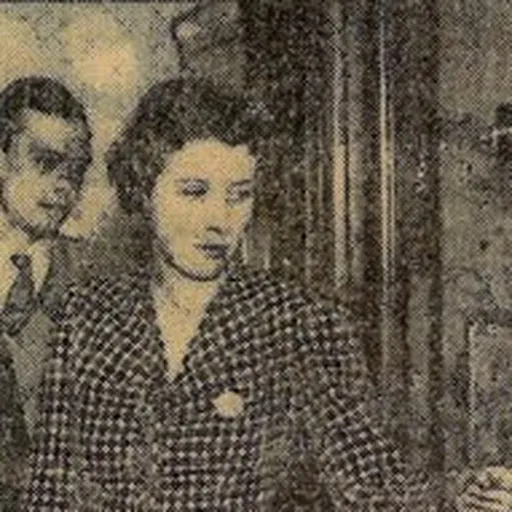
About Florence Bell
Lived 1913 – 2000 (aged 87). Florence Bell was a British crystallographer, biochemist and biophysicist.
Florence Ogilvy Bell (1 May 1913 – 23 November 2000
Early life
Florence Ogilvy Bell was born at 47 Hanover Road, Brondesbury Park, London, the second daughter of Thomas Bell and his wife, Annie Mary Lucas. Her father was a photographer and later advertising manager who had been born in Allendale, Northumberland, and later he moved to Greycotes, Ambleside. Florence grew up in London and attended Haberdashers' Aske Girls School in Acton, where she was head girl. Whilst a student at Cambridge, she was taught how to use x-ray crystallography to study biological molecules by John Desmond Bernal. Her initial work was on the structure of protein multilayers, but after Leeds received samples of highly purified DNA, Astbury directed her to study DNA as the second part of her Ph.D. thesis.
Career Astbury's original appointment at the University of Leeds was to study textile physics, where he identified a change in keratin inside wool fibres from alpha to beta form on stretching. Bell came up with a method to stretch out the fibers to make dried films of purified DNA, with which she took x-ray diffraction photographs that were clearer than previous work. She recognised that the "beginnings of life are clearly associated with the interaction of proteins and nucleic acids". Bell and Astbury published an X-ray study on DNA in 1938, describing the nucleotides as a "Pile of Pennies". Astbury presented their work at the Cold Spring Harbor Laboratory. At the time, they were unaware that DNA can change conformation from A to B-form with humidity, and as a result their photographs are more blurry than the later Photo 51 x-ray image Astbury greatly admired Bell's willingness to challenge his ideas, referring to her as his "vox diabolica" (Devil's Advocate). She died in Hereford It is also worth noting that this work was done at a time when most scientists believed that proteins were the genetic material and that DNA was just a structural component composed of a monotonous repeat of bases.
Bell's notebook is held in the University of Leeds archives. She is included in the Oxford Dictionary of National Biography.
A seminar room was named in Bell's honor in the recently opened Sir William Henry Bragg Building on the campus of University of Leeds in 2022.
Bell's name is one of those featured on the sculpture Ribbons, unveiled in 2024.
Don’t just read it —
keep it.
Full-length biographies made to live with: read them, listen on the way to work, watch them tonight.
- E-book
- Audio
- Video
Instant download · yours to keep · every purchase keeps this site free
Important facts
People in Florence Bell's life
Named in this biography and alive at the same time





Related people
Same field, nearest in time





Contemporaries
People whose lives overlapped Florence Bell's




Frequently asked questions
Who was Florence Bell?
British X-ray crystallographer (1913-2000)
When was Florence Bell born?
Florence Bell was born on 1 May 1913 in London.
When did Florence Bell die?
Florence Bell died on 23 November 2000 in Hereford.
What was Florence Bell's occupation?
Florence Bell was a crystallographer, biochemist and biophysicist.
What nationality was Florence Bell?
Florence Bell was British.
Sources & further reading
· DBpedia: Florence Bell (scientist)
Cite this page
APA: Biography.guide. (2026). Florence Bell. https://biography.guide/florence-bell/
MLA: "Florence Bell." Biography.guide, https://biography.guide/florence-bell/.
Chicago: "Florence Bell." Biography.guide. https://biography.guide/florence-bell/.
Data last updated: 2026-09-22 · Spot an error? Report a correction.
Portrait: Wikimedia Commons · author & licence
Page generated 2026-09-27 05:01 UTC