
About Filippo Parodi
Lived 1630 – 1702 (aged 71–72). Filippo Parodi was a sculptor and wood carver.
Filippo Parodi (1630 – 22 July 1702) was an Italian sculptor of the Baroque period, "Genoa's first and greatest native Baroque sculptor".
Biography Filippo Parodi was born in Genoa into a family of sculptors. His father, Giovanni Battista, was a woodcarver. Filippo trained in the family workshop. Having developed his facility with wood, he then transferred his mastery to marble in the 1670s. He also worked in stucco.
His two extended sojourns in Rome refined his style; he joined the studio of Bernini as an assistant (1655–1661), although he appears to have been influenced by Algardi and his pupil Ercole Ferrata. Under Bernini, Parodi learned to exploit the sensuous and tactile possibilities of the marble to enhance the emotional impact. The influence of the Roman Baroque style permeates his early work. Later on returning to Genoa, he met the French Baroque sculptor Pierre Puget, who stayed in Genoa from 1661–1666. Parodi developed a large studio to handle a large number of commissions.
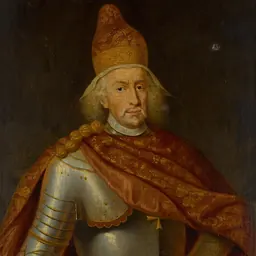
In Venice, he completed the elaborate funeral Monument of Bishop Francesco Morosini (1678), in San Nicolò da Tolentino.
For Johann Adam Andreas I von Liechtenstein of Vienna, he produced two allegorical busts: Vice and Virtue, which remain in the Liechtenstein collection, Vienna. The expressive bust of Vice has a specific Bernini source in Bernini's Anima dannata.
His sculptures commissioned by Eugenio Durazzo in 1679 during the renovation of the Palazzo Balbi Durazzo, Genoa, remain in situ (the present Palazzo Reale); they are a sentimental Christ at the Column for the chapel and a set of four mythological figures from Ovid's Metamorphoses (Venus, Clytie, Adonis, and Hyacinth) for the garden. The statues are emotive and often witty reworkings of sculptures by Bernini.
In 1689, Parodi was in charge of the architectural, decorative and sculptural design of the Cappella della Pietà in the abbey church of Santa Giustina. The ceiling is adorned with stucco angels. In the center is the Pietà, surrounded by statues of Mary Magdalene and John the Apostle. In 1691 he and his studio were responsible for the six white marble sculptures of saints and the Glory of Saint Anthony (1689–97) in the polychrome marble setting of the Cappella del Tesoro ("Chapel of the Treasure") at the Basilica of Saint Anthony of Padua. The cornice is crowded with celebrative angels by his student, Pietro Roncaioli, Winter from a set of Seasons (Cleveland Museum of Art).
Don’t just read it —
keep it.
Full-length biographies made to live with: read them, listen on the way to work, watch them tonight.
- E-book
- Audio
- Video
Instant download · yours to keep · every purchase keeps this site free
Important facts
People in Filippo Parodi's life
Named in this biography and alive at the same time

Related people
Same field, nearest in time


Contemporaries
People whose lives overlapped Filippo Parodi's




Frequently asked questions
Who was Filippo Parodi?
Italian artist (1630-1702)
When was Filippo Parodi born?
Filippo Parodi was born in 1630 in Genoa.
When did Filippo Parodi die?
Filippo Parodi died on 22 July 1702 in Genoa.
What was Filippo Parodi's occupation?
Filippo Parodi was a sculptor and wood carver.
Sources & further reading
Cite this page
APA: Biography.guide. (2026). Filippo Parodi. https://biography.guide/filippo-parodi/
MLA: "Filippo Parodi." Biography.guide, https://biography.guide/filippo-parodi/.
Chicago: "Filippo Parodi." Biography.guide. https://biography.guide/filippo-parodi/.
Data last updated: 2026-09-20 · Spot an error? Report a correction.
Page generated 2026-09-27 05:27 UTC