
About Fernand Pouillon
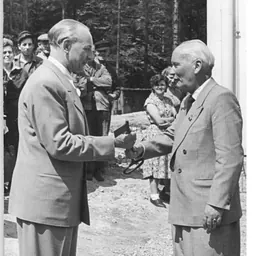
Lived 1912 – 1986 (aged 74). Fernand Pouillon was a French architect, entrepreneur and writer.
Fernand Pouillon (14 May 1912 – 24 July 1986) was a French architect, urban planner, building contractor and writer.
Pouillon was one of the most active and influential post-World War II architects and builders in France. He is remembered for his use of ‘noble’ building materials like stone, his integration of all phases of the building process, his inexpensive and efficient building techniques and his harmonious juxtaposition of forms. He was a humanist, as well as an architect. :6 His stated goal was to meet human needs, and especially, those of middle-class and poorer families who faced severe shortages of adequate housing in the post-War period.
Due to his success and personality, he attracted the jealousy and ill-will of many. His life included time in and escape from prison. Some architectural critics have speculated that he will be remembered as one of the great French architects of the 20th century.
In 2025, Bloomberg News showcased Pouillon's architectural work, especially the post-World War II housing estates in the Old Port of Marseille, where the historic urban fabric had been destroyed. Bloomberg News summarizes Pouillon as "an architect, painter, communist, novelist and convicted fraudster".
Early life, early career and architectural degree Pouillon was born 14 May 1912 in Cancon, Lot-et-Garonne, the son of Alexis Pouillon, a civil engineer and entrepreneur. The family was in this region because Alexis Pouillon was working on a railroad project. The family moved back to Marseille in 1919. :206
At the age of 15, Pouillon attended the School of Beaux-Arts of Marseille, where, for one year, he studied drawing, sculpture and architecture (he did not obtain an official architecture degree until the Vichy period). He then moved to Paris, where he worked on both the construction and commercial sides of the building sector for several years. At the age of 22, he built his first project (le Palais Albert I) in Aix-en-Provence (at the time, an architecture degree was not required for such a role). He started with centres for refugees and prisoners of war — projects with very short deadlines. :13-14 After a struggle, Pouillon and another architect (André Devin) were asked to take over the project under the supervision of August Perret. Perret was named Chief Architect of the reconstruction process because it was thought that his authority and stature would calm tensions. This disagreement between Leconte and Pouillon was to be the first of many that pitted Pouillon against some of the major architects of his time.
During this time, Pouillon perfected, along with his partners in the building trades, a construction system based largely on natural materials and close coordination between builders, artisans and artists. The system involved designs that (in addition to responding to human wants and needs) could be efficiently built using materials and technical components that had been standardised in advance with project suppliers. He also developed and used a ‘co-ordinating office’ charged with project design and with regulating the activities of the various actors on the construction site. and Iran. His firms employed dozens of architects. He earned a great deal of money and showed it—at one point, he owned a Bentley, an Alfa Romeo, two chateaux, a house in Algiers, a mansion in Paris and a yacht.
These were exceptional projects, creating thousands of (often lower-income) apartments, built with stone and featuring such amenities as courtyards, water features, gardens and art work. In pursuing these projects, Pouillon tended to adopt the same mix of roles he knew from his early career (e.g, he was both project architect, builder and developer). This, however, violated what were recently developed professional ethics in France, as it was thought to create conflicts of interest.
While in prison he wrote Les Pierres Sauvages (The Stones of the Abbey), a book in which he imagines the medieval construction of Le Thoronet Abbey. The novel won a prestigious literary award (Les Deux Magots).
He died in the Château de Belcastel on 24 July 1986. It is said that he had requested that his final resting place not show his name.
Gallery
Don’t just read it —
keep it.
Full-length biographies made to live with: read them, listen on the way to work, watch them tonight.
- E-book
- Audio
- Video
Instant download · yours to keep · every purchase keeps this site free
Important facts
Related people
Same field, nearest in time

Contemporaries
People whose lives overlapped Fernand Pouillon's






Frequently asked questions
Who was Fernand Pouillon?
French architect (1912–1986)
When was Fernand Pouillon born?
Fernand Pouillon was born on 14 May 1912 in Cancon.
When did Fernand Pouillon die?
Fernand Pouillon died on 24 July 1986 in Belcastel.
What was Fernand Pouillon's occupation?
Fernand Pouillon was an architect, entrepreneur and writer.
What nationality was Fernand Pouillon?
Fernand Pouillon was French.
Sources & further reading
Cite this page
APA: Biography.guide. (2026). Fernand Pouillon. https://biography.guide/fernand-pouillon/
MLA: "Fernand Pouillon." Biography.guide, https://biography.guide/fernand-pouillon/.
Chicago: "Fernand Pouillon." Biography.guide. https://biography.guide/fernand-pouillon/.
Data last updated: 2026-09-20 · Spot an error? Report a correction.
Page generated 2026-09-27 05:00 UTC