
About Felix Manalo
Lived 1886 – 1963 (aged 76). Felix Manalo was a Filipino religious leader and evangelist.
Felix Manalo (born Félix Ysagun y Manalo; May 10, 1886 – April 12, 1963), also known as Ka Felix, was a Filipino minister who founded Iglesia ni Cristo (INC), a Christian new religious movement in the Philippines officially registered in 1914 (as Iglesia ni Kristo). Manalo is believed by INC adherents to be the last prophet of God in the final days sent to reestablish the church that Jesus first founded, which they claimed to have fallen into apostasy following the deaths of the apostles. He served as the church's first Executive Minister until his death in 1963, and was succeeded by his son, Eraño Manalo.
Born in a devout Catholic family, Manalo began questioning Catholic teachings during the Philippine Revolution in the 1890s, ultimately converting first as a Methodist in 1904, then as a Seventh-day Adventist in 1911 before he began preaching what was to become the doctrine of the Iglesia ni Cristo at a neighborhood in Santa Ana, Manila, which he formally registered to the Philippine government on July 27, 1914 as a religious corporation. He was seen as the "angel ascending from the East" (as mentioned in Revelation 7) by his early followers. During his tenure as Executive Minister, he oversaw the church's early growth and rapid expansion following the Japanese occupation of the country during World War II. By the 1950s, Manalo's health had deteriorated, leaving most of his official church duties to his son Eraño. He died in 1963.
Biography
Cover of the August 1939 issue of the Pasugo, the official publication of the Iglesia ni Cristo, featuring an artist's depiction of the "angel from the East" which INC members believe to be Manalo himself.
Manalo was born as Felix Ysagun in Barrio Calzada, Tipas, Taguig, Manila province (now Calzada, Taguig, Metro Manila) on May 10, 1886, the eldest child of Mariano Ysagun y Villanueva and Bonifacia Manalo y Cruz. While records of his baptismal was lost, because parish records would only go back as early as June 1886, it is believed that he was christened on May 18, the feast day of Felix of Cantalice, most likely his namesake given the common practice of Catholic Filipino families during that period to name their child after saints whose feast fall on the date of birth or baptismal. At the age of seven, Manalo was said to have attended classes under a certain "Maestro Cario" in Manila. His studies were interrupted by the Philippine Revolution in 1896, prompting him not to pursue further formal education, and turn to farming and hatmaking instead.
Manalo began questioning Catholic teachings by the late 1890s. He resided in Manila at his uncle Mariano Borja, a Catholic priest assigned to a local parish in Sampaloc. During this period, Manalo started becoming disillusioned with mainstream Catholic faith and began believing in colorumism, a syncretism of Christian and animist beliefs popular among Filipino peasants during the revolution, making secret trips to Mount Banahaw and Mount San Cristobal in southern Luzon. During the early years of the American period, Manalo became interested in Protestant doctrine that entered the country through American missionaries. In 1904, he became a Methodist, After being antagonized by fellow Adventists for his colorum past, and being reprimanded for his elopement with his future wife (they were married in a different church), Manalo left Adventism in 1913, and associated himself with atheist and agnostic peers. Frustrated with the doctrines of foreign denominations, he soon began personally studying the Bible which culminated in November 1913 when he concluded that a fresh examination of the Bible is needed from a non-Western perspective.
Iglesia ni Cristo
Built in 1937, the former chapel of the congregation of Punta in Santa Ana, Manila is now an INC museum. Notable is the fence design featuring the letters "INK", the abbreviation of the church's original registered name Iglesia ni Kristo.
Completed in 1954, the Iglesia Ni Cristo (INC) Lokal ng Cubao in Quezon City is the first major chapel designed by Filipino Architect Carlos A. Santos-Viola for the INC. It is believed to have inspired future designs of INC chapels all over the Philippines.
In November 1913, Manalo began a three-day fast and meditation at a friend's house in Pasay, writing his core doctrine. while the Amended Articles of Incorporation filed in 1948 indicated the registration date is June 27, 1914 (as Iglesia ni Cristo or INC). The Amended Articles of Incorporation filed in 1973 already indicated the registration date of the church as July 27, 1914. The last mentioned date is carried over by the SEC in its website. This date of registration (July 27) is currently commemorated by the church as its anniversary date. the date now officially acknowledged by the INC as its foundation date. Expansion followed as the INC started building congregations in the provinces as early as 1916. (During Manalo's early ministry, wearing of jewelry, and engagement in vices such as smoking and drinking alcohol were banned.) Drinking soft drinks were also prohibited by Manalo. Later on, as the INC began to attract more affluent members, and enforcing abstinence on new converts proved more difficult, church doctrine softened on these prohibitions. Manalo and the ministers who agree with him defended the change in doctrine by saying that these practices are not explicitly prohibited in the Bible. By 1936, the INC had 85,000 recruits. This figure grew to 200,000 by 1954. During World War II, Manalo was offered by the Japanese to lead the all-Filipino Evangelical Church of the Philippines (福音教会). His refusal led to Japanese suspicion and surveillance, to the point that Manalo acceded to the Japanese demand to have Prudencio Vasquez, division minister of Nueva Ecija and later of Bicol, as the Executive Minister of the Iglesia ni Cristo. This was formalized through a circular issued on June 29, 1942. Manalo resumed to be the Executive Minister after the war. Meanwhile, the INC's first concrete chapel was built in Sampaloc, Manila, in 1948. Adherents fleeing Manila, where the Japanese forces were concentrated during the Second World War, were used for evangelization. The 1960 Census in the Philippines, however, showed adherents totaling to 270,104. By 1955, the overall educational attainment of INC members had also improved, with an estimated 35 percent of its total membership being considered literate. This is, however, lower than the national literacy rate of 75 percent in the same year. He died in the early hours of April 12 at the age of 76. Leadership of the church was passed two weeks later to his son, Eraño, who was chosen unanimously by the district ministers as his successor in 1953. His remains were viewed by mourners in San Francisco del Monte, Quezon City. On April 23, he was buried at what was then the central office of the Iglesia ni Cristo in San Juan, Rizal. The local police estimated the crowd at the funeral procession to have been two million, and the rite took five hours.
Legacy
Completed on July 27, 1962, the Iglesia Ni Cristo (INC) Lokal ng San Francisco del Monte, also known locally as the Lokal ng Frisco, is one of the major chapels designed by Architect Carlos A. Santos-Viola for the INC. It was also one of the last chapels dedicated during the lifetime of INC founder Felix Manalo, later serving as the site of his funeral in 1963. Prior to the construction of the current structure of the INC Lokal ng Tondo (1967) and the INC Lokal ng Templo Central (1984), the INC Lokal ng Frisco was the largest INC chapel in terms of seating capacity at 3,200.
Historical marker at Manalo's birth place in Calzada, Taguig.
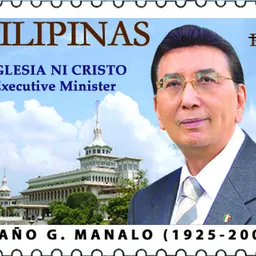
Coinciding with the fifth (5th) anniversary celebration of the INC, the ministers of the Iglesia ni Cristo 1901 (Christian Mission) honored him on December 25, 1918, as an outstanding evangelist. On the same year, the Philippine government declared July 27 of every year as "Iglesia ni Cristo Day". On May 10, 2014, coinciding with his 128th birth anniversary, Philpost controversially released a commemorative stamp celebrating the 100th year of the church's registration in the Philippines, which featured a portrait of him against the backdrop of the INC Central Temple. Philpost was sued for allegedly using public funds to support religious groups, reaching the Supreme Court of the Philippines but was dismissed, with the court holding that the stamps acknowledged the Iglesia ni Cristo but did not sponsor it.
A significant number of roads and streets were named after Felix Manalo or variants of his name in the following areas: Felix Manalo, Santa Ana, Manila (vicinity of the first INC chapel in Punta) Felix Manalo, Quezon City (connected to Aurora Boulevard) Felix Y. Manalo, Cainta (connected to Sumulong Highway) F. Y. Manalo, Las Piñas (connected to Marcos Alvarez Avenue Extension) F. Manalo, San Juan, Metro Manila (location of Manalo's burial site) F. Manalo, Taguig (vicinity of Manalo's National Historical Landmark) F. Manalo, Pasig (vicinity of INC Lokal ng Pasig) F. Manalo Bridge, Pasig (a segment of Caruncho Road) F. Manalo, Marikina (a segment of Balubad Street) F. Manalo, Antipolo (vicinity of INC Lokal ng Antipolo) Felix Manalo, San Miguel, Bulacan (vicinity of INC Lokal ng San Miguel) Felix Manalo, Santo Tomas, Batangas (intersecting General Miguel Malvar Avenue) Felix Manalo, Botolan, Zambales (a segment of Korokoy Road)
Family tree
Works
Manalo, Felix Y. (n.d.). Ang Kahulugan at Kahalagahan sa Tao ng Pasko [The Meaning and Importance of Christmas to Man]. Manalo, Felix Y. (n.d.). Ang Pagtawag ng Diyos ng mga sali't saling lahi mula ng una, ang Una at kasama ang Huli, Ako Nga [The Calling of God of generations since the past, the First and also the Last, I am.]. Manalo, Felix Y. (n.d.). Ang Muling Pagsusugo at Ang Tandang Ikakikilala sa mga Taong Itinalaga ng Diyos na Katuparang Gawaing Ito sa Huling Araw. [The Recommissioning and the Distinguishing Sign of the People Assigned by God to Fulfill the Work during the End Times.]. Manalo, Felix Y. (n.d.). Kung Sino Ang Tao Na Kumakatawan Sa Ibong Mandaragit [On Who Is The Person Identified As The Bird of prey.]. Manalo, Felix Y. (n.d.). Ang Kahulugan Ng "Mga Wakas Ng Lupa" Ayon Sa Biblia [The Meaning Of "The Ends of the Earth" According To The Bible.].
Don’t just read it —
keep it.
Full-length biographies made to live with: read them, listen on the way to work, watch them tonight.
- E-book
- Audio
- Video
Instant download · yours to keep · every purchase keeps this site free
Important facts
People in Felix Manalo's life
Named in this biography and alive at the same time
Related people
Same field, nearest in time



Contemporaries
People whose lives overlapped Felix Manalo's


Frequently asked questions
Who was Felix Manalo?
Filipino Christian pastor, 1886-1963
When was Felix Manalo born?
Felix Manalo was born on 10 May 1886 in Taguig.
When did Felix Manalo die?
Felix Manalo died on 12 April 1963 in Quezon City.
What was Felix Manalo's occupation?
Felix Manalo was a religious leader and evangelist.
What nationality was Felix Manalo?
Felix Manalo was Filipino.
Sources & further reading
Cite this page
APA: Biography.guide. (2026). Felix Manalo. https://biography.guide/felix-manalo/
MLA: "Felix Manalo." Biography.guide, https://biography.guide/felix-manalo/.
Chicago: "Felix Manalo." Biography.guide. https://biography.guide/felix-manalo/.
Data last updated: 2026-09-24 · Spot an error? Report a correction.
Page generated 2026-09-27 05:06 UTC