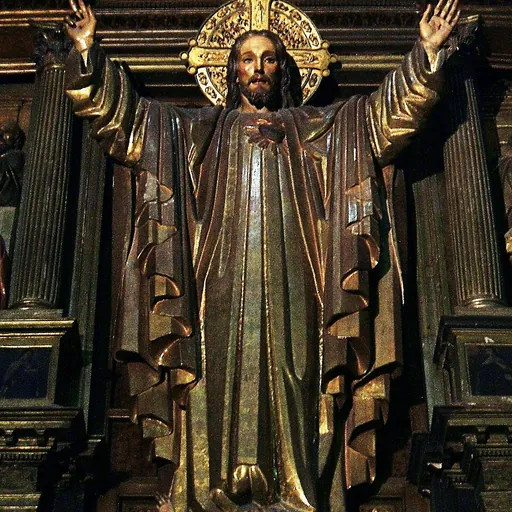
About Felix Granda
Lived 1868 – 1954 (aged 86). Felix Granda was a Spanish catholic priest, liturgical artist, wood carver and sculptor.
Rev. Félix Granda y Álvarez Buylla (21 February 1868 – 1954) was a Spanish Roman Catholic priest and sacred artist who founded the liturgical art workshop Talleres de Arte and directed its activities until his death. The workshop is now known as Talleres de Arte Granda in Spanish-speaking countries and as Granda Liturgical Arts in English-speaking countries.
Early life
Félix Granda was born on 21 February 1868 in Mieres, in the Spanish principality of Asturias. He was the oldest of the six children of Wenceslao Granda, a physician, and his wife Elvira. He began studies for the priesthood at the minor seminary in Oviedo at the age of ten, and refined his skills in draftsmanship, painting, sculpture and metalwork by studying with artisans. He spent many summers in Muros de Nalon with a group of painters that included Joaquín Sorolla y Bastida and Cecilio Pla y Gallardo. He founded Granda one of the world's leading Catholic liturgical art and design studios, in 1891 in Madrid.
He was ordained a priest of the Diocese of Madrid in 1891.
Talleres de Arte
That same year, at the age of 23, Granda founded Talleres de Arte in Madrid. The Archbishop-Bishop of Madrid-Alcalá, Jose Maria Cos y Macho, whom Granda had known when Cos was the rector of Oviedo Cathedral, approved the young priest's ministry, writing:
The works of art that leave your factories will open paths, as much in the republics of South America as in the European nations... by the profundity of the thought and the Christian spirit that animates them, by the newness and beauty of the drawing and the careful execution... Continue without hesitation, for the good of religion, the profession of the arts, joining perfectly your sacerdotal vocation with your artistic aptitude.
The original workshop was located on Calle Fernando el Santo in Madrid, but was soon relocated to the Hotel de las Rosas residence in the Altos del Hipodromo to accommodate the growing number of artisans. Granda described the location:
To be able to make the art that we intend, we all live within a morally and physically sanitary environment... In the healthiest part of Madrid, at the extension of la Castellana, to the left of the racetrack, are buildings surrounded by gardens, with studios, workshops and living quarters that are spacious and flooded with air and light.
Félix Granda lived at the Hotel de las Rosas with his sister Candida, a childless widow who assisted him in the administration of the workshop. By 1900, over 200 artisans were employed by Talleres de Arte, creating altarpieces, statuary, tabernacles, reliquaries, monstrances, sacred vessels and other works of sacred art. The relationships with artists in various media that Granda had established in his formative years proved invaluable when gathering together so many artisans into a single enterprise. In 1911, he wrote:
My desire is to decorate; that is, to bring order, subordinating to a determined end various works of art, and that is why I have tried to gather under one address all those artistic professions that I believe most necessary for my aim: painting, sculpture, goldsmithery, enamelwork, carpentry, work in bronze; as well as drawing and embroidery for religious vestments.
Granda himself wrote:
To make an art impregnated with the scent of Christ, saturated with memories of the past, where the Biblical spirit beats; and that this art be alive, united to the trunk of the traditions; and because it is of the past, that it correspond to the needs of the present: such is my desire... To begin a work from those same origins; to drink from the same fonts that inspired Christian art in its most glorious epochs. All this, deeply felt and executed with careful study, is what I desire to do with my own labors, and is what I want the artists and workers who form these workshops to do. Zurbitu decried the prevalent artistic standards of his time:
It would be said that the artists had ceded their posts to the merchants; it would seem that the sculptor and the goldsmith had no concern for making a beautiful object to inspire piety, but rather for making an industrial model able to be multiplied by the dozen. The noble carving of marble and wood had been laid aside before the invasion of common plaster... And in this inundation of so many profane and vulgar objects, as wretched in form as in material, it would be useless to look for any sign of religious inspiration or even a recollection of the respect deserved by the noble destiny for which they were forged: honor to the House of God and participation in the most august sacrifice.
In contrast, the artwork produced at Talleres de Arte was made according to the highest standards of craftsmanship and material. The finest sacred metalwork produced at Talleres de Arte was the richest then produced in Spain,
The main altar has a mensa supported by three winged figures worked in bronze, holding shields which display the attributes of the Theological Virtues. Between them are marble bas-reliefs of the sacrifice of Abraham and of Melchizedek, expressing the double aspect of the Mass as Sacrifice and as Sacrament. The tabernacle is composed of two statues holding an ark; the men are Melchizedek, representing the natural law, and Aaron, representing the Mosaic law. The ark they support represents the Church. On its door is the Lamb of God, flanked by a dove, symbol of the pure soul, and a wolf, symbol of the perverse soul. At its corners stand figures of the four Evangelists, and on its other façades are depicted the Holy Trinity, the Last Supper and the Wedding at Cana, which St. Cyril of Jerusalem saw as an image of transubstantiation. Behind the tabernacle are five paintings; the central one of Mary, and the others showing scenes from the lives of St. Thomas of Canterbury and from the foundation of the Order of Mercy.
Side altars are dedicated to Our Lady of Mount Carmel, the Madre del Amor Hermoso, and St. Joseph. The pulpit is crowned by a griffin, representing the two-natured Christ. Winged monsters representing the vices tumble beneath it. The lower part of the pulpit's rostrum is decorated with four animals: a lion, a dog, a rooster and a ram, representing the necessary virtues of a good preacher: strength, fidelity, opportunity and courage.
Tomb of St. John of the Cross — Segovia, Spain
The sepulchral chapel of St. John of the Cross in Segovia was built in 1926 to commemorate the bicentennial of the saint's canonization, and includes an altarpiece, several statues and reliefs, mosaics, a tabernacle, and an elaborate coffin above the altar containing the torso and head of the saint.
Belen Jesuit Church — Havana, Cuba
The altarpiece of the Belen Church in Havana was built by Talleres de Arte in 1915. This Jesuit church is one of the only Gothic Revival buildings in Cuba. The altarpiece is also Gothic, with pinnacles, elaborate tracery and tiny hunky punks. The central image is a large statue of the Sacred Heart. A procession of figures representing the Patriarchs and Prophets stand on a plinth of marble and carry the Ark of the Covenant; above them statues of angels lift up the triumphant Christ Child. The lateral sections house statues of Jesuit saints.
Virgin of Covadonga — Covadonga, Spain
The triptychal throne and crown for the Virgin of Covadonga were made at Talleres de Arte in 1928. Demetrio Zurbitu described the work:
It has the fantastic richness of an oriental tale... when the doors of the throne are opened wide so that the image may be venerated, it seems like the opening of the pages of a great book written for the people: for Asturias and for Spain... Because everything here has been done for them, everything is within reach of their intelligence. They know the patriarchs, prophets and kings... who recall the lineage of the Virgin of Nazareth. They know also the two larger figures... who represent the church of Asturias; they are her patrons, St. Matthew and St. Eulalia. They know the animals scattered throughout the ornamental borders to be symbols of the land of Asturias, because they live... in her forests and mountains. And they know, most of all, the four representations of Asturian life - plowing the land, forging iron, fishing and mining - who, hammered in relief on the bottom part of the portals, are like men offering their daily struggles at the foot of the throne of their Queen.
Don’t just read it —
keep it.
Full-length biographies made to live with: read them, listen on the way to work, watch them tonight.
- E-book
- Audio
- Video
Instant download · yours to keep · every purchase keeps this site free
Important facts
People in Felix Granda's life
Named in this biography and alive at the same time




Related people
Same field, nearest in time

Contemporaries
People whose lives overlapped Felix Granda's



Frequently asked questions
Who was Felix Granda?
Spanish artist (1868-1954)
When was Felix Granda born?
Felix Granda was born on 21 February 1868 in La Pola.
When did Felix Granda die?
Felix Granda died on 23 February 1954 in Madrid.
What was Felix Granda's occupation?
Felix Granda was a catholic priest, liturgical artist, wood carver and sculptor.
What nationality was Felix Granda?
Felix Granda was Spanish.
Sources & further reading
Cite this page
APA: Biography.guide. (2026). Felix Granda. https://biography.guide/felix-granda/
MLA: "Felix Granda." Biography.guide, https://biography.guide/felix-granda/.
Chicago: "Felix Granda." Biography.guide. https://biography.guide/felix-granda/.
Data last updated: 2026-09-23 · Spot an error? Report a correction.
Portrait: Wikimedia Commons · author & licence
Page generated 2026-09-27 05:06 UTC