
About Félix Callet
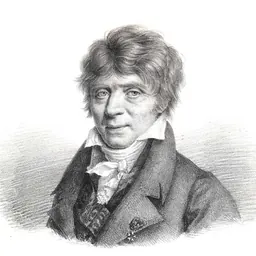
Lived 1791 – 1854 (aged 63). Félix Callet was a French architect.
Félix-Emmanuel Callet (23 May 1791 – August 1854) was a French neoclassical architect.
Early life and family Felix-Emmanuel Callet was born in Paris, the son of Antoine Callet (1755–1850), architect of civil buildings and highways of the city of Paris, known for his biographical works on French architects of the sixteenth century and his rich collection of books and antiques, amassed at his house in the Rue de la Pépinière and completed by his son. Felix was the elder brother of Adolphe Apollodorus Callet (1799–1831), historical painter and cousin of Antoine-François Callet (1799–1850), also an architect (not to be confused with the painter of the same name).
Education Felix Callet was admitted to the School of Fine Arts in 1809. A pupil of his father and Pierre-Jules Delespine, he won the Grande médaille d'émulation in 1818 and achieved first class in 1819. He finished second in the Prix de Rome in 1818 with the topic: "a public promenade" before winning the Grand Prix the following year with his subject "a cemetery", tied with Jean-Baptiste Lesueur. Resident at the Villa Medici, his time in Rome included a project for reconstruction of the Forum of Pompeii in 1822. In collaboration with Lesueur, he published a book entitled Architecture italienne, ou palais, maisons et autres édifices de l'Italie moderne, of which some plates were exhibited at the Salon of 1827.
Career He was appointed architect for the city of Paris and taught his art to future architects. The architects Adolphe Azemard, Lucien-Dieudonné Bessières, Amant Constant-Mathurin Chalange, Jules Duru, Laurent-Amable Fauconnier, Jean Charles Geslin, Jean Jordan, Jean-Jacques Mellerio, Louis-Alphonse Nassau, Leon Ohnet, Pierre-Christophe Quinegagne, Jacques-Alfred Ruelle, François-Alexandre-Tingry Lehuby and Victor Nicolas Vollier, were all taught by Felix Callet or possibly his father.
Felix Callet was one of the founding members of the Société centrale des architectes in 1840.
In 1845, he partnered with Victor Baltard, who had been working for two years on the proposed new central market, Les Halles. After the first plan was presented in 1848, the two architects accepted a new project, whose works commenced in 1851. Their part of an outdoor stone structure bearing a type of metal frame in the style of Polonceau however was quickly criticised, by Hector Horeau, who called for a project that did not hide the metal, and by those who scoffed at the massive aspect of this "Fortress Halles". Work stopped in 1853 and the first pavilion was finally dismantled in 1866. A new project more in line with the wishes of the administration, with visible metal structures and simple brick fillings instead of stone façades, was proposed by the two architects between the end of 1853 and the beginning of 1854. The first two pavilions (demolished in 1972) were inaugurated in October 1857, three years after the death of Callet, Baltard continuing the work until 1874.
Grandson of the architect, politician Marcel Habert demanded in 1912 that covered walkways in the central Halles should be named in Callet's honour. The proposal was approved by the Paris City Council in 1914.
Works
All located in Paris unless otherwise stated: Villa "La Perl du Lac" for François Bartholoni (now the Museum of History of Science, Geneva ) in Sécheron, Geneva (1828–1830). "Hôtel des commissaires-priseurs" of the Seine (former headquarters of the Paris Chamber of Commerce), Place de la Bourse (1832). Railway stations: The original Gare d'Austerlitz station, rebuilt after 1862 and the Gare de Corbeil-Essonnes for the Compagnie du chemin de fer de Paris à Orléans (with Callet's father and the engineer Jullien, 1835–1840). Funereal monuments for the Marcilly, Tattet (after 1837), Bartholony, Leconte, Perier, Delacroix, Ganneron families at the Père Lachaise Cemetery. Hotel Casimir Lecomte, Place Saint-Georges. Villa Dufour, Bellevue, Switzerland. Saulsure Castle, near Vernon. Tomb of Marshal Clauzel, Mirepoix (after 1842). "Stone Hall" of the central market (with Baltard, from 1851 to 1853, demolished in 1866). Paved walkways of the central market (with Baltard, made by him from 1854 to 1874 and demolished in 1972). Project for the Geneva Conservatory of Music (1853), finally realised and completed in 1858 by Samuel Darier from Lesueur's plans.
Don’t just read it —
keep it.
Full-length biographies made to live with: read them, listen on the way to work, watch them tonight.
- E-book
- Audio
- Video
Instant download · yours to keep · every purchase keeps this site free
Important facts
People in Félix Callet's life
Named in this biography and alive at the same time




Related people
Same field, nearest in time

Contemporaries
People whose lives overlapped Félix Callet's


Frequently asked questions
Who was Félix Callet?
architect
When was Félix Callet born?
Félix Callet was born on 23 May 1791 in Paris.
When did Félix Callet die?
Félix Callet died on 1 August 1854 in Paris.
What was Félix Callet's occupation?
Félix Callet was an architect.
What nationality was Félix Callet?
Félix Callet was French.
Sources & further reading
Cite this page
APA: Biography.guide. (2026). Félix Callet. https://biography.guide/felix-callet/
MLA: "Félix Callet." Biography.guide, https://biography.guide/felix-callet/.
Chicago: "Félix Callet." Biography.guide. https://biography.guide/felix-callet/.
Data last updated: 2026-09-20 · Spot an error? Report a correction.
Page generated 2026-09-27 05:21 UTC