About Evagrius Ponticus
Lived 345 – 399 (aged 53–54). Evagrius Ponticus was a Roman writer, theologian, christian monk, ascetic and monk.
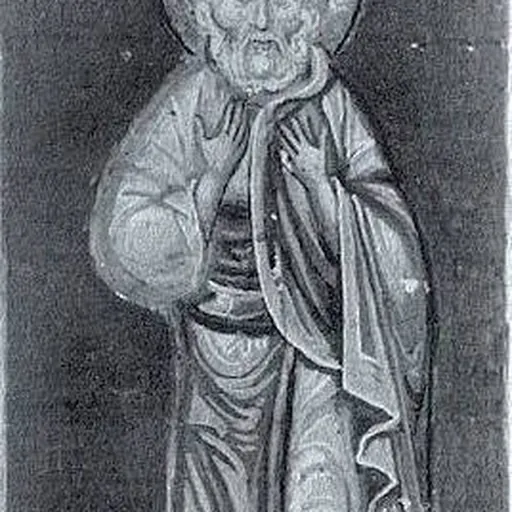
Evagrius Ponticus (left), John of Sinai, and an unknown saint. 17th-century icon.
Evagrius Ponticus ; (Syriac: ܐܘܓܪܝܣ ܦܘܢܛܝܩܝܐ; Awgrīs Ponṭīqāyā) also called Evagrius the Solitary (345–399 AD), was a Christian monk and ascetic from Heraclea, a city on the coast of Bithynia in Asia Minor. One of the most influential theologians in the late fourth-century church, he was well known as a thinker, polished speaker, and gifted writer. He left a promising ecclesiastical career in Constantinople and traveled to Jerusalem, where in 383 AD he became a monk at the monastery of Rufinus and Melania the Elder. He then went to Egypt and spent the remaining years of his life in Nitria and Kellia, marked by years of asceticism and writing. He was a disciple of several influential contemporary church leaders, including Basil of Caesarea, Gregory of Nazianzus, and Macarius of Egypt. He was a teacher of many others, including John Cassian and Palladius of Galatia.
Life There are five main sources of information on Evagrius's life. Firstly, there exists a biographical account in chapter 38 of The Lausiac History of bishop Palladius of Helenopolis (c. 420); Palladius was a friend and disciple of Evagrius, and spent about nine years sharing Evagrius's life in the desert. Secondly, there is a chapter on Evagrius in the anonymous Enquiry about the monks of Egypt, which predates Palladius, and is a first-hand account of a voyage taken by seven monks from Palestine in the winter of 394–395 to the principal monastic sites in Egypt. The final three sources are briefer and with more distinct biases: Evagrius features in some of the Apophthegmata literature, as well as in the church histories of Socrates and Sozomen.
Evagrius was born into a Christian family in the small town of Ibora, modern-day İverönü, Erbaa in the late Roman province of Helenopontus. He was educated in Neocaesarea, where he was ordained as a lector under Basil the Great. Around 380 he joined Gregory of Nazianzus in Constantinople, where Gregory had been installed as bishop, and was promoted to deacon. He stayed on in Constantinople after Gregory left in July 381, and eventually became an archdeacon. When Emperor Theodosius I convened the Second Ecumenical Council in 381, Evagrius was present, despite Gregory's premature departure.
According to the biography written by Palladius, Constantinople offered many worldly attractions, and Evagrius's vanity was aroused by the high praise of his peers. Eventually, he became infatuated with a married woman. Amid this temptation, he is said to have had a vision in which he was imprisoned by the soldiers of the governor at the request of the woman's husband. This vision, and the warning of an attendant angel, made him flee from the capital and head for Jerusalem.
For a short time, he stayed with Melania the Elder and Rufinus of Aquileia in a monastery near Jerusalem, but even there he could not forsake his vainglory and pride. He apparently took special care of his dress, and spent much of his time sauntering through the streets of the cosmopolitan Holy City. He fell gravely ill and only after he confessed his troubles to Melania, and accepted her instruction to become a monk was he restored to health. He also refrained from bathing. Evagrius did not sleep more than a few hours each night and devoted much time to contemplation and prayer.
Epistula fidei. This was probably written around 379 in Constantinople and is possibly Evagrius's earliest published work. Institutio ad monachos (Exhortations to Monks) Sentences for Monks Ad virginem (Exhortation to a Virgin) Hypotyposis De diversis malignis cogitationibus De magistris et disciplulis Treatise on Various Evil Thoughts (Capita Cognoscitiva) Protrepticus Paraeneticus The Chapters of the Disciples of Evagrius 62 letters Various scholia also remain, including Scholia on the Psalms Scholia on Proverbs Scholia on Ecclesiastes Scholia on Job Scriptural commentaries Commentary on the Psalms De Seraphim (deals with the vision of Isaiah) De Cherubim (deals with the vision of Ezekiel) Commentary on the Pater Noster Various ascetic treatises: De Justis et Perfectis
Although ascribed to Evagrius, these two works are considered to be of doubtful authenticity.
His more advanced students enjoyed more theoretical, contemplative material (gnostike).
Logismoi The most prominent feature of his research was a system of categorizing various forms of temptation. He developed a comprehensive list in AD 375 of eight evil thoughts (λογισμοὶ), or eight terrible temptations, from which all sinful behavior springs. This list was intended to serve a diagnostic purpose: to help readers identify the process of temptation, their own strengths and weaknesses, and the remedies available for overcoming temptation.
Evagrius stated that "The first thought of all is that of love of self; after this, the eight."
The eight patterns of evil thought are gluttony, lust, greed, sadness, acedia [despondency], anger, vainglory, and pride. The Greek and Syriac terms for Evagrius' canonical eight logismoi are:
English Greek Syriac gluttony gastrimargia la‘buthā sexual lust porneia zāniuthā love of money philargyria rehmat kespā sadness lypē ‘aqthā anger orgē rugzā / rigzā akēdia akēdia ma’inuthā vainglory kenodoxia šubḥā sriqā pride hyperēphania rmúthā
Some two centuries later in 590 AD, Pope Gregory I, "Pope Gregory The Great" would revise this list to form the more commonly known Seven Deadly Sins, where Pope Gregory the Great combined acedia (despondency) with tristitia (sorrow), calling the combination the sin of sloth; vainglory with pride; and added envy to the list of "Seven Deadly Sins".
Apatheia In Evagrius's time, the Greek word apatheia was used to refer to a state of being without passion. Evagrius wrote: "A man in chains cannot run. Nor can the mind that is enslaved to passion see the place of spiritual prayer. It is dragged along and tossed by these passion-filled thoughts and cannot stand firm and tranquil."
Later reputation and influence
Accusations of heresy Even in his own day, Evagrius's views had been criticised. A controversy over how to conceptualise God that broke out in the Nitrian desert in 400 saw dispute in which one side was influenced by Origenist views. Although Evagrius was not mentioned in this dispute, in 415 Jerome's Letter 133 accuses Evagrius of being a prominent Origenist, and critiques his teaching on apatheia.
Many of Evagrius's more ascetic works survive in Greek, often in manuscripts of the tenth century and after from Mount Athos and other monastic centres, although often attributed to Nilus of Ancyra, or occasionally to Basil or Gregory of Nazianzus. The fullest flowering of his influence was in the spiritual writings of Isaac of Nineveh, who relies heavily on Evagrius’s teaching on both the passions and prayer. In the Latin world, Evagrius's influence came in the way that John Cassian, one of his most faithful disciples, preserved and propagated the basic elements of Evagrius's teaching on the stages of the monastic life, tripartite anthropology, and the eight thoughts (although Cassian never mentions Evagrius by name, since his reputation was already tainted). Through Cassian, Evagrius's thought passed to Gregory the Great, and the Evagrian schema of eight generic thoughts afflicting the monks of Egypt was transformed into a list now famous as the Seven Deadly Sins.
Works
Modern editions A list of modern editions of Evagrius's writings in Greek and Syriac, as well as German translations, is contained in Julia Konstantinovsky, Evagrius Ponticus: The Making of a Gnostic, (Ashgate, 2009), pp. 186–8, and in Columba Stewart, Imageless Prayer and the Theological Vision of Evagrius Ponticus, Journal of Early Christian Studies 9:2, (2001), pp. 202–4.
English translations Evagrius. The Praktikos and Chapters on Prayer. Cistercian Studies Series, vol. 4. Translated by John Eudes Bamberger OCSO. Kalamazoo: Cistercian Publications, 1972. On Prayer, One-Hundred and Fifty-Three Texts, The Philokalia, vol 1, ed and translated by Palmer, Sherrard and Ware, (London, 1979) Evagrius Ponticus. Chapters on Prayer. Translated and introduced by Sr. Pascale-Dominique Nau, OP, Bergamo, 2023. M Parmentier, 'Evagrius of Pontus and the "Letter to Melania"', Bijdragen, tijdschrift voor filosofie en theologie, 46, (Amsterdam, 1985), 2-38 Evagrius Ponticus: Praktikos and On Prayer, trans , (Oxford: Faculty of Theology, 1987) 'Epistula fidei', in RJ Deferrari, Loeb 190, pp. 46–93 G Gould, 'An Ancient Monastic Writing giving advice to spiritual directors (Evagrius of Pontus, On the Teachers and Disciples)', Hallel 22, (1997), pp. 96–103) [translation of De magistris et discipulis] 'Evagrius Ponticus, Antirrheticus (Selections)', translated by M O'Laughlin, in Vincent L Wimbush, ed, Ascetic Behavior in Greco-Roman antiquity: a sourcebook, (Minneapolis, 1990), pp. 243–62. Evagrius Ponticus: Ad Monachos, translation and Commentary by Jeremy Driscoll, ACW 59. (Paulist Press, 2003) [See also Jeremy Driscoll, The “Ad monachos” of Evagrius Ponticus: Its Structure and a Select Commentary, Studia Anselmiana 104 (Rome: Pontificio Ateneo S. Anselmo, 1991)] Evagrius. Evagrius Ponticus. Translated by Augustine Casiday. (New York: Routledge, 2006) Evagrius. Evagrius of Pontus: The Greek Ascetic Corpus. Translated by Robert E. Sinkewicz, (Oxford and New York: Oxford University Press, 2003). William Harmless and Raymond R. Fitzgerald, "'The Sapphire Light of the Mind': The Skemmata of Evagrius Ponticus," Theological Studies 62 (2001): 498–529. Martin Parmentier, "Evagrius of Pontus and the 'Letter to Melania,'" Bijdragen, tijdschrift voor filosofie en theologie 46 (1985): 2–38, reprinted in Forms of Devotion: Conversion, Worship, Spirituality, and Asceticism, ed. Everett Ferguson (New York: Garland, 1999), 272–309.
French translations Antoine Guillaumont & Claire Guillaumont, Évagre le Pontique, traité pratique ou le Moine, SC 170–171 (Paris: Éditions du Cerf, 1971). (Praktikos in French) Antoine Guillaumont, Évagre Le Pontique: "Le gnostique" ou, À celui qui est devenu digne de la science, SC 356 (Paris: Éditions du Cerf, 1989). (Gnostikos in French) Antoine Guillaumont, Les six centuries des "Kephalaia Gnostica": édition critique de la version syriaque commune et édition d'une nouvelle version syriaque, PO 28, fasc. 1 (Paris: Firmin–Didot, 1958). (Kephalaia Gnostica in French) Paul Géhin, Claire Guillaumont, and Antoine Guillaumont, eds., Évagre le Pontique: sur les pensées, SC 438 (Paris: Éditions du Cerf, 1998). (Peri logismōn in French) Paul Géhin, Évagre le Pontique: scholies aux Proverbes, SC 340 (Paris: Éditions du Cerf, 1987). Paul Géhin, Évagre le Pontique: scholies à l'Ecclésiaste, SC 397 (Paris: Éditions du Cerf, 1993).
Don’t just read it —
keep it.
Full-length biographies made to live with: read them, listen on the way to work, watch them tonight.
- E-book
- Audio
- Video
Instant download · yours to keep · every purchase keeps this site free
Important facts
People in Evagrius Ponticus's life
Named in this biography and alive at the same time



Related people
Same field, nearest in time




Contemporaries
People whose lives overlapped Evagrius Ponticus's
Frequently asked questions
Who was Evagrius Ponticus?
Christian Monk
When was Evagrius Ponticus born?
Evagrius Ponticus was born in 345 in Ibora.
When did Evagrius Ponticus die?
Evagrius Ponticus died in 399 in Wadi El Natrun, Egypt.
What was Evagrius Ponticus's occupation?
Evagrius Ponticus was a writer, theologian, christian monk, ascetic and monk.
What nationality was Evagrius Ponticus?
Evagrius Ponticus was Roman.
Sources & further reading
· Wikipedia: Evagrius Ponticus
Cite this page
APA: Biography.guide. (2026). Evagrius Ponticus. https://biography.guide/evagrius-ponticus/
MLA: "Evagrius Ponticus." Biography.guide, https://biography.guide/evagrius-ponticus/.
Chicago: "Evagrius Ponticus." Biography.guide. https://biography.guide/evagrius-ponticus/.
Data last updated: 2026-09-20 · Spot an error? Report a correction.
Portrait: Wikimedia Commons · author & licence
Page generated 2026-09-27 04:57 UTC