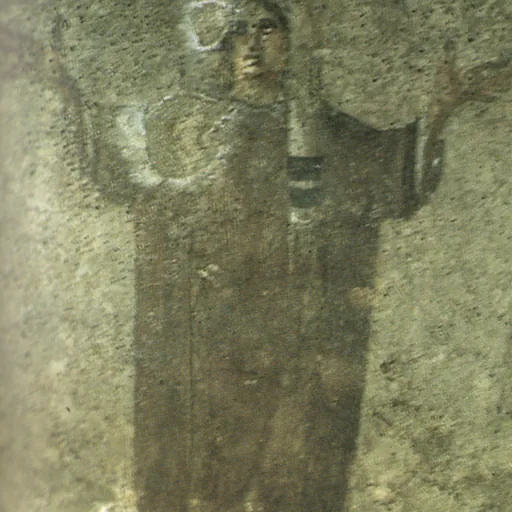
About Melania the Elder
Lived 350 – 410 (aged 59–60). Melania the Elder was an abbess, nun and hermit.
Melania the Elder, Latin Melania Maior (c. 350 – before 410 ) was a Desert Mother who was an influential figure in the Christian ascetic movement (the Desert Fathers and Mothers) that sprang up in the generation after the Emperor Constantine made Christianity a legal religion of the Roman Empire. She was a contemporary of, and well known to, Abba Macarius and other Desert Fathers in Egypt, Jerome, Augustine of Hippo, Paulinus of Nola (her cousin or cousin-in-law; he gives a colorful description of her visit to Nola in his Letters), and Evagrius of Pontus, and she founded two religious communities on the Mount of Olives in Jerusalem.
Life Pagan period Melania the Elder (c. 350 – c. 410) was born in Hispania and became one of the wealthiest citizens of the empire. Her father, Marcellinus, was of consular rank and she was related to Paulinus of Nola. She was married at fourteen, and moved with her husband (probably Valerius Maximus signo Basilius of the powerful patrician family of gens Valeria, or possibly a politician named Maximus) to the suburbs of Rome. Her husband and two out of three sons had died by the time she was twenty-two.
With the Egyptian monks She became a Christian in Rome and, leaving her son, Valerius Publicola, with a guardian, set off to Alexandria, accompanied by her servants, to join other Christian ascetics to visit the monks at Nitria.
She stayed with the monks in the desert near Alexandria, Egypt (today the area is known as Wadi Natroun) for about six months. When persecution broke out after the death of Bishop Athanasius in 373 and many of the monks were exiled to Diocaesaraea in Palestine, Melania followed and supported them financially. The governor had her briefly imprisoned, but released her when he realized her social status.
Because of her involvement as a pro-Origenist in the controversy over Origen in the 390s, Jerome was especially vitriolic about her, punning on her name and calling her "black in name and black in nature." (He tried to expunge his earlier lavish praises of her from his writings.) Palladius of Galatia described her as "a very learned lady who loved the world". and her feast day is June 8.
Influence She was a spiritual mentor to Evagrius of Pontus, author of some texts found in the Eastern Orthodox Philokalia. She persuaded him to go to Egypt to join the desert ascetics and carried on a correspondence with him while he was there.
Don’t just read it —
keep it.
Full-length biographies made to live with: read them, listen on the way to work, watch them tonight.
- E-book
- Audio
- Video
Instant download · yours to keep · every purchase keeps this site free
Important facts
People in Melania the Elder's life
Named in this biography and alive at the same time



Related people
Same field, nearest in time



Contemporaries
People whose lives overlapped Melania the Elder's


Frequently asked questions
Who was Melania the Elder?
Holy Land saint
When was Melania the Elder born?
Melania the Elder was born in 350 in Rome, Hispania.
When did Melania the Elder die?
Melania the Elder died in 410 in Jerusalem.
What was Melania the Elder's occupation?
Melania the Elder was an abbess, nun and hermit.
Sources & further reading
· Wikipedia: Melania the Elder
Cite this page
APA: Biography.guide. (2026). Melania the Elder. https://biography.guide/melania-the-elder/
MLA: "Melania the Elder." Biography.guide, https://biography.guide/melania-the-elder/.
Chicago: "Melania the Elder." Biography.guide. https://biography.guide/melania-the-elder/.
Data last updated: 2026-09-23 · Spot an error? Report a correction.
Portrait: Wikimedia Commons · author & licence
Page generated 2026-09-27 05:06 UTC