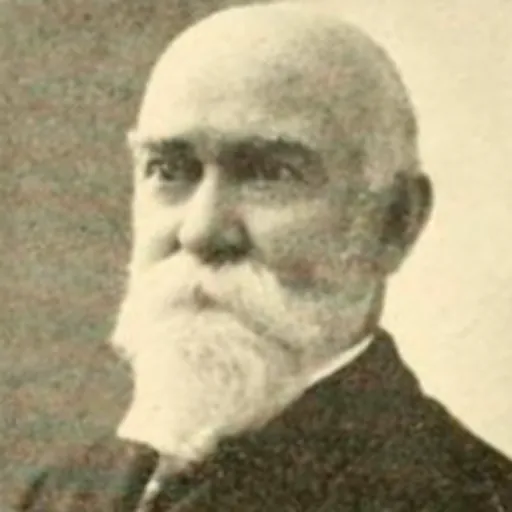
Eugene Clarence Gardner
Architect and politician in Massachusetts, US, 1836-1915
About Eugene Clarence Gardner
Lived 1836 – 1915 (aged 78). Eugene Clarence Gardner was an American architect and politician.
Grove Hill in Leeds, Massachusetts, designed by E. C. Gardner in 1879. Mary Lyon Hall at Mount Holyoke College in South Hadley, Massachusetts, designed by Gardner, Pyne & Gardner in 1897. Eugene Clarence Gardner (1836–1915) was an American architect and author of Springfield, Massachusetts. Gardner was noted both for the architectural influence of his extensive practice as well as his writings on the American home. Gardner was the most notable architect of Springfield.
Life and career Eugene Clarence Gardner was born March 28, 1836, in Ashfield, Massachusetts to Bela Gardner and Lucy (Barber) Gardner. He was raised on the family farm, and attended district schools as well as the Ashfield and Conway Academies. He learned the trade of mason and worked for some time in New Ipswich, New Hampshire, before moving to Florence, where his family had moved in his absence. In 1858 Gardner married and moved west, and was appointed principal of Tallmadge Academy in Tallmadge, Ohio. In 1859, while principal, he oversaw the construction of a new building for the academy. In 1862, he returned to Florence, and the following year opened an architect's office in Northampton. Perhaps facing competition from established architect William Fenno Pratt, in 1868 he moved downriver to Springfield, where he formed a partnership with contractor-turned-architect Jason Perkins, also a former resident of Northampton. The firm of Perkins & Gardner was dissolved in 1873, and both returned to private practice. From Washington he went to Europe, returning to the United States to spend the winter of 1889–90 in Atlanta. Both times, Gardner acted as representative of his firm and they were commissioned to design major projects in these cities. The partnership of Gardner, Pyne & Gardner lasted until 1901, when Pyne left to open an independent office. Father and son formed a new partnership, practicing as E. C. & G. C. Gardner.
As designer and author Gardner always made a point to stay abreast of contemporary architectural fashion. For the First Congregational Church of West Springfield, completed in 1872, Gardner used as a model H. H. Richardson's Church of the Unity in Springfield. Henry-Russell Hitchcock noted that although crude, it represents one of the earliest pieces of evidence of Richardson's influence. Vincent Scully noted Gardner as an important figure in the development of the Stick Style, in such a way that revived the ideas of Andrew Jackson Downing. After the 1880s, likely due to the influence of the academically trained George C. Gardner, the firm's designs were chiefly derived from Colonial and Renaissance precedents.
Beyond his own buildings, Gardner is known as the author of a number of influential books on the design and construction of homes. Beginning with Homes, and How to Make Them (1874) and ending with The House that Jill Built (1882, reissued 1896), Gardner promoted a highly personal and considered design process for homes. In Space, Time and Architecture, Sigfried Giedion noted that Gardner's writings represented a move away from the fussiness that then typified American architecture to a more considered whole.
Gardner was also a frequent contributor to The Republican and the architectural press.
Political and personal life In 1901 Gardner was elected a member of the Massachusetts House of Representatives from the 3rd Hampden district as a Republican, but declined to run for a second term. Some of his proposals, like the development of Court Square and construction of the Memorial Bridge, were eventually brought to fruition, but others, including the development of a park and boulevard system, were not.
Gardner married in 1858, to Harriet Bellows Hubbard of Ashfield, Massachusetts. In addition to their son, they had a daughter who died young. In the 1870s they were host to several students of the Chinese Educational Mission, including Tang Shaoyi and Liang Ju-hao, who would become officials of the Republic of China.
In 1898, the Gardners and Pyne were among the founding members of the Architectural Club of Springfield, though this organization was not long-lived. Gardner became a member of the American Institute of Architects in 1913.
Partners and associates
George C. Gardner George Clarence Gardner was born August 3, 1865, in Florence. He attended the Springfield public schools before enrolling at the Massachusetts Institute of Technology, taking courses in 1885–86 and 1888. In addition to his formal architectural education, he worked as a student draftsman in his father's office before becoming partner after his final return to Springfield in 1888. Gardner was considered an expert on Colonial architecture and remodeled several Colonial churches. He was chairman of the Springfield Planning Board from its establishment in 1921 until his death in 1930.
Gardner became a member of the American Institute of Architects in 1902.
The younger Gardner died August 27, 1930, at the age of 64.
George R. Pyne George Rovillo Pyne was born February 12, 1853, in Waterbury, Connecticut. He was educated in the schools of South Hadley and Agawam, and in 1873 went to Boston as a student draftsman, working for Putnam & Tilden and George F. Meacham. In 1876 he came back to Springfield, where he entered Gardner's employ. From 1881 to 1886 he practiced architecture in Evansville, Indiana, returning to Springfield at the end of that period. When the partnership of Gardner, Pyne & Gardner was formed, Pyne moved to Washington as the elder Gardner's assistant, returning to Springfield by 1890. After the dissolution of the partnership in 1901, Pyne practiced on his own in Springfield for ten years. He died February 18, 1911, in Springfield.
F. W. S. King After the death of George C. Gardner, the firm was taken over by Frank Wesley Stetson King. Usually known as F. W. S. or Frank, King was born March 5, 1870, in Springfield and entered the Gardner office in the 1890s after completing his education in the public schools. For a few years after the breakup of Gardner, Pyne & Gardner, King operated his own practice, but soon returned to the Gardners. By 1913, he was the firm's main construction superintendent. King continued to practice as E. C. & G. C. Gardner, changing the name to Gardner & King in 1937. He continued to practice until his death, which occurred on July 19, 1940, in Springfield.
King was a founding member and first vice president of the Architectural Society of Western Massachusetts, established in 1934 and later merged into the American Institute of Architects.
Many of Gardner's works, designed alone or with partners, have been listed on the United States National Register of Historic Places, and others contribute to listed historic districts.
Architectural works
Factory for the International Screw Nail Company, Bay State Village, Massachusetts (1866) Mill for the Florence Manufacturing Company, Florence, Massachusetts (1866) House for William L. Wilcox, Springfield, Massachusetts (1870–71) Fitzgerald's Stearns Square Block, Springfield, Massachusetts (1871, NRHP 1983, demolished) First Congregational Church, West Springfield, Massachusetts (1872) Parish house, First Church of Christ, Congregational, Springfield, Massachusetts (1872–74) Powers Block and Wason Building, Springfield, Massachusetts (1873, 1881 and 1911, NRHP 1979) Opera House Block, Turners Falls, Massachusetts (1874) Chinese Educational Mission Building, Hartford, Connecticut (1877, demolished) "Grove Hill" for Lucius Dimock, Leeds, Massachusetts (1879) House for George P. Dickinson, Northampton, Massachusetts (1879) "Stonecrest" for Francis L. Underhill, Bedford Corners, New York (1879, NRHP 2004) Arms Academy (former), Shelburne Falls, Massachusetts (1880) Mill for the Nonotuck Silk Company, Leeds, Massachusetts (1880) Clarissa C. Cook Home for the Friendless, Davenport, Iowa (1881–82, NRHP 1983) Parish house, East Congregational Church (former), Ware, Massachusetts (1881) Young Men's Library Association, Ware, Massachusetts (1881) Cottage Row, Mount Hermon School, Gill, Massachusetts (1882) Boston and Albany Railroad Depot (former), West Brookfield, Massachusetts (1884) House for Frances M. Lincoln, Worcester, Massachusetts (1884) House for Julius H. Appleton, Springfield, Massachusetts (1886) Springfield City Hospital, Springfield, Massachusetts (1887–89, demolished) Henderson Castle for John Brooks and Mary Foote Henderson, Washington, D.C. (1888–89, Demolished 1949) Remodeling of the East Congregational Church, Ware, Massachusetts (1890, burned 1925) Backus Hospital, Norwich, Connecticut (1893, demolished) Springfield Armory (former), Springfield, Massachusetts (1894–95, NRHP 1976) Noble Hospital, Westfield, Massachusetts (1895–96, demolished) Northampton High School (former), Northampton, Massachusetts (1895–96) Parish house, First Congregational Church, Adams, Massachusetts (1895) Parks Building, Westfield, Massachusetts (1895, burned 1952) Stafford Springs House, Stafford Springs, Connecticut (1895–96, burned 1959) Worthy Hotel, Springfield, Massachusetts (1895, NRHP 1983) Remodeling of the First Congregational Church, Williamsburg, Massachusetts (1897–98) Homer Street School, Springfield, Massachusetts (1897–98 and 1924) Indian Orchard Fire Station (former), Indian Orchard, Massachusetts (1897) Mary Lyon Hall, Mount Holyoke College, South Hadley, Massachusetts (1897) Safford Hall, Mount Holyoke College, South Hadley, Massachusetts (1897) Vernon Street School, Northampton, Massachusetts (1897) Ware United Methodist Church (former), Ware, Massachusetts (1897–98) Lee Hall, American International College, Springfield, Massachusetts (1898–99) Springfield Science Museum, Springfield, Massachusetts (1898–99) Northampton Armory (former), Northampton, Massachusetts (1899–1900) State Normal Training School (former), Westfield, Massachusetts (1899-1900, NRHP 1983) Hinsdale Town Hall, Hinsdale, New Hampshire (1900) Park Street School (former), Palmer, Massachusetts (1900–01) Chestnut Street School, Springfield, Massachusetts (1901, 1907–08, 1917 and 1928, burned and demolished 2013) Remodeling of the First Congregational Church, Marietta, Ohio (1901, burned 1905) Dickinson Hall, Westfield State University (former campus), Westfield, Massachusetts (1902–03, demolished) George H. Gilbert School (former), Gilbertville, Massachusetts (1903) Greenfield High School (former), Greenfield, Massachusetts (1903–04) House for George E. Rogers, Greenfield, Massachusetts (1903) Additions to the Myrtle Street School (former), Indian Orchard, Massachusetts (1903–04 and 1914–15, NRHP 1985) Springfield Technical High School (former), Springfield, Massachusetts (1904–06, 1924 and 1935, demolished 2003 and 2011) St. Paul's United Methodist Church, Ludlow, Massachusetts (1904–05) White Street School, Springfield, Massachusetts (1904–05 and 1930–31) First Congregational Church, Marietta, Ohio (1905–06) Lincoln School, Springfield, Massachusetts (1909–10) Telephone Building, Springfield, Massachusetts (1909, demolished) Hardwick High School (former), Gilbertville, Massachusetts (1910) Gilbertville Public Library, Gilbertville, Massachusetts (1911–12) Christopher Allen Bridge, Stafford Springs, Connecticut (1912) Fidelia Nash Field Gate, Mount Holyoke College, South Hadley, Massachusetts (1912) Remodeling of the Worthington Building, Springfield, Massachusetts (1914, NRHP 1979) Drury High School (former), North Adams, Massachusetts (1915–17) Remodeling of the First Congregational Church, Chicopee, Massachusetts (1915–16) Converse Street School (former), Longmeadow, Massachusetts (1916) Pleasant View School (former), East Longmeadow, Massachusetts (1916) Granby Free Public Library (former), Granby, Massachusetts (1917) Norway Street School (former), Longmeadow, Massachusetts (1917) Washington School, Springfield, Massachusetts (1917–18 and 1931) Liberty School, Springfield, Massachusetts (1918–19 and 1926) Borough Elementary School, Stafford Springs, Connecticut (1921) East Street School, Ludlow, Massachusetts (1921) Warren Memorial Town Hall, Stafford Springs, Connecticut (1922) North wing addition, George Walter Vincent Smith Art Museum, Springfield, Massachusetts (1923) Monson High School (former), Monson, Massachusetts (1924–25, demolished 2013) Taylor Street Fire Station (former), Springfield, Massachusetts (1924) Emmanuel Congregational Church, Springfield, Massachusetts (1926–27) Alumni Hall, Springfield College, Springfield, Massachusetts (1927) Springfield District Court, Springfield, Massachusetts (1929–30, NRHP 1983) Glenwood School, Springfield, Massachusetts (1930) Van Sickle Junior High School, Springfield, Massachusetts (1930–31) Franklin County Courthouse, Greenfield, Massachusetts (1931) Springfield Trade High School, Springfield, Massachusetts (1939, demolished 2012)
Gallery of architectural works
Partial bibliography Books E. C. Gardner, Homes, and How to Make Them (Boston: James R. Osgood and Company, 1874) E. C. Gardner, Illustrated Homes: A Series of Papers Describing Real Houses and Real People (Boston: James R. Osgood and Company, 1875) E. C. Gardner, Home Interiors (Boston: James R. Osgood and Company, 1878) E. C. Gardner, Common Sense in Church Building (New York: Bicknell & Comstock, 1880) E. C. Gardner, Farm Architecture (Holyoke: C. W. Bryan, 1882) E. C. Gardner, The House that Jill Built, after Jack's had Proved a Failure (New York: Fords, Howard & Hulbert, 1882) E. C. Gardner, Homes, and All About Them (Boston, James R. Osgood and Company, 1885) E. C. Gardner, Town and Country School Buildings (New York and Chicago: E. L. Kellogg & Company, 1888)
Book chapters and articles E. C. Gardner, "The Architecture of Modern Hospitals," Engineering Magazine 9, no. 6 (September 1895): 1086–1110. E. C. Gardner, "An Arraignment of American City Architecture," Engineering Magazine 12, no. 1 (October 1896): 30–48. E. C. Gardner, "The Visible Charm: As it Was, is and May Be" in Springfield, Present and Prospective, ed. James E. Tower (Springfield: Pond & Campbell, 1905) E. C. Gardner, "Planning the Commercial Portions of Cities," American City 6, no. 5 (May 1912): 724–727.
Don’t just read it —
keep it.
Full-length biographies made to live with: read them, listen on the way to work, watch them tonight.
- E-book
- Audio
- Video
Instant download · yours to keep · every purchase keeps this site free
Important facts
People in Eugene Clarence Gardner's life
Named in this biography and alive at the same time





Related people
Same field, nearest in time


Contemporaries
People whose lives overlapped Eugene Clarence Gardner's




Frequently asked questions
Who was Eugene Clarence Gardner?
architect and politician in Massachusetts, US, 1836-1915
When was Eugene Clarence Gardner born?
Eugene Clarence Gardner was born on 28 March 1836 in Ashfield, Massachusetts.
When did Eugene Clarence Gardner die?
Eugene Clarence Gardner died on 7 February 1915 in Springfield, Massachusetts.
What was Eugene Clarence Gardner's occupation?
Eugene Clarence Gardner was an architect and politician.
What nationality was Eugene Clarence Gardner?
Eugene Clarence Gardner was American.
Sources & further reading
· Wikipedia: Eugene Clarence Gardner
Cite this page
APA: Biography.guide. (2026). Eugene Clarence Gardner. https://biography.guide/eugene-clarence-gardner/
MLA: "Eugene Clarence Gardner." Biography.guide, https://biography.guide/eugene-clarence-gardner/.
Chicago: "Eugene Clarence Gardner." Biography.guide. https://biography.guide/eugene-clarence-gardner/.
Data last updated: 2026-09-20 · Spot an error? Report a correction.
Portrait: Wikimedia Commons · author & licence
Page generated 2026-09-27 04:57 UTC