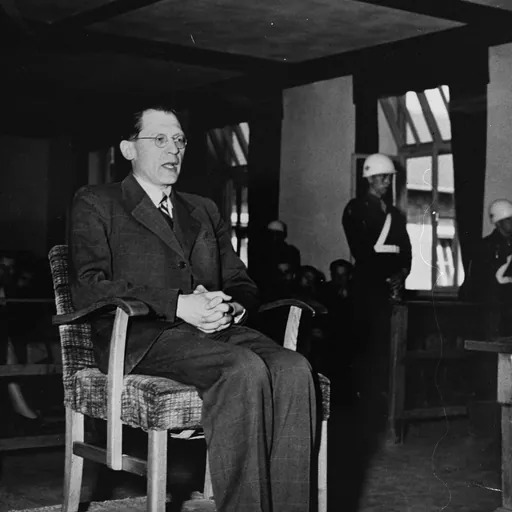
Eugen Kogon
German journalist, sociologist, professor and Holocaust survivor
About Eugen Kogon
Lived 1903 – 1987 (aged 84). Eugen Kogon was a German and Austrian journalist, historian of Modern Age, sociologist, writer, university teacher and politician.
Eugen Kogon (2 February 1903 – 24 December 1987) was a German historian and Nazi concentration camp survivor. A well-known Christian opponent of the Nazi Party, Kogon was arrested more than once and spent six years at Buchenwald concentration camp. Known in Germany as a journalist, sociologist, political scientist, author, and politician, he went on to be considered one of the "intellectual fathers" of both West Germany and European integration. His 1946 book still stands as a basic reference on Nazi crimes (translated 1950).
Early years Eugen Kogon was born in Munich, the son of an unmarried Russian-Jewish mother from Mykolaiv (a city then part of the Russian Empire, now in Ukraine). When he was 2 years old, she died and he was given foster parents and later attended a Catholic boarding school. He spent the larger portion of his youth in Catholic monasteries. After studying economics and sociology at the universities in Munich, Florence, and Vienna, Kogon received his doctorate in 1927 in Vienna with a dissertation on the Faschismus und Korporativstaat ("Corporate State and Fascism"). That same year, Kogon got a job as editor of the Catholic magazine Schönere Zukunft ("Brighter Future") and stayed there till 1937. Through his work, he made the acquaintance of sociologist Othmar Spann, who recommended him for the Zentralkommission der christlichen Gewerkschaften ("Central Committee of Christian Unions"). Kogon was an advisor there several years later. In 1934, after the July Putsch, Kogon took over the asset management of the House of Saxe-Coburg-Koháry for Prince Prince Philipp of Saxe-Coburg.
Nazi resistance Original 1946 cover of Kogon's (1950 tr. The Theory and Practice of Hell)
An avowed opponent of Nazism, Kogon was arrested by the Gestapo in 1936 and again in March 1937, charged with, among other things, "work[ing] for anti-national socialist forces outside the territory of the Reich". In March 1938, he was arrested a third time and, in September 1939, was deported to Buchenwald concentration camp, where he spent the next six years as "prisoner number 9093".
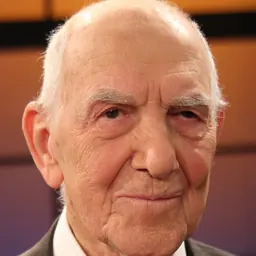
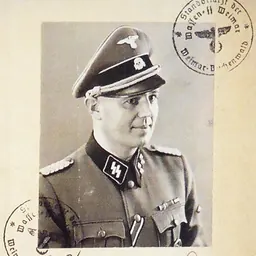
At Buchenwald, Kogon spent part of his time working as a clerk for camp doctor Erwin Ding-Schuler, who headed up the typhus experimentation ward there. According to Kogon's own statements, he was able to develop a relationship bordering on trust with Ding-Schuler, after becoming his clerk in 1943. In time, they had conversations about family concerns, the political situation and events at the front. According to Kogon, through his influence on Ding-Schuler, he was able to save the lives of many prisoners, including Stéphane Hessel, Edward Yeo-Thomas, and Harry Peulevé by exchanging their identities with those of prisoners who had died of typhus. In early April 1945, Kogon and the head prisoner nurse in the typhus experimentation ward, Arthur Dietzsch, found out from Ding-Schuler that their names were on a list of 46 prisoners whom the SS wanted to execute shortly before the expected liberation of the camp. Ding-Schuler saved Kogon's life at the end of the war by arranging to hide him in a crate, then smuggling him out of Buchenwald to his own home in Weimar.
Right after being liberated in 1945, Kogon again began working as a journalist. He worked as a volunteer historian for the United States Army at Camp King and began writing his book : Das System der deutschen Konzentrationslager ("The SS-State: The System of the German Concentration Camps"), first published in 1946, which still stands as a basic reference on Nazi crimes. The book was translated into several languages, in English, as . The German language version alone sold 500,000 copies.
Despite this intensive involvement with the past, Kogon primarily chose to look ahead, toward building a new society—one that would blend with Kogon's convictions of Christianity and socialism. Kogon had already spoken about his ideas in Buchenwald with fellow prisoner Kurt Schumacher. However, the rapid growth of the Social Democratic Party hindered the proposed alliance of right-wing social democrats and the Centre Party into a "Labour Party" after the British model.
Journalism
In September 1945, Kogon and other journalists, among them Walter Dirks, later his friend and companion, published the Frankfurter Leitsätze ("Frankfurt Guiding Principles"). In this Program of the Volkspartei ("popular party"), they called for an "economic socialism on a democratic basis", laying out an important basis for the Christian-socialist founding program of the Hessian Christian Democratic Union (CDU), also for the Constitution of Hesse, which was finalized at the end of 1946 and provided for the nationalization of key industries.
In 1946, Kogon and Dirks founded the Frankfurter Hefte ("Frankfurt Notebooks"), a cultural and political magazine with a left-wing Catholic point of view. They quickly reached a circulation of 75,000, which was very high for that time and, until 1984, remained one of the most influential socio-political and cultural magazines in the postwar era. In the , Kogon was involved in the search for a "third way" in the renewal of Germany. He quickly turned away from Konrad Adenauer's CDU, which was not interested in communal ownership and nationalization of key industries. Kogon instead wrote many essays taking a critical look at the Adenauer government. Among other issues, he turned against the Wiederbewaffnung, atomic weapons and the "madness of excessive armament".
European politician As a lesson from Nazism, Kogon early called for departure from a traditional nation-state and fought for the establishment of a European Republic. Among others, he was involved in the Union of European Federalists (UEF) and the German section of the UEF, where he served as the first President from 1949 to 1954. From 1951 to 1953, Kogon was also president of the German council of the European Movement.
Alfred Grosser counted him as one of the three "creators of Europe".
Later years In 1951, the Technische Hochschule Darmstadt established the first chair of scientific policy in Germany. The first chair holder was Kogon. He co-founded political science as a field of study in Germany. He was teaching there till his retirement in 1968, whereupon he was made professor emeritus. In 2002, the city began awarding an annual "Eugen Kogon Prize for Democracy in Action". The first winner was the former Polish Foreign Minister Wladyslaw Bartoszewski.
Don’t just read it —
keep it.
Full-length biographies made to live with: read them, listen on the way to work, watch them tonight.
- E-book
- Audio
- Video
Instant download · yours to keep · every purchase keeps this site free
Important facts
People in Eugen Kogon's life
Named in this biography and alive at the same time



Related people
Same field, nearest in time


Contemporaries
People whose lives overlapped Eugen Kogon's
Frequently asked questions
Who was Eugen Kogon?
German journalist, sociologist, professor and Holocaust survivor (1903-1987)
When was Eugen Kogon born?
Eugen Kogon was born on 2 February 1903 in Munich.
When did Eugen Kogon die?
Eugen Kogon died on 24 December 1987 in Königstein im Taunus.
What was Eugen Kogon's occupation?
Eugen Kogon was a journalist, historian of Modern Age, sociologist, writer, university teacher and politician.
What nationality was Eugen Kogon?
Eugen Kogon was German and Austrian.
Sources & further reading
Cite this page
APA: Biography.guide. (2026). Eugen Kogon. https://biography.guide/eugen-kogon/
MLA: "Eugen Kogon." Biography.guide, https://biography.guide/eugen-kogon/.
Chicago: "Eugen Kogon." Biography.guide. https://biography.guide/eugen-kogon/.
Data last updated: 2026-09-22 · Spot an error? Report a correction.
Portrait: Wikimedia Commons · author & licence
Page generated 2026-09-27 05:04 UTC