
About Eudokia Makrembolitissa
Lived 1021 – 1096 (aged 74–75). Eudokia Makrembolitissa was a Byzantine writer, sovereign and christian nun.
Co-guardian of her sons with Romanos IV
With her new husband's assistance, Eudokia was able to dispel the impending danger. She had two sons with Romanos IV, Nikephoros and Leo. Another of Eudokia and Constantine's sons, Andronikos Doukas, was also made co-emperor by Romanos IV, although he had been excluded from power by his own father, mother, and brothers. He was probably crowned too in 1068, although he is ignored by contemporary chronicles.
While Romanos appears on the reverse of his own coinage, where Christ is shown blessing the marriage of Eudokia and Romanos, Michael and his brothers occupy the important obverse side, showing Romanos ranks after Eudokia's sons. A tetarteron pattern depicts Eudokia with the scepter and the title of basilissa on the obverse outranking Romanos with the akakia and the title of despotes on the reverse, a contrast claiming too much in favor of the empress. On coins, the title of basilissa is used by only the empresses who assumed the throne: Irene, Zoe, Theodora, and Eudokia Makrembolitissa. The struck tetarteron shows Romanos and Eudokia, holding between them the globe, a gesture symbolizing that they rule the world together. A seal, dated to early 1068, link Romanos and Eudokia as co-rulers with the title 'Romanos and Eudokia emperors of the Romaioi'.
According to Michael Psellos, Eudokia explicitly referred to Romanos as "a subject, not a ruler." Romanos, however, soon started to act independently of her, even starting to resent her. Discontent was also shared by a faction of the Senate and army, with John Doukas at the head.
Co-sovereign with Michael VII
On 26 August 1071, Romanos IV faced Alp Arslan, sultan of the Seljuk Empire, at the decisive Battle of Manzikert. The Byzantine army was destroyed and the emperor himself was captured, partly because of the treachery of general Andronikos, John Doukas's son. The news reached Constantinople a few days later, causing much shock in the populace. The Senate declared Romanos IV deposed and proclaimed Eudokia and Michael VII as joint rulers, because Psellos had proposed their joint rule to resolve the dispute over whether power should be handed over to Michael VII or Eudokia. Some sources state that Eudokia was already planning on deposing her husband, but this is very unlikely.
Alexios II, for whom Maria was regent, was simply basileus, but upon his father Manuel I's death, he was immediately proclaimed autokrator. On the other hand, Michael VII continued to be referred to simply as basileus after his father Constantine X's death and was only proclaimed autokrator in 1071, reflecting how Eudokia's legal status after her husband's death differed from Maria's. Schreiner dates it in 1 October – 1 November 1071, and Polemis dates it in late September – late October 1071. when Eudokia's opposition became strong enough to depose her, especially after news of Romanos release arrived at the capital. Michael VII was then proclaimed sole autokrator by John Doukas, who forced Eudokia to retire to a monastery as a nun.
Later life
15th-century portrait of Eudokia, from the Mutinensis gr. 122 Eudokia continued to be influential even after her exile in 1071. Soon after her deposition, she allied with Anna Dalassene, a sister-in-law of Isaac I Komnenos who had also been exiled, to restore Romanos IV and depose John Doukas. However, Doukas soon fell from grace as a result of the schemes of eunuch Nikephoritzes, who was close to the Komnenos family. Eudokia later performed a memorable funeral and burial for Romanos IV, who died on 4 August 1072.
After Michael VII was deposed in 1078 by Nikephoros III Botaneiates, Eudokia was recalled to Constantinople by the new emperor, who offered to marry her. This plan did not come to pass, mainly due to the opposition of John Doukas, who returned to power after Nikephoritzes's exile. However, Nikephoros still sent her many rewards and gifts of gratitude. Her date of death is unknown, but it was sometime after the accession of Alexios I Komnenos in 1081. Her last known action is the adoption of one of the cousins of Patriarch Michael I Cerularius.
Attributed to Eudokia is a dictionary of history and mythology, called (i.e., Collection or Bed of Violets). It is prefaced by an address to her husband, Romanos Diogenes, and the work is described as "a collection of genealogies of gods, heroes, and heroines, of their metamorphoses, and of the fables and stories respecting them found in the ancients; containing also notices of various philosophers". However, the book is now thought to be a modern (16th-century) compilation, falsely attributed to Eudokia, and compiled by the counterfeiter Constantine Paleocappa 1540. The sources from which the work was compiled include Diogenes Laërtius and the Suda.
Issue
Miniature of Constantine X and Eudokia alongside their son and co-emperor Michael VII Doukas. By her first husband, Eudokia had seven children, four sons and three daughters: Michael VII Doukas, co-emperor from 1060 and senior emperor after 1071. A son who died in infancy. Anne Doukaina, nun. Andronikos Doukas, co-emperor from 1068 to 1078. Theodora Doukaina, who married Domenico Selvo, Doge of Venice. Konstantios Doukas, co-emperor from 1060 to 1078, died in battle with the Normans in 1081. Zoe Doukaina, who married Adrianos Komnenos, a brother of Emperor Alexios I Komnenos. They had a son, Alexios, and two daughters, maybe named Anne and Alexia.
By her second husband, she had two sons, most likely twins: Nikephoros Diogenes, blinded by order of Alexios I Comnenus on charges of treason. Leo Diogenes, died in battle.
Don’t just read it —
keep it.
Full-length biographies made to live with: read them, listen on the way to work, watch them tonight.
- E-book
- Audio
- Video
Instant download · yours to keep · every purchase keeps this site free
Important facts
Family & relationships
People in Eudokia Makrembolitissa's life
Named in this biography and alive at the same time

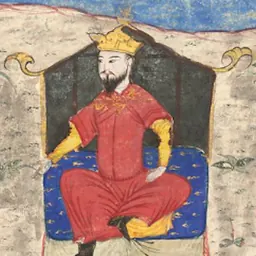

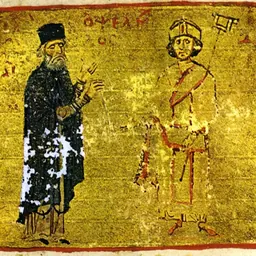

Related people
Same field, nearest in time



Contemporaries
People whose lives overlapped Eudokia Makrembolitissa's



Frequently asked questions
Who was Eudokia Makrembolitissa?
Byzantine Empress from 1059 to 1071
When was Eudokia Makrembolitissa born?
Eudokia Makrembolitissa was born in 1021.
When did Eudokia Makrembolitissa die?
Eudokia Makrembolitissa died in 1096.
What was Eudokia Makrembolitissa's occupation?
Eudokia Makrembolitissa was a writer, sovereign and christian nun.
What nationality was Eudokia Makrembolitissa?
Eudokia Makrembolitissa was Byzantine.
Sources & further reading
· Wikipedia: Eudokia Makrembolitissa
· DBpedia: Eudokia Makrembolitissa
Cite this page
APA: Biography.guide. (2026). Eudokia Makrembolitissa. https://biography.guide/eudokia-makrembolitissa/
MLA: "Eudokia Makrembolitissa." Biography.guide, https://biography.guide/eudokia-makrembolitissa/.
Chicago: "Eudokia Makrembolitissa." Biography.guide. https://biography.guide/eudokia-makrembolitissa/.
Data last updated: 2026-09-20 · Spot an error? Report a correction.
Page generated 2026-09-27 05:22 UTC