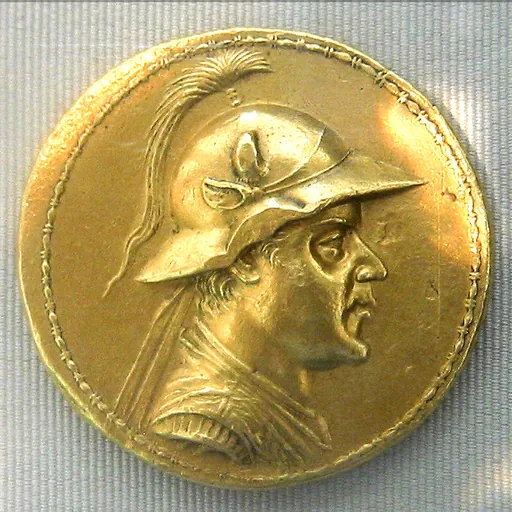
About Eucratides I
Lived 150 BC – 145 BC (aged 4–5). Eucratides I was a monarch.
Eucratides I (, Eukratídēs; Pali: Evukratida; reigned 172/171–145 BC), also known as Eucratides the Great, was one of the most important Greco-Bactrian kings. He conquered large parts of northern India, and minted a vast and prestigious coinage, suggesting a rule of considerable importance and prosperity. His immediate successors were the last Greek kings to rule in Bactria.
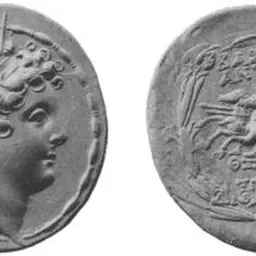
Biography Eucratides was born around 210–205 BC, the son of Heliocles and Laodice as depicted on various finds of his coinage. It is unclear whether he was a Bactrian nobleman who raised a rebellion, or, according to some scholars, a cousin of the Seleucid king Antiochus IV Epiphanes who was trying to regain the Bactrian territory. There has been much speculation on Eucratides' background and parentage. His mother, Laodice, is depicted wearing a royal diadem and therefore of royal descent, while his father is bare-headed. Tarn asserted that Laodice was a Seleucid princess, the daughter of Seleucus II Callinicus. Narain and other modern authors have challenged this established view.
Coup d'état Whatever his origins, Eucratides came to power by overthrowing the Euthydemid dynasty in Bactria, possibly when its king, Demetrius was conquering northwestern India. The king whom Eucratides dethroned in Bactria was probably Antimachus I.
Justin explains that Eucratides acceded to the throne at about the same time as Mithridates, whose rule is accurately known to have started in 171 BC, thereby giving an approximate date for the accession of Eucratides:
Having become master of Bactria after de-throning the Euthydemid dynasty, Eucratides was faced with a Parthian invasion which began when Demetrius I was conquering India. Having taken Tapuria and Margiana from Demetrius in about 170 BC, the powerful Mithridates I attempted to conquer Bactria itself but was checked by Eucratides. Having secured his western borders, Eucratides then conquered parts of India, campaigning as far south as Barigaza (modern day Bharuch), solidifying Greek presence in Northern India with the Indo-Greek Kingdom. According to the single remaining source, Roman historian Justin, Eucratides defeated Demetrius of India, but the identity of this king is uncertain: he could be either Demetrius I, or Demetrius II, but more likely Menander I. "Eucratides led many wars with great courage, and, while weakened by them, was put under siege by Demetrius, king of the Indians. He made numerous sorties, and managed to vanquish 60,000 enemies with 300 soldiers, and thus liberated after four months, he put India under his rule" Justin XLI,6
Numismatic evidence suggests that Eucratides I was a contemporary of the Indo-Greek kings Apollodotus I, Apollodotus II and Plato of Bactria. In any case, Eucratides' advances into India are proved by his abundant bilingual coinage that are spread all over northern India and Pakistan.
The city of Eucratideia (Εὐκρατίδεια), which is mentioned by ancient Greek geographers as city of great wealth straddling the Oxus River, was probably named after Eucratides. It might have been a totally new foundation or an existing city which he had renamed after himself. The location of the city is uncertain, but it was probably Ai-Khanoum or perhaps Dilbarjin.
From 162-158 BCE, Eucratides lost the satrapies of Aria and Margiana to Mithridates I of Parthia .
Death
Justin ends his account of Eucratides' life by claiming that the warlike king was murdered on his way back from India by his son, who hated Eucratides so much that he mutilated and dragged his dead body after his chariot. This may have been a misinterpretation by Justin, and the regicide could instead have been perpetrated by an Euthydemid prince, Demetrius II, the son and successor of Demetrius I. Justin appears to believe Eucratides was killed by his own son, Heliocles I, but this is unlikely as patricide was uncommon in the Hellenistic age.
"As Eucratides returned from India, he was killed on the way back by his son, who ran his chariot over the blood of the king, and ordered the corpse to be left without a sepulture" Justin XLI,6
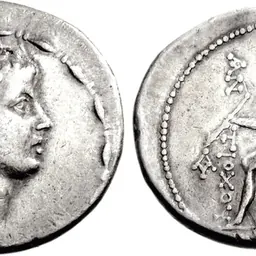
Tetradrachm of Eucratides I, obverse showing him wearing a Boeotian type helmet with a diadem and holding a spear in his right hand. The murder of Eucratides probably brought about a civil war amongst the members of the dynasty. The successors to Eucratides were Eucratides II and Heliocles I (145–130 BC), who was the last Greek king to reign in Bactria. Once the Yuezhi tribes overpowered Heliocles, the Greco-Bactrians lost control of the provinces north of the Hindu Kush. Other members of the dynasty were Plato of Bactria and probably Demetrius II, who in that case was not identical with the king Justin claimed was the enemy of Eucratides I.
Eucratides was the last known ruler of Ai-Khanoum, which was also his capital city. Ai-Khanoum was a prosperous Greek city in Bactria and excavations in the 20th century showed that it had all the hallmarks of a true Hellenistic city. It was likely destroyed at the end of Eucratides' reign in about 145 BC.
The rule of the Greco-Bactrians soon crumbled following these numerous wars:
"The Bactrians, involved in various wars, lost not only their rule but also their freedom, as, exhausted by their wars against the Sogdians, the Arachotes, the Dranges, the Arians and the Indians, they were finally crushed, as if drawn of all their blood, by an enemy weaker than them, the Parthians." Justin, XLI,6
Gallery Eucratides issued many different coin designs, such as dynastic coins with what looks like his parents, normal Attic coins and also square Indian coins with legends in Greek and Pali language.
Don’t just read it —
keep it.
Full-length biographies made to live with: read them, listen on the way to work, watch them tonight.
- E-book
- Audio
- Video
Instant download · yours to keep · every purchase keeps this site free
Important facts
Family & relationships
Related people
Same field, nearest in time


Frequently asked questions
Who was Eucratides I?
Greco-Bactrian king from 172/171 BC to 145 BC
When was Eucratides I born?
Eucratides I was born in 150 BC.
When did Eucratides I die?
Eucratides I died in 145 BC.
What was Eucratides I's occupation?
Eucratides I was a monarch.
Sources & further reading
Cite this page
APA: Biography.guide. (2026). Eucratides I. https://biography.guide/eucratides-i/
MLA: "Eucratides I." Biography.guide, https://biography.guide/eucratides-i/.
Chicago: "Eucratides I." Biography.guide. https://biography.guide/eucratides-i/.
Data last updated: 2026-09-23 · Spot an error? Report a correction.
Portrait: Wikimedia Commons · author & licence
Page generated 2026-09-27 05:07 UTC