
About Antiochus VII Sidetes
Lived 159 BC – 129 BC (aged 29–30). Antiochus VII Sidetes was a monarch.
Antiochus VII Euergetes (; 164/160 BC 129 BC), nicknamed Sidetes (from Side, a city in Asia Minor), also known as Antiochus the Pious, was ruler of the Hellenistic Seleucid Empire from July/August 138 to 129 BC. He was the last Seleucid king of any stature. After Antiochus was killed in battle, the Seleucid realm was restricted to Syria.
Biography Early life and early reign He was one of the sons of Demetrius I Soter, the brother of Demetrius II Nicator and his mother may have been Laodice V. Antiochus was elevated after Demetrius was captured by the Parthians. He married Cleopatra Thea, who had been the wife of Demetrius. Their offspring was Antiochus IX, who thus became both half-brother and cousin to Seleucus V and Antiochus VIII.
In his nine-year reign, Antiochus made some effort to undo the massive territorial and authority losses of recent decades. Antiochus defeated the usurper Diodotus Tryphon at Dora and laid siege to Jerusalem in 134 BC. During the siege he allowed a seven-day truce for the Jews to celebrate a religious festival, impressing the Jewish leadership. According to Josephus the Hasmonean leader John Hyrcanus opened King David's sepulchre and removed three thousand talents, which he then paid Antiochus to spare the city. Nevertheless, King Antiochus' respectful treatment of the Jews, and respect for their religion, earned him their gratitude and added name Euergetes ("the Benefactor"). With no Jewish sources of that time (the Book of Maccabees ends a few years before his time), it is unclear if the siege of Jerusalem ended with a decisive Seleucid victory or simply a peace treaty. Furthermore, Jewish forces later assisted Antiochus in his wars, and for nearly 20 years after his death, John Hyrcanus refrained from attacking areas under Seleucid control.
Later territory disputes and defeat
Antiochus spent the final years of his life attempting to reclaim the lost eastern territories, overrun by the Parthians under their "Great King", Mithridates I. Marching east, with what would prove to be the last great Seleucid royal army (including a unit of Judean troops under John Hyrcanus), he defeated Mithridates in two battles. He restored Mesopotamia, Babylonia and Media to the Seleucid empire, before dispersing his army into winter quarters.
The Seleucid king and army spent the winter feasting, hunting and drinking (the Seleucids maintained the Macedonian tradition of heavy drinking). As with any time an army is quartered upon a population, tensions soon grew between the locals and the Syrian troops.
The new Parthian ruler, Phraates II, had not been idle. He raised a new army while stirring up rebellion in the Seleucid occupied towns of Media. Hoping to further sow dissension amongst his foes, Phraates also released his long-held prisoner, Demetrius II, Antiochus' older brother, who returned to Syria to reclaim the throne.
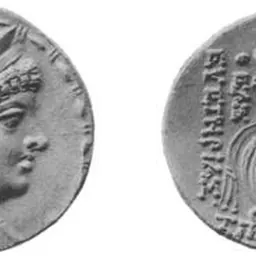
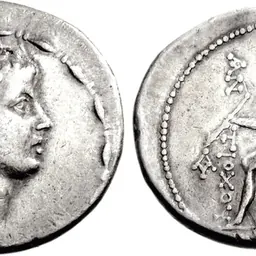
That winter (130–129 BC), several Median towns rose in rebellion and attacked their Seleucid garrisons. Antiochus marched to support one such isolated garrison with only a small force (probably only his Royal Guards). In a barren valley, he was ambushed and killed in the Battle of Ecbatana by Phraates II and a large force of Parthians, who had entered the country without being detected. Most Greco-Roman historians state that Antiochus died in battle; the victorious Parthians claimed that he killed himself because of fear, an assertion also made by Appian. Silver coin of Antiochus VII Sidetes, with the reverse showing seated Tyche holding cornucopia. Greek legend reads: ΒΑΣΙΛΕΩΣ ΑΝΤΙΟΧΟΥ ΕΥΕΡΓΕΤΟΥ, Basileōs Antiochou Euergetou, "of king Antiochus, the benefactor."
Succession Antiochus's confirmed heir was Antiochus IX Cyzicenus. But a fragment from book 16 of Posidonius' "Histories", which survives in the Deipnosophistae written by Athenaeus, mentions a king named Seleucus, who was captured in Media by king Arsaces and treated like royalty. The identity of this Seleucus have been a matter of debate; the possibility of Seleucus being a son of Antiochus VII captured after the death of his father is suggested by Felix Jacoby and, with reservations, by Ian G. Kidd.
Don’t just read it —
keep it.
Full-length biographies made to live with: read them, listen on the way to work, watch them tonight.
- E-book
- Audio
- Video
Instant download · yours to keep · every purchase keeps this site free
Important facts
Family & relationships
People in Antiochus VII Sidetes's life
Named in this biography and alive at the same time


Related people
Same field, nearest in time

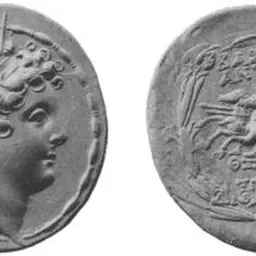

Contemporaries
People whose lives overlapped Antiochus VII Sidetes's


Frequently asked questions
Who was Antiochus VII Sidetes?
king of Seleucid Empire from 138 to 129 BC
When was Antiochus VII Sidetes born?
Antiochus VII Sidetes was born in 159 BC in Side.
When did Antiochus VII Sidetes die?
Antiochus VII Sidetes died in 129 BC in Ecbatana.
What was Antiochus VII Sidetes's occupation?
Antiochus VII Sidetes was a monarch.
What nationality was Antiochus VII Sidetes?
Antiochus VII Sidetes's recorded nationality: Seleucid Empire.
Sources & further reading
· Wikipedia: Antiochus VII Sidetes
· DBpedia: Antiochus VII Sidetes
Cite this page
APA: Biography.guide. (2026). Antiochus VII Sidetes. https://biography.guide/antiochus-vii-sidetes/
MLA: "Antiochus VII Sidetes." Biography.guide, https://biography.guide/antiochus-vii-sidetes/.
Chicago: "Antiochus VII Sidetes." Biography.guide. https://biography.guide/antiochus-vii-sidetes/.
Data last updated: 2026-09-26 · Spot an error? Report a correction.
Page generated 2026-09-27 05:14 UTC