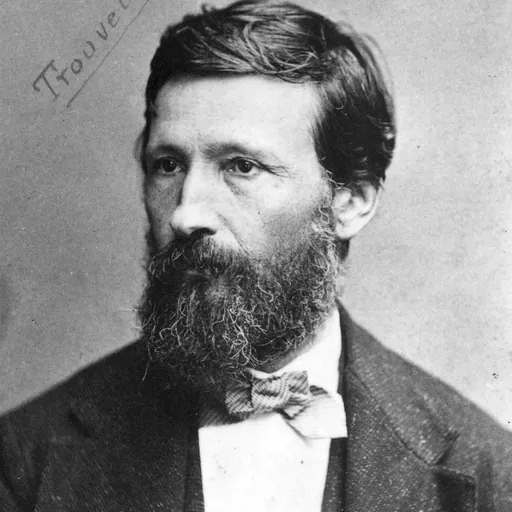
Étienne Léopold Trouvelot
Astronomer, entomologist and lithographer from France
About Étienne Léopold Trouvelot
Lived 1827 – 1895 (aged 67). Étienne Léopold Trouvelot was a French astronomer, entomologist, lithographer, illustrator, painter and visual artist, known for Spongy moth.
Étienne Léopold Trouvelot (December 26, 1827 – April 22, 1895) was a French artist, astronomer and amateur entomologist. He is noted for the import and release of the gypsy moth, also known as the spongy moth, into North America. The spread of the moths as an invasive species has resulted in damage to millions of trees throughout the eastern United States.
Biography
Trouvelot was born at Aisne, France. Little is known about his early life, although it is possible he was a republican and anti-royalist. Following a coup d'état by Louis-Napoleon Bonaparte in 1851, he fled with his family to the United States. They settled in the town of Medford, Massachusetts, a suburb of Boston, at the address of 27 Myrtle St. There he supported himself and his family as an artist and astronomer.
Trouvelot had an interest as an amateur entomologist. In the U.S., silk-producing moths were being killed off by various diseases. Trouvelot was very interested in Lepidoptera larvae including native North American silk moths which he believed could potentially be used for silk production. For reasons that remain unknown, Trouvelot brought some spongy moth egg masses from Europe in the mid-1860s and was raising spongy moth larvae in the forest behind his house. Unfortunately, some of the larvae escaped into the nearby woods. Trouvelot likely mentioned the escape to local entomologists, and an entomology journal from 1870 claims the incident occurred the previous year. Some sources say Trouvelot issued warnings to government officials, but there is no record of these communications. If he did, no officials were willing to assist in searching out and destroying the moths.
Shortly following this incident, Trouvelot lost interest in entomology and turned again to astronomy. In this field he could put his skills as an artist to good use by illustrating his observations. His interest in astronomy was apparently aroused in 1870 when he witnessed several auroras.
When Joseph Winlock, the director of Harvard College Observatory, saw the quality of his illustrations, he invited Trouvelot to join the staff there in 1872. In 1875, he was invited to use the U. S. Naval Observatory to use the 26-inch refractor for a year. During the course of his life he produced about 7,000 quality astronomical illustrations. He first produced pastel illustrations and then fifteen of his most superb works were published as chromolithographs by Charles Scribner's Sons in 1881. He was particularly interested in the Sun, and discovered "veiled spots" in 1875. He was elected a fellow of the American Academy of Arts and Sciences in 1877.
Besides his illustrations, he published about 50 scientific papers.
By 1882, Trouvelot had returned to France and joined the Meudon Observatory where he worked with photography and became engaged in a bitter rivalry with his boss, the astronomer Jules Janssen. This was a few years before the magnitude of the problem caused by his spongy moth release became apparent to the local government of Massachusetts. He died in Meudon, France. The spongy moth was considered a serious pest and attempts were underway to eradicate it (ultimately these were unsuccessful). To this date, the spongy moth continues to expand its range in the United States, and together with other foliage-eating pests, cause an estimated $868 million in annual damages.
Awards and honors Valz Prize by the French Academy of Sciences The crater Trouvelot on the Moon is named after him. The crater Trouvelot on Mars is named after him.
Don’t just read it —
keep it.
Full-length biographies made to live with: read them, listen on the way to work, watch them tonight.
- E-book
- Audio
- Video
Instant download · yours to keep · every purchase keeps this site free
Important facts
People in Étienne Léopold Trouvelot's life
Named in this biography and alive at the same time
Related people
Same field, nearest in time


Contemporaries
People whose lives overlapped Étienne Léopold Trouvelot's





Frequently asked questions
Who was Étienne Léopold Trouvelot?
astronomer, entomologist and lithographer from France (1827-1895)
When was Étienne Léopold Trouvelot born?
Étienne Léopold Trouvelot was born on 26 December 1827 in Guyencourt.
When did Étienne Léopold Trouvelot die?
Étienne Léopold Trouvelot died on 22 April 1895 in Meudon.
What was Étienne Léopold Trouvelot's occupation?
Étienne Léopold Trouvelot was an astronomer, entomologist, lithographer, illustrator, painter and visual artist.
What was Étienne Léopold Trouvelot known for?
Étienne Léopold Trouvelot was known for Spongy moth.
What nationality was Étienne Léopold Trouvelot?
Étienne Léopold Trouvelot was French.
Sources & further reading
· Wikipedia: Étienne Léopold Trouvelot
· DBpedia: Étienne Léopold Trouvelot
Cite this page
APA: Biography.guide. (2026). Étienne Léopold Trouvelot. https://biography.guide/etienne-leopold-trouvelot/
MLA: "Étienne Léopold Trouvelot." Biography.guide, https://biography.guide/etienne-leopold-trouvelot/.
Chicago: "Étienne Léopold Trouvelot." Biography.guide. https://biography.guide/etienne-leopold-trouvelot/.
Data last updated: 2026-09-20 · Spot an error? Report a correction.
Page generated 2026-09-27 05:10 UTC