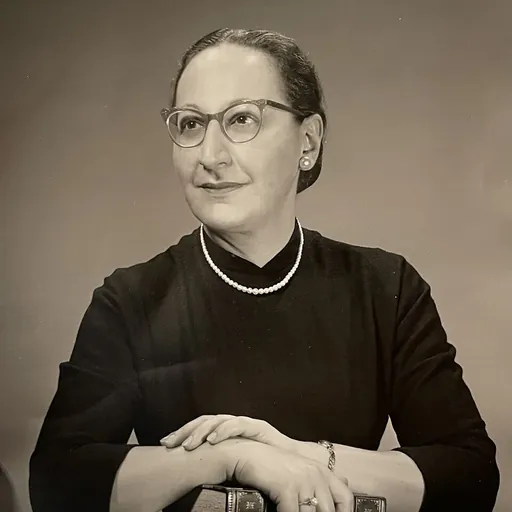
About Ethel M. Albert
Lived 1918 – 1989 (aged 70–71). Ethel M. Albert was an American ethnologist, known for Navajo and Rundi people.
Ethel M. Albert (28 March 1918 – October 1989) was an American ethnologist. Albert conducted ethnological research related to speech, values, and ethics, employing a cross-cultural approach studying different social classes, ethnic groups, and locations. and the Rundi people in the Republic of Burundi.
Early life and education Ethel Mary Albert was born in New Britain, Connecticut, on March 28, 1918, to Zundel and Dorothy (Eisenstadt) Sokolsky.
Albert developed a variety of research interests, including cross-cultural anthropological studies of values and speech, semiotics, and eventually later in her life, fatalism.
Fieldwork with the Navajo (Diné) Albert's research focused on comparative ethnophilosophy and value systems in different Native American groups. In 1953, she became a research associate at the Laboratory of Social Relations at Harvard University, a position she held until 1955 while conducting fieldwork with the Navajo (Diné). Albert prevented her research from being overwhelmed by these variables by forming a "normal operating base" Hundreds of speakers of the Rundi language live in Uganda, Tanzania, and Rwanda.
Albert studied speech training among boys and girls in the Burundi tribe, including how they compose amazina, or "praise poems," funeral orations, or rhetoric as opposed to girls who are taught to listen and repeat conversations. Albert also studied different political behaviors among closely related countries, including between Ruanda and Urundi.
Albert published her work widely and contributed to the publications of other researchers. Albert published her research related to social values based on social statutes among the Burundi in Denise Paulme's Women of Tropical Africa. Albert also applied her value system research in the United States, publishing an article on value uncertainty and value conflicts in American society, related to changes in the mid-twentieth century and the presence of alternative value systems make up of different cultural groups in American society. Albert taught anthropology and speech at Northwestern University from 1966 to 1977.
Albert was actively involved in professional anthropological associations. She participated in a two-day conference of regional specialists in West and Central Africa fieldwork in May 1958 at Northwestern University. The product of this conference was the Field Guide to West and Central Africa (1959), by Alvin William Wolfe. Later in life, Albert began a manuscript on cross cultural studies of fatalism, but it remains unpublished. Notes and drafts of Albert's unpublished manuscript are in the Ethel Mary Albert Papers at the National Anthropological Archives.
Semiotician Thomas Albert Seboek notes that he kept in touch with Albert throughout the 1960s after he first met her in Kluckhohn's Harvard office. He explains in his book Global Semiotics that Albert was forced into early retirement due to a progressive chronic disease. Albert died in October 1989 in Sarasota, Florida at the age of 71.
The Ethel Mary Albert Papers are kept at the National Anthropological Archives. Albert's papers include writings, photographs, and sound recordings from her research among the Burundi, Rundi texts and biographies, research materials from Albert's fieldwork with the Navajo (Diné), and materials related to cross cultural studies of fatalism.
Selected bibliography
1956 "The classification of values: a method and illustration." American Anthropologist 58, no. 2: 221–248. 1960 "Socio-political organization and receptivity to change: Some differences between Ruanda and Urundi." Southwestern Journal of Anthropology 16, no. 1: 46–74. 1963 "Women of Burundi: A study of social values." In Women of tropical Africa, edited by Denise Paulme, pp. 179–217. 1963 "Conflict and Change in American Values a Culture-Historical Approach." Ethics 74, no. 1 (1963): 19–33. 1964 "'Rhetoric,' 'Logic,' and 'Poetics' in Burundi: Culture Patterning of Speech Behavior." American Anthropologist 66, no. 6: 35–54. 1969 Great Traditions in Ethics. New York: American Book Co. 1970 "Conceptual Systems in Africa." In The African Experience, Volume I: Essays, edited by John N. Paden and Edward W. Soja, pp. 99–100.
Don’t just read it —
keep it.
Full-length biographies made to live with: read them, listen on the way to work, watch them tonight.
- E-book
- Audio
- Video
Instant download · yours to keep · every purchase keeps this site free
Important facts
People in Ethel M. Albert's life
Named in this biography and alive at the same time



Related people
Same field, nearest in time



Contemporaries
People whose lives overlapped Ethel M. Albert's


Frequently asked questions
Who was Ethel M. Albert?
American ethnologist
When was Ethel M. Albert born?
Ethel M. Albert was born on 28 March 1918 in New Britain.
When did Ethel M. Albert die?
Ethel M. Albert died in 1989 in Sarasota.
What was Ethel M. Albert's occupation?
Ethel M. Albert was an ethnologist.
What was Ethel M. Albert known for?
Ethel M. Albert was known for Navajo and Rundi people.
What nationality was Ethel M. Albert?
Ethel M. Albert was American.
Sources & further reading
Cite this page
APA: Biography.guide. (2026). Ethel M. Albert. https://biography.guide/ethel-m-albert/
MLA: "Ethel M. Albert." Biography.guide, https://biography.guide/ethel-m-albert/.
Chicago: "Ethel M. Albert." Biography.guide. https://biography.guide/ethel-m-albert/.
Data last updated: 2026-09-22 · Spot an error? Report a correction.
Portrait: Wikimedia Commons · author & licence
Page generated 2026-09-27 05:04 UTC