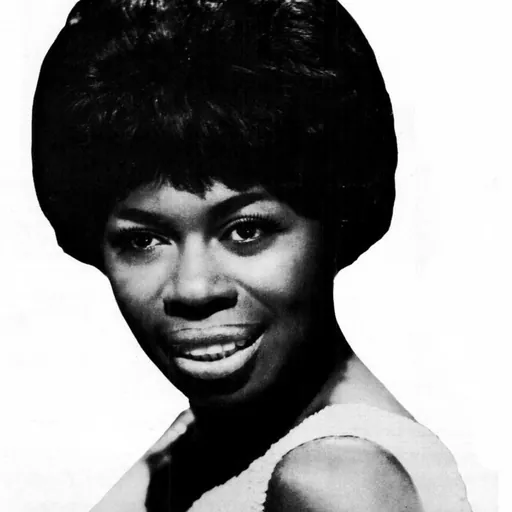
About Esther Phillips
Lived 1935 – 1984 (aged 48). Esther Phillips was an American singer, jazz musician, soul musician and musician.
Esther Phillips (December 23, 1935 – August 7, 1984), born Esther Mae Jones, She rose to prominence in 1950, scoring several major R&B hits including "Double Crossing Blues" and "Mistrustin' Blues" under the moniker "Little Esther." In the 1960s, she achieved chart success with the country song "Release Me" and recorded in the pop, jazz, blues and soul genres. Phillips received four Grammy nominations, including for her album From a Whisper to a Scream in 1973, as well as for the album that featured her disco recording of "What a Diff'rence a Day Makes," which was a major hit in 1975. She died from liver and kidney failure due to long-term drug abuse in 1984.
Biography
Early life Esther Phillips was born Esther Mae Jones in Galveston, Texas, the daughter of Arthur Jones and Lucille (née) Washington. Her parents divorced during her adolescence, and she divided her time between her father, in Houston, and her mother, in the Watts section of Los Angeles. She was brought up singing in church and was reluctant to enter a talent contest at a local blues club, but her sister insisted. A mature singer at the age of 14, she won the amateur talent contest in 1949 at the Barrelhouse Club, owned by Johnny Otis. Otis was so impressed that he recorded her for Modern Records and added her to his traveling revue, the California Rhythm and Blues Caravan, billed as Little Esther. She later took the surname Phillips as her stage name, reportedly inspired by a sign at a gas station.
Early career Her first hit record was "Double Crossing Blues", with the Johnny Otis Quintette and the Robins (a vocal group), released in 1950 by Savoy Records, which reached number 1 on the Billboard R&B chart. She made several hit records for Savoy with the Johnny Otis Orchestra, including "Mistrusting Blues" (a duet with Mel Walker) and "Cupid's Boogie", both of which also went to number 1 that year. Four more of her records made the Top 10 in the same year: "Misery" (number 9), "Deceivin' Blues" (number 4), "Wedding Boogie" (number 6), and "Far Away Blues (Xmas Blues)" (number 6). Few female artists performing in any genre had such success in their debut year.
In 1954, she returned to Houston to live with her father and recuperate. Short on money, she worked in small nightclubs around the South, punctuated by periodic hospital stays in Lexington, Kentucky, to treat her addiction. In 1962, Kenny Rogers discovered her singing at a Houston club and helped her get a contract with Lenox Records, owned by his brother Lelan.
Comeback Phillips eventually recovered enough to launch a comeback in 1962. Now billed as Esther Phillips instead of Little Esther, she recorded a country tune, "Release Me", with the producer Bob Gans. This went to number 1 on the R&B chart and number 8 on the pop chart. After several other minor R&B hits for Lenox, she was signed by Atlantic Records. Her cover of the Beatles' song "And I Love Him" nearly made the R&B Top 20 in 1965. The Beatles flew her to the UK for her first overseas performances. In July 2018, Paul McCartney recalled "the earliest [Beatles cover] that really caught my ear was by Esther Phillips ... 'And I Love Him' which is really great. I love it."
She had other hits in the 1960s for Atlantic, such as the Jimmy Radcliffe song "Try Me", which featured a saxophone part by King Curtis (and is often mistakenly credited as the James Brown song of the same title), but she had no more chart-toppers. Her heroin dependence worsened, and she checked into a rehabilitation facility. There she met the singer Sam Fletcher. While undergoing treatment, she recorded some sides for Roulette in 1969, mostly produced by Lelan Rogers. On her release, she returned to Los Angeles and re-signed with Atlantic. Her friendship with Fletcher resulted in a performance engagement at Freddie Jett's Pied Piper club in late 1969, which produced the album Burnin'''. She performed with the Johnny Otis Show at the Monterey Jazz Festival in 1970.
The 1970s and 1980s
One of her biggest post-1950s triumphs was her first album for the Kudu label, From a Whisper to a Scream, in 1972. The lead track, "Home Is Where the Hatred Is", an account of drug use written by Gil Scott-Heron, was nominated for a Grammy Award. Phillips lost to Aretha Franklin, but Franklin presented the trophy to her, saying she should have won it instead.
In 1975, she released a disco-style update of Dinah Washington's "What a Diff'rence a Day Makes", her biggest hit single since "Release Me". It reached the Top 20 in the United States and the Top 10 in the UK Singles Chart. On November 8, 1975, she performed the song on an episode of NBC's Saturday Night (later called Saturday Night Live) hosted by Candice Bergen. The accompanying album of the same name became her biggest seller yet, with arranger Joe Beck on guitar, Michael Brecker on tenor sax, David Sanborn on alto sax, Randy Brecker on trumpet, Steve Khan on guitar and Don Grolnick on keyboards.
She continued to record and perform throughout the 1970s and early 1980s, completing seven albums for Kudu/CTI and four for Mercury Records, which signed her in 1977. Her first album for Mercury, You've Come a Long Way, Baby, was released that year; according to Village Voice critic Robert Christgau, "using Kudu producer Pee Wee Ellis and the basic Kudu formula—mixing blues and standards and rock with MOR and disco crossovers—she comes up with her most consistent album of the '70s." Her funeral services were conducted by Johnny Otis. she was reinterred in 1985 in the Morning Light section at Forest Lawn Memorial Park, Hollywood Hills, in Los Angeles. A bronze marker recognizes her career achievements and quotes a Bible passage: "In My Father's House Are Many Mansions" (John 14:2).
Rock and Roll Hall of Fame Phillips was twice nominated for the Rock and Roll Hall of Fame, in 1986 and 1987, but has not yet been inducted.
Blues Hall of Fame In 2023 Phillips was inducted in the Blues Hall of Fame.
Grammy nominations Esther Phillips Grammy Award History Year Category Title Genre Label Result 1970 Best Rhythm & Blues Vocal Performance – Female "Set Me Free" R&B Atlantic Nominee 1972 Best Rhythm & Blues Vocal Performance – FemaleFrom a Whisper to a Scream R&B Kudu/CTI Nominee 1973 Best Rhythm & Blues Vocal Performance – Female Alone Again (Naturally) R&B Kudu/CTI Nominee 1975 Best Rhythm & Blues Vocal Performance – Female What a Diff'rence a Day Makes R&B Kudu/CTI Nominee
Discography
Albums Year Title Label
1963 Release Me|Lenox
1965
Burnin' (Live)
From a Whisper to a Scream|Kudu/CTI
1974
What a Diff'rence a Day Makes|Kudu/CTI
Capricorn Princess|Kudu/CTI
Confessin' the Blues* Atlantic* (1966, 1970)
For All We Know|Kudu/CTI
1977
1978
1979
1981
1986 A Way to Say Goodbye|Muse (Compilation).
Singles Year SingleChart positions US USR&B USAC AUS 1950 "Double Crossing Blues"* — 1 — — — "Mistrusting Blues"* — 1 — — — "Misery"* — 9 — — — "Cupid's Boogie"* — 1 — — — "Deceivin' Blues"* — 4 — — — "Wedding Boogie"* — 6 — — — "Far Away Blues (Xmas Blues)"* — 6 — — — 1952 "Ring-a-Ding-Doo" — 8 — — — 1962 "Release Me" 8 1 — — — 1963 "I Really Don't Want to Know" 61 — — — — "Am I That Easy to Forget" 112 — — — — "You Never Miss Your Water (Til the Well Runs Dry)"** 73 — — — — "If You Want It (I've Got It)"** 129 — — — — 1964 "Hello Walls" — 36 — — — 1965 "And I Love Him" 54 11 14 — — "Moonglow and Theme from Picnic" 115 — 28 — — "Let Me Know When It's Over" 129 — — — — 1966 "When a Woman Loves a Man" 73 26 — — — 1969 "Too Late to Worry, Too Blue to Cry" 121 35 — — — 1970 "Set Me Free" 118 39 — — — 1972 "Home Is Where the Hatred Is" 122 40 — — — "Baby, I'm for Real" — 38 — — — "I've Never Found a Man (To Love Me Like You Do)" 106 17 — — — 1975 "What a Diff'rence a Day Makes"*** 20 10 29 38 6 1976 "For All We Know" — 98 — — — 1983 "Turn Me Out" — 85 — — — With the Johnny Otis Orchestra With Big Al Downing "What a Diff'rence a Day Makes" also reached number 2 on the US Dance chart. Another two-sided single, "Magic's In the Air" / "Boy I Really Tied One On", peaked at number 5 on the same chart in 1976.
Complete singles for Federal Records, 1951–1953 All released on 45- and 78-rpm records 1951 Federal 12016, "The Deacon Moves In" (with the Dominoes) / "Other Lips, Other Arms" Federal 12023, "I'm a Bad, Bad Girl" / "Don't Make a Fool Out of Me" Federal 12036, "Lookin' for a Man to Satisfy My Soul" / "Heart to Heart" (with The Dominoes) Federal 12042, "Cryin' and Singin' the Blues" / "Tell Him That I Need Him" 1952 Federal 12055, "Ring-a-Ding-Doo" (with Bobby Nunn) / "The Cryin' Blues" Federal 12063, "Summertime" / "The Storm" Federal 12065, "Better Beware" / "I'll Be There" Federal 12078, "Aged and Mellow" / "Bring My Lovin' Back to Me" Federal 12090, "Ramblin' Blues" / "Somebody New" Federal 12100, "Mainliner" (with 4 Jacks) / "Saturday Night Daddy" (with Bobby Nunn) 1953 Federal 12108, "Last Laugh Blues" (with Little Willie Littlefield) / "Flesh, Blood and Bones" Federal 12115, "Turn The Lamp Down Low" (with Little Willie Littlefield) / "Hollerin' and Screamin Federal 12122, "You Took My Love Too Fast" (with Bobby Nunn) / "Street Lights" Federal 12126, "Hound Dog" / "Sweet Lips" Federal 12142, "Cherry Wine" / "Love Oh Love"Taken from the original logbooks of the defunct Federal Records, which I copied decades ago. Filmography Television 1965: The Music of Lennon & McCartney, musical guest 1970: The Barbara McNair Show, musical guest 1970: The Tonight Show Starring Johnny Carson, musical guest 1975: Saturday Night Live, musical guest 1975: Soul Train'', musical guest
Don’t just read it —
keep it.
Full-length biographies made to live with: read them, listen on the way to work, watch them tonight.
- E-book
- Audio
- Video
Instant download · yours to keep · every purchase keeps this site free
Important facts
People in Esther Phillips's life
Named in this biography and alive at the same time







Related people
Same field, nearest in time





Contemporaries
People whose lives overlapped Esther Phillips's


Frequently asked questions
Who was Esther Phillips?
American singer (1935–1984)
When was Esther Phillips born?
Esther Phillips was born on 23 December 1935 in Galveston.
When did Esther Phillips die?
Esther Phillips died on 7 August 1984 in Carson.
What was Esther Phillips's occupation?
Esther Phillips was a singer, jazz musician, soul musician and musician.
What nationality was Esther Phillips?
Esther Phillips was American.
Sources & further reading
Cite this page
APA: Biography.guide. (2026). Esther Phillips. https://biography.guide/esther-phillips/
MLA: "Esther Phillips." Biography.guide, https://biography.guide/esther-phillips/.
Chicago: "Esther Phillips." Biography.guide. https://biography.guide/esther-phillips/.
Data last updated: 2026-09-22 · Spot an error? Report a correction.
Portrait: Wikimedia Commons · author & licence
Page generated 2026-09-27 05:04 UTC