
About Ester Hernandez
Born 1944. Ester Hernandez is an American artist.
Ester Hernández (born 1944) is an American Chicana visual artist recognized for her prints and pastels focusing on farm worker rights, cultural, political, and Chicana feminist issues. Hernández was an activist in the Chicano Arts Movement in the 1960's and also made art pieces that focus on issues of social justice, civil rights, women's rights, and the Farm Worker Movement. She is based in San Francisco, California.
Early life and education Hernández is a Chicana of Yaqui and Mexican heritage. During the Great Depression, Hernandez’s grandparents immigrated from Mexico to California to work on commercial grape farms. She was born in Dinuba, a small town in the central San Joaquin Valley of California. Her parents and family were farmworkers. Hernandez’s father Simón Hernández was a member of the United Farm Workers Union. Hernandez had an interest in art from an early age, particularly in paintings and pastels. During her time in Dinuba, Hernandez watched as friends and family were diagnosed with cancer as a result of the usage of pesticides in the grape fields. Hernandez described having memories of watching her mother boil water to ensure that it was safe to drink due to pesticide contamination. Although Hernandez had originally began studying anthropology, she became interested in print-making during her time attending Berkeley. the Smithsonian American Art Museum in Washington, DC and the National Museum of Mexican Art.
Hernández's archives are housed at the Stanford University Library's Department of Special Collections in Palo Alto, California.
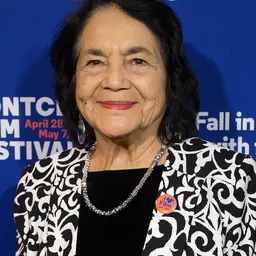
Hernández often draws inspiration from her personal heroines, who include Frida Kahlo, Dolores Huerta, and Lydia Mendoza. Notable Artworks La Virgen de Guadalupe Defendiendo los Derechos de Los Xicanos (1976) La Virgen de Guadalupe Defendiendo los Derechos de Los Xicanos is an etching and aquatint created by Hernandez in 1976 while she was a student at UC Berkeley.
While enrolled in an etching class at UC Berkeley, Ester Hernandez was inspired by personal experiences that ultimately led her to create La Virgen de Guadalupe Defendiendo los Derechos de los Xicanos. In an interview with scholar Roman-Odio, who has written extensively on Chicana feminist art, Ester Hernandez shared she received a card with the image of Our Lady of Guadalupe at her grandmother's funeral but immediately thought that it did not truly represent her grandmother: “My grandmother had sixteen kids, worked years in the fields and had a hard, but beautiful life. She was a strong and powerful woman, so I decided to change the image.” In Libertad, Hernandez reimagines the Statue of Liberty, an iconic American symbol, to reclaim the history of the Americas and uplift the presence of natives peoples.
Sun Mad (1982)
Sun Mad is a 1982 serigraph. This screen print is in the permanent collection of the Los Angeles Museum of Art in California, and the National Museum of Mexican Art in Chicago.
Describing this image, Hernandez states, "Slowly I began to realize how to transform the Sun Maid and unmask the truth behind the wholesome figures of agribusiness. Sun Mad evolved out of my anger and my fear of what would happen to my family, my community, and to myself."
This image is featured in a 1989 installation titled Sun Mad that is dedicated to the artist's father who was a farm worker from the San Joaquin Valley, California. This installation is in the permanent collection of the National Mexican Museum of Art in Chicago.
Tejido de los Desaparecidos / Weaving of the Disappeared (1984) Tejido de los Desaparecidos is a silkscreen print created by Hernandez in 1984. This piece is a commentary on the Guatemalan civil war that led to the genocide of Maya people. The silkscreen print replicates the pattern and textures of a traditional Guatemalan rebozo (shawl) but also includes small white images of helicopters, skeletons, and red blood splatters. and the National Museum of Mexican Art in Chicago. By depicting this tattoo on a woman, Vincent Carillo argues that Hernández "questions the gendered power dynamics" that restrict women to the domestic sphere.
La Virgen De Las Calles (2001) In 2001, Hernández created La Virgen de las Calles (Virgin of the Streets), a pastel print, to represent the hard working Latina women in a glorified and divine perspective. The subject of the print is a woman wearing a red sweatshirt with the letters “USA”, jeans, black Nike tennis shoes and a green and red striped shawl with stars. The shawl closely resembles the mantel in the image of Our Lady of Guadalupe. In front of the women, there is a bucket full of roses with the word “future”. The roses depicted here also reinforce the reimagination of Our Lady of Guadalupe as it references the story of her apparition to Juan Diego.
La Virgen de las Calles was special to Hernández because it was important for her to depict the love a Chicana mother has for her family, and how many Chicana mothers just like the one in this piece “‘…[often] work day and night to educate their children because they know this is the greatest gift a parent can give a child.’" The cross-cultural nature of BudaLupe is representative of the artist's own family as well as a reflection of the idea that cultural diversity brings a richness to life.
Sun Raid (2008) Sun Raid is a 2008 screen print on paper. This screen print is the permanent collection at the Smithsonian American Art Museum. Hernandez reimagines the classic Sun Mad to condemn the high amounts of workplace raids and the creation of Immigration and Customs Enforcement (ICE) during the administration of George W. Bush on the grounds of “national security”. Sun Raid references this national security strategy as a consequence of globalization, stating it as a “by-product of NAFTA”, the North American Free Trade Agreement that went into effect in 1994. Using visual signifiers such as huipil clothing the skeletal figure, and a wrist monitor that says “ICE”, Hernandez connects the effects of globalization to the forced economic and physical displacement of various indigenous communities that made up a portion of undocumented immigrants largely affected by these national security strategies. La Virgen de Guadalupe is the patroness saint of Mexico and is strongly associated with the Mexican national identity.
CUANDO BAILA YEMAYA (2014) CUANDO BAILA YEMAYA is a Giclee print created by Hernández in 2014. The print depicts an interpretation of the goddess Yemọja also known as Yemaya, including her symbols or items associated with her: cowrie shells, fans and watermelon. The goddess, Yoruba in origin, is representative of many different cultures, and is often associated with or linked to worship of The Virgin Mary (or La Virgen de Guadalupe) in Latin American practices.
Solo exhibitions
The Defiant Eye, Galeria de La Raza, San Francisco (1988) Sun Mad Installation, Mexican Museum, San Francisco (1993) The Art of Provocation: Ester Hernandez - A Retrospect, Gorman Gallery, University of California, Davis (1995) Day of the Dead, CreArte Gallery, Minneapolis (1996) Ester Hernandez - Everyday Passions, Galeria de la Raza, San Francisco (2001) Inspiraciones, Patricia Correia Gallery, Santa Monica (2005)
Awards
Sor Juana Award | National Museum of Mexican Art (2016) Corazon del Barrio, Award of Excellence | Mission Cultural Center for Latino Arts (2012) Lifetime Achievement Award | Women's Caucus for Art (2009) Artist Activist Award | California Rural Legal Assistance (2007) Premio Galeria | Galeria de la Raza (2004)
Don’t just read it —
keep it.
Full-length biographies made to live with: read them, listen on the way to work, watch them tonight.
- E-book
- Audio
- Video
Instant download · yours to keep · every purchase keeps this site free
Important facts
People in Ester Hernandez's life
Named in this biography and alive at the same time





Related people
Same field, nearest in time




Contemporaries
People whose lives overlapped Ester Hernandez's



Frequently asked questions
Who is Ester Hernandez?
American artist (born 1944)
When was Ester Hernandez born?
Ester Hernandez was born in 1944 in Dinuba.
What is Ester Hernandez's occupation?
Ester Hernandez is an artist.
What nationality is Ester Hernandez?
Ester Hernandez is American.
Sources & further reading
Cite this page
APA: Biography.guide. (2026). Ester Hernandez. https://biography.guide/ester-hernandez/
MLA: "Ester Hernandez." Biography.guide, https://biography.guide/ester-hernandez/.
Chicago: "Ester Hernandez." Biography.guide. https://biography.guide/ester-hernandez/.
Data last updated: 2026-09-20 · Spot an error? Report a correction.
Page generated 2026-09-27 05:26 UTC