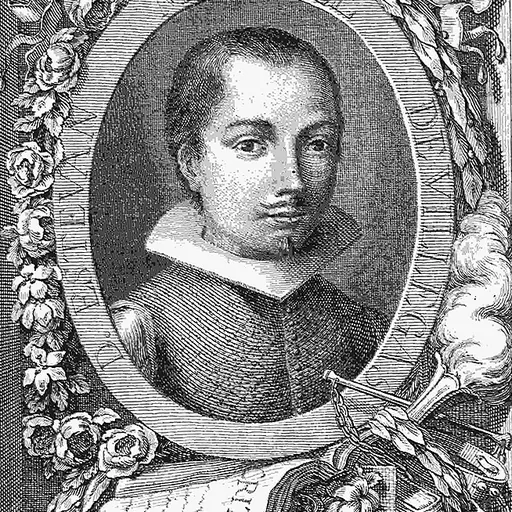
About Esteban Manuel de Villegas
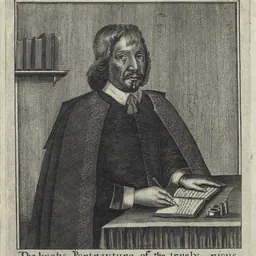
Lived 1589 – 1669 (aged 80). Esteban Manuel de Villegas was a Spanish writer, poet and translator.
Esteban Manuel de Villegas (5 February 1589, in Matute, La Rioja – 3 September 1669, in Nájera, La Rioja) was a 17th-century Spanish poet.
Biography
Villegas studied grammar in Madrid and later enrolled at the University of Salamanca on 20 November 1610. There he obtained a degree in Law, though he never entered the legal profession. Though he was the royal treasurer in Nájera, he did not obtain any of the positions he wanted. Despite coming from a wealthy family, he spent his entire life in financial difficulties due to his numerous children and his continuous involvement in litigation. At the age of 36, he married Doña Antonia de Leyva Villodas, twenty years younger than him. In 1659 he was tried by the Inquisition which accused him of believing himself in possession of the absolute truth. He was jailed after responding that he knew more about thorny questions than the Church Fathers. He wrote satires against religious communities. Many of these writings are lost, as they were confiscated by the Inquisition. The Inquisition condemned him to four years of exile in Santa María Ribarredonda, but he was pardoned after a year. It seems probable that the rest of the sentence was remitted, for the report of the local inquisition lays stress on Villegas’s simple piety, on the extravagance of his attire, and on the eccentricity of his general conduct and conversation, so marked as to suggest a mental disturbance. attr1="Saphicos", lines 1-4| Sweet denizen of verdant woods, eternal guest of flowery April, vital breath of mother Venus, soft Zephyr.
He also, fortunately, tried to adapt Spanish poetry to the Anacreontic style; he was imitated during the 18th century in this lyric subgenre, specially cultivated in Villegas' style, particularly by Juan Meléndez Valdés and José Iglesias de la Casa. Also his gracefully rhythmic pastoral "Cantilenas" was much imitated. At an advanced age, he translated Boethius' De consolatione Philosophiae and, wiser after his encounter with the Inquisition, left in Latin the part corresponding to free will. He wrote in addition two volumes of Disertaciones in which he commented on the classics that had been lost. This work was lost into the hands of Father Martín Sarmiento shortly thereafter. In addition he composed "Discurso contra las comedias" and "Antiteatro", which were never published.
Don’t just read it —
keep it.
Full-length biographies made to live with: read them, listen on the way to work, watch them tonight.
- E-book
- Audio
- Video
Instant download · yours to keep · every purchase keeps this site free
Important facts
Related people
Same field, nearest in time

Contemporaries
People whose lives overlapped Esteban Manuel de Villegas's




Frequently asked questions
Who was Esteban Manuel de Villegas?
Spanish poet (1589-1669)
When was Esteban Manuel de Villegas born?
Esteban Manuel de Villegas was born on 5 February 1589 in La Rioja.
When did Esteban Manuel de Villegas die?
Esteban Manuel de Villegas died on 3 September 1669.
What was Esteban Manuel de Villegas's occupation?
Esteban Manuel de Villegas was a writer, poet and translator.
What nationality was Esteban Manuel de Villegas?
Esteban Manuel de Villegas was Spanish.
Sources & further reading
· Wikipedia: Esteban Manuel de Villegas
· DBpedia: Esteban Manuel de Villegas
Cite this page
APA: Biography.guide. (2026). Esteban Manuel de Villegas. https://biography.guide/esteban-manuel-de-villegas/
MLA: "Esteban Manuel de Villegas." Biography.guide, https://biography.guide/esteban-manuel-de-villegas/.
Chicago: "Esteban Manuel de Villegas." Biography.guide. https://biography.guide/esteban-manuel-de-villegas/.
Data last updated: 2026-09-24 · Spot an error? Report a correction.
Portrait: Wikimedia Commons · author & licence
Page generated 2026-09-27 05:08 UTC