
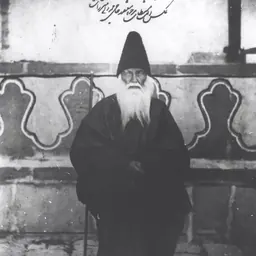
Eshaq Khan Qaraei-Torbati
Iranian military commander
About Eshaq Khan Qaraei-Torbati
Lived 1771 – 1816 (aged 44–45).
Eshaq Khan Qaraei-Torbati , was one of the wealthiest and most powerful chieftains in Khorasan during the reigns of Agha Mohammad Khan and Fath Ali Shah. He was fluent in Persian and Arabic.
Rise to power Originally known by the name of Mohammad Eshaq Khan Koohi overcame extraordinary odds to establish himself as a leader of the Qaraei tribe. The son of a Tajik (a term applied to non-Turkic people specially Persians) by the name of Haji Mohammad Khan Koohi (commonly known as Mohammad Khov ) who was working for Najaf Qoli Khan Qara Tatar, the chief of the Qaraei tribe. Eshaq grew up alongside his brother as shepherds. He inherited a social position that was inferior to even the lowest member of a military tribe. His father gained the attention of the leader of the Qaraei tribe and was appointed yuzbashi or centurion. Consequently, Eshaq was granted the position of Yessawul (mace bearer) to the chief and used this position to convince the chief of a need for a caravansarai in the then small village of Torbat-e Heydarieh. While undertaking this project the ambitions of Eshaq began to manifest themselves. As Eshaq's project grew, he slowly converted the caravansarai into a fort while simultaneously fomenting quarrels and divisions within the tribe through various intrigues. His plan culminated in Najaf Qoli's being murdered by his own officers with the chief's sons fleeing Khorasan.
Soon afterward, he married the daughter of Najaf Qoli and entered into an alliance with Ahmad Shah Durrani. These maneuvers gained him the leadership of the tribe. As the chief of the tribe, he managed to transform Torbat-e Heydarieh into a prosperous and safe district, while also making a fortune through farming, leasing camels to merchants, and developing an export/import trade.
Eshaq Khan's allegiance to Tehran (and also to Herat) remained nominal, and his display of submission to Agha Mohammad Khan and Fath Ali Shah at the time of their marches on Mashhad in 1796 and 1802, respectively, was anything but genuine. Fath Ali Shah's appointment in 1803 of his young son, Mohammad Vali Mirza, as governor of Khorasan was probably perceived by Eshaq Khan as a move designed to exact his allegiance and thus did not please the ambitious chief). However, he used this opportunity and joined his service and assumed the positions of Sardar (commander of the armies) and Vazir (prime minister). In December 1804 Eshaq Khan Qarai conquered Ghurian.
Downfall The influence of Eshaq completely overshadowed that of Mohammad Vali, a state of affairs that aroused Eshaq's ambitions. He initiated a conspiracy with the chiefs of Khabushan, Radkan, Chenaran, Darra Gaz, Jahan-Arghiyan, and Bojnord
Don’t just read it —
keep it.
Full-length biographies made to live with: read them, listen on the way to work, watch them tonight.
- E-book
- Audio
- Video
Instant download · yours to keep · every purchase keeps this site free
Important facts
Family & relationships
People in Eshaq Khan Qaraei-Torbati's life
Named in this biography and alive at the same time
Contemporaries
People whose lives overlapped Eshaq Khan Qaraei-Torbati's





Frequently asked questions
Who was Eshaq Khan Qaraei-Torbati?
Iranian military commander
When was Eshaq Khan Qaraei-Torbati born?
Eshaq Khan Qaraei-Torbati was born in 1771 in Torbat-e Heydarieh.
When did Eshaq Khan Qaraei-Torbati die?
Eshaq Khan Qaraei-Torbati died on 8 July 1816 in Mashhad.
Sources & further reading
· Wikipedia: Eshaq Khan Qaraei-Torbati
· DBpedia: Eshaq Khan Qaraei-Torbati
Cite this page
APA: Biography.guide. (2026). Eshaq Khan Qaraei-Torbati. https://biography.guide/eshaq-khan-qaraei-torbati/
MLA: "Eshaq Khan Qaraei-Torbati." Biography.guide, https://biography.guide/eshaq-khan-qaraei-torbati/.
Chicago: "Eshaq Khan Qaraei-Torbati." Biography.guide. https://biography.guide/eshaq-khan-qaraei-torbati/.
Data last updated: 2026-09-20 · Spot an error? Report a correction.
Page generated 2026-09-27 05:17 UTC