
Erwin Schulz
German Nazi SS general and Holocaust perpetrator
About Erwin Schulz
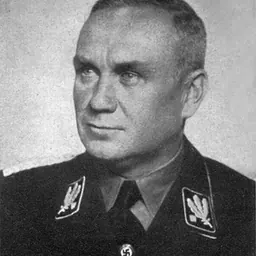
Lived 1900 – 1981 (aged 80). Erwin Schulz was a German police officer and gestapo employee.
Erwin Wilhelm Schulz (27 November 1900 – 11 November 1981) was a German member of the Gestapo and the SS in Nazi Germany. He was the leader of Einsatzkommando 5, part of Einsatzgruppe C, which was attached to the Army Group South during the planned invasion of Soviet Union in 1941, and operated in the occupied territories of south-eastern Poland and Ukrainian SSR committing mass killings of civilian population, mostly men of Jewish ethnicity, under the command of SS-Brigadeführer Otto Rasch.
Schulz is notable for demonstrating that service in the Einsatzgruppen was voluntary. He did not volunteer for the job, nor did he turn it down. Previously, he'd expressed opposition to the mass shootings of Jews. Under orders, Schulz would participate in the mass executions of Jewish men despite "serious misgivings" about his actions.
Career In April 1918, Schulz, then 17, volunteered for service in the Imperial German Army. However, World War I ended before he saw combat. The German Empire collapsed in the face of a communist revolution. Around this time, many German youths who were not old enough to have served in the war enlisted in the Freikorps, hoping to prove themselves as patriots and as men by crushing the revolution. Schulz participated in the suppression of the Spartacist uprising as a member of the 3rd Guards Regiment, and was discharged later that year.
After finishing high school, Schulz went to a university in Berlin. He'd wanted to study medicine, but was "frustrated by the economic consequences of the war" and for reasons of "expediency," studied political science and law for two semesters instead. Schulz never received a doctorate in law, albeit some called him Dr. Schulz. He left his studies to join the Freikorps Oberland in the spring of 1921. During his time in the Freikorps, Schulz fought Polish insurgents during the Silesian Uprisings. Afterwards, he worked in a bank and relocated to Hamburg in 1923. He joined the uniformed police force (Schutzpolizei) in Bremen, and in 1926 was appointed a police lieutenant.
Schulz's direct involvement in Nazism started in 1931. In 1930, he was transferred to the intelligence division of the Bremen police, which dealt with political counter intelligence. In 1931, he started working as an informant for the SS. Schulz secretly helped the Nazis gradually take over the offices of the Bremen police. In May 1933, Schulz joined the Nazi Party. In June 1933, the intelligence division was incorporated into the Gestapo, and in November, Schulz was appointed the acting (kommissarisch) chief. He took over as permanent Gestapo chief in Bremen on 1 May 1935. In 1935, he also joined the SS and SD. In March 1938, Schulz was promoted to SS-Sturmbannführer and became a Staatsrat (state councilor) for the state of Bremen.
In May 1941, Schulz was appointed chief of Einsatzkommando 5, a sub-unit of Einsatzgruppe C. The unit departed Germany in June 1941, and arrived in Ukraine in early July 1941. Overall, Einsatzgruppe C executed 2,500 to 3,000 people in Lviv in July 1941. Schulz himself was later proven to have presided over the executions of at least 90 to 100 men by his unit. When Schulz convened with SS-Brigadeführer Otto Rasch, the Einsatzgruppe C commander at Zhytomyr on 10 August 1941, Rasch informed him that on the orders of Adolf Hitler, more Jews needed to be shot. The Higher SS and Police Leader (HSSPF) for occupied Eastern Russia, SS-Obergruppenführer Friedrich Jeckeln, ordered that all Jews not engaged in forced labor, including women and children, were to be killed. Schulz later summarized what had happened at the meeting.
Shortly thereafter, Schulz questioned both Bruno Streckenbach and Reinhard Heydrich on this point; it was confirmed that this order had come from Hitler. He asked to be relieved of his post, saying he could not handle this kind of job. On 24 August 1941, he left for Berlin, arriving there three days later.
While testifying at the Frankfurt Auschwitz trials in the 1960s, Schulz said he "tried to prevent the worst". However, he was then asked why he did not object further to the new orders. He admitted that at the time, he'd tried to rationalize the orders to himself, despite personally refusing to carry them out."Because the orders were given. And I have to say that here, since they were known to all authorities, I assumed at first that this was, in fact, a carefully considered order issued out of wartime necessity. I did not have the feeling that they were completely unjustified, as inhuman as the orders were."
Schulz' refusal to carry out the orders to kill women and children do not seem to have harmed his career, although he was viewed as being too soft. In November 1941, he was promoted to SS-Oberführer and Oberst of police. In December 1942, he returned to RSHA where he replaced Streckenbach as the chief of Amt I, and where he remained until he was succeeded by Erich Ehrlinger on April 1, 1944. At that time, Schulz was appointed the IdS for Wehrkreis XVIII, based in Salzburg. He reported to Erwin Rösener, HSSPF and commander of SS-Oberabschnitt (main district) "Alpenland". Within weeks, this position was elevated to Befehlshaber der Sicherheitspolizei und des SD (BdS). According to the diary of Felix Landau, he'd witnessed the aftermath of the release of the Jews:"The Ukrainians had taken some Jews up to the former GPU citadel. These Jews had apparently helped the GPU persecute the Ukrainians and the Germans. They had rounded up 800 Jews there, who were supposed to be shot by us tomorrow. They had released them. We continued along the road. There were hundreds of Jews walking along the street with blood pouring from their faces, holes in their heads, their hands broken and their eyes hanging out of their sockets. They were covered in blood. Some of them were carrying others who had collapsed. We went to the citadel; there we saw things that few people had ever seen. […] The Jews were pouring out of the entrance. There were rows of Jews lying one on top of the other like pigs whimpering horribly. We stopped and tried to see who was in charge of the Kommando. 'Nobody.' Someone had let the Jews go. They were just being hit out of rage and hatred."While the court accepted Schulz's release of the detainees, it cast doubt on his defense for the executions, saying the documents listed the shootings as reprisals. This meant that thorough investigations or trials had not been conducted prior to the executions, making them illegal. The court also pointed out that while Schulz was on duty in Russia on 9 August 1941, his men had shot 400 Jews, described as mostly "saboteurs and political functionaries". Schulz's men shot another 74 Jews up until this date. From 24 and 30 August, they executed 157 people, the victims being "Jews, officials, and saboteurs." Schulz used his trip to Berlin as an alibi for these executions. However, the court said this did not necessarily exonerate him since they might've been planned in advance. Schulz then attempted to distinguish "good Jews" from other Jews: "If a Jew was an honorable man, his race or religious opinions were of no interest to me." He claimed that following Kristallnacht, as the chief of the Gestapo in Bremen, he had returned all of the stolen property to a certain Jewish jewelry shop owner named "Fischbein".
Don’t just read it —
keep it.
Full-length biographies made to live with: read them, listen on the way to work, watch them tonight.
- E-book
- Audio
- Video
Instant download · yours to keep · every purchase keeps this site free
Important facts
People in Erwin Schulz's life
Named in this biography and alive at the same time
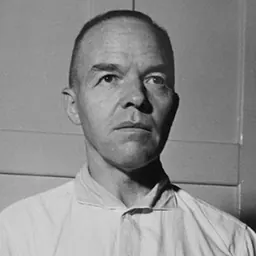
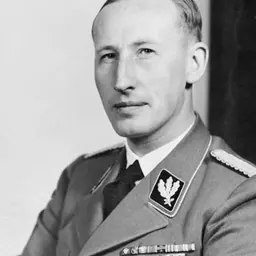
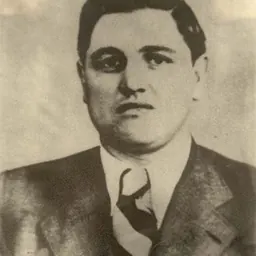

Related people
Same field, nearest in time


Contemporaries
People whose lives overlapped Erwin Schulz's




Frequently asked questions
Who was Erwin Schulz?
German Nazi SS general and Holocaust perpetrator (1900–1981)
When was Erwin Schulz born?
Erwin Schulz was born on 27 November 1900 in Berlin.
When did Erwin Schulz die?
Erwin Schulz died on 11 November 1981 in Bremen.
What was Erwin Schulz's occupation?
Erwin Schulz was a police officer and gestapo employee.
What nationality was Erwin Schulz?
Erwin Schulz was German.
Sources & further reading
Cite this page
APA: Biography.guide. (2026). Erwin Schulz. https://biography.guide/erwin-schulz/
MLA: "Erwin Schulz." Biography.guide, https://biography.guide/erwin-schulz/.
Chicago: "Erwin Schulz." Biography.guide. https://biography.guide/erwin-schulz/.
Data last updated: 2026-09-20 · Spot an error? Report a correction.
Page generated 2026-09-27 05:20 UTC