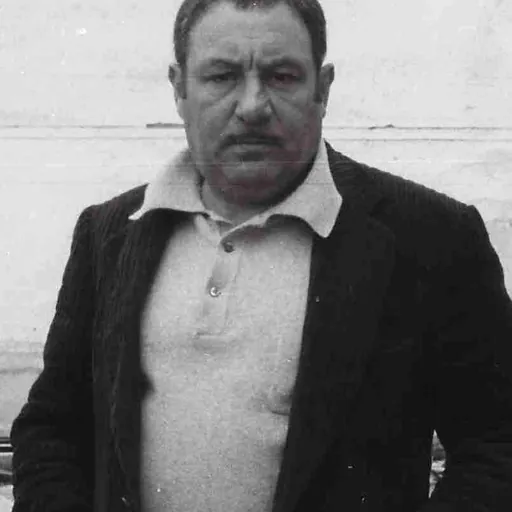
About Ernst Neizvestny
Lived 1925 – 2016 (aged 91). Ernst Neizvestny was a Russian and American sculptor, draftsperson and graphic artist.
Ernst Iosifovich Neizvestny (born Erik Iosifovich Neizvestny, ; 9 April 1925 – 9 August 2016) was a Russian sculptor, painter, graphic artist, and art philosopher. He emigrated to the United States in 1976 and lived and worked in New York City.
American playwright Arthur Miller once described Neizvestny as an "artist of the East" who is regarded by Russians as an "expression of the country, of its soul, language, and spirit" and as a "prophet of the future" who represents the "philosophical conscience of his country."
Alexander Calder, the American artist, once said to Neizvestny, "All my life I create the world of children, and you create the world of man."
Early life Erik Neizvestny was born 9 April 1925 in Sverdlovsk (now Yekaterinburg) into a Jewish family. His father was a doctor and his mother was a scientist. Ernst's great grandfather received his surname, literally meaning "unknown," when he was conscripted for military service as a cantonist.
During his teens, he went to the Sverdlovsk School № 16. There, he was on friendly terms with another student named Vladimir Vinnichevsky, who later on became a serial killer.
In 1942, at the age of 17, he joined the Red Army as a volunteer. He changed his name to Ernst during this period because the name Erik "sounded childish," but his mother and friends still called him Erik. At the close of World War II, he was heavily wounded and sustained a clinical death.
As they continued to argue, someone in Khrushchev's entourage called Neizvestny a homosexual, but 'after excusing himself to Minister of Culture Yekaterina Furtseva', Neizvestny replied: "Give me a girl right here and now and I'll show what sort of homosexual I am." At the end of the session, Khrushchev told him: "You are the kind of man I like. There's an angel and a devil in you. If the angel wins, we can get along together. If it's the devil who wins, we'll destroy you."
On 15 December, Neizvestny was among 400 guests invited to hear Khrushchev speak at Moscow's House of Receptions. Khrushchev reputedly intended to be conciliatory, but went off script and pointing at one of Neizvestny's statues and demanded: "is that a horse or a cow? Whatever it is, it makes an ugly mockery of a perfectly noble animal." Pointing at another he said: "If that's supposed to be a woman, then you're a faggot. And the sentence for them is ten years in prison." He went on to compare looking at Neizvestny's work to being in a toilet looking up while someone else was sitting on it.
Despite these insults, in 1975, four years after Khrushchev's death, his family commissioned Neizvestny to design the monument over his grave at the Novodevichy Cemetery.
Art career
Other well-known works he created during the Soviet period include Prometheus in Artek (1966). Much of his art from the Soviet era was destroyed before he was forcibly exiled to America.
Neizvestny's talent for large monumental sculptures was again recognized when in the late 1980s six Taiwan cities commissioned the New Statue of Liberty to be built in Kaohsiung harbor. Like the original in New York, it was planned to be 152 feet tall. Several models were built. At least one about five feet tall, and approximately 13 smaller bronzes, each slightly over 18 inches, sold to clients of Magna Gallery in San Francisco. Although the authorized maximum number of signed and numbered castings was 200, far fewer were actually cast and sold, in part because the monument was never built in Taiwan. The reasons are largely political and are described in Albert Leong's bio of Neizvestny, referred to below.
During the 1980s, Neizvestny was a visiting lecturer at the University of Oregon and at UC Berkeley. He also worked with Magna Gallery in San Francisco and had a number of shows which were well-attended in the mid to late 1980s. This gallery also asked him to create his suite of five original graphics, "Man through the Wall," to mark the end of Communism at the end of the 1980s. Magna Gallery was closed at the end of 1992.
During this time, Neizvestny worked diligently to get his dream "Tree of Life" monumental sculpture funded and built. Several small versions or spinoffs based on the theme were built, but the enormous monumental version that Neizvestny dreamed to build, inside which people could walk, has not been built although it has been fully conceptualized, planned out and detailed by the artist as a labor of love.
In 1996, Neizvestny completed his Mask of Sorrow, a tall monument to the victims of Soviet purges, situated in Magadan. The same year, he was awarded the State Prize of the Russian Federation. Although he lived in New York City and worked at Columbia University, Neizvestny frequently visited Moscow and celebrated his 80th birthday there. A museum dedicated to his sculptures was established in Uttersberg, Sweden. Some of his crucifixion statues were acquired by John Paul II for the Vatican Museums. In 2004, Neizvestny became an honorary member of the Russian Academy of Arts.
In 1995, he participated as a painter in the jubilee exhibition on Gogol Boulevard, dedicated to the 20th anniversary of the exhibition of painting in the pavilion "beekeeping" at VDNH with Eduard Drobitsky, Julia Dolgorukova and other nonconformist artists.
A biography of Neizvestny was written by University of Oregon professor Albert Leong in 2002 entitled: Centaur: The Life and Art of Ernst Neizvestny. Another book about Neizvestny is Art and Revolution: Ernst Neizvestny, Endurance, and the Role of the Artist, written by British art critic John Berger in 1969.
He died on 9 August 2016 in New York.
Gallery
Awards and decorations Order of the Red Star (1945) Order "For Merit to the Fatherland", third class Order of Honour State Prize of the Russian Federation
Don’t just read it —
keep it.
Full-length biographies made to live with: read them, listen on the way to work, watch them tonight.
- E-book
- Audio
- Video
Instant download · yours to keep · every purchase keeps this site free
Important facts
more
Ernst Neisvestny, Ernst Neizvestni, Ernst NeizwestnyjPeople in Ernst Neizvestny's life
Named in this biography and alive at the same time




Related people
Same field, nearest in time


Contemporaries
People whose lives overlapped Ernst Neizvestny's



Frequently asked questions
Who was Ernst Neizvestny?
Soviet sculptor (1925–2016)
When was Ernst Neizvestny born?
Ernst Neizvestny was born on 9 April 1925 in Yekaterinburg.
When did Ernst Neizvestny die?
Ernst Neizvestny died on 9 August 2016 in New York City.
What was Ernst Neizvestny's occupation?
Ernst Neizvestny was a sculptor, draftsperson and graphic artist.
What nationality was Ernst Neizvestny?
Ernst Neizvestny was Russian and American.
Sources & further reading
Cite this page
APA: Biography.guide. (2026). Ernst Neizvestny. https://biography.guide/ernst-neizvestny/
MLA: "Ernst Neizvestny." Biography.guide, https://biography.guide/ernst-neizvestny/.
Chicago: "Ernst Neizvestny." Biography.guide. https://biography.guide/ernst-neizvestny/.
Data last updated: 2026-09-21 · Spot an error? Report a correction.
Portrait: Wikimedia Commons · author & licence
Page generated 2026-09-27 04:59 UTC