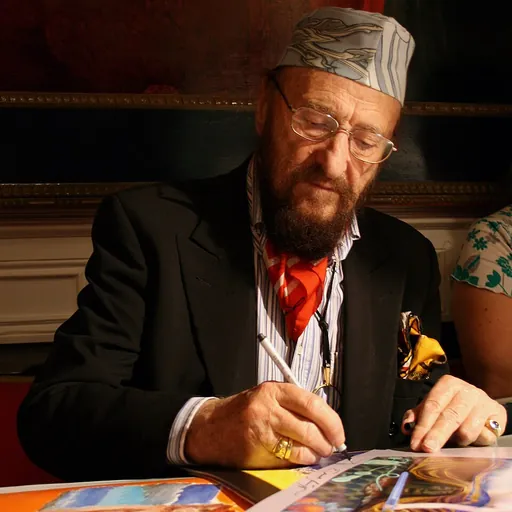
About Ernst Fuchs
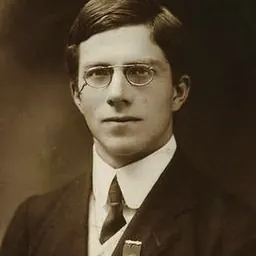
Lived 1930 – 2015 (aged 85). Ernst Fuchs was an Austrian architect, painter, university teacher, writer, sculptor and printmaker.
Ernst Fuchs (13 February 19309 November 2015) was an Austrian painter, draftsman, printmaker, sculptor, architect, stage designer, composer, poet, and one of the founders of the Vienna School of Fantastic Realism. In 1972, he acquired the derelict Otto Wagner Villa in Hütteldorf, which he restored and transformed. The villa was inaugurated as the Ernst Fuchs Museum in 1988.
Education Born in Vienna as the only child of Maximilian and Leopoldine Fuchs, Fuchs attended the St. Anna Painting School, where he studied under Fritz Fröhlich (1944). He was also a founding member of the Art-Club (1946), as well as the Hundsgruppe, set up in opposition to it in 1951, together with Friedensreich Hundertwasser and Arnulf Rainer.
Fuchs' work of this period was influenced by the art of Gustav Klimt and Egon Schiele and then by Max Pechstein, Heinrich Campendonk, Edvard Munch, Henry Moore and Pablo Picasso. During this time, seeking to achieve the vivid lighting effects achieved by such Old Masters as Albrecht Altdorfer, Albrecht Dürer, Matthias Grünewald and Martin Schongauer, he revived and adopted the mischtechnik (mixed technique) of painting. In the mischtechnik, egg tempera is used to build up volume, and is then glazed with oil paints mixed with resin, producing a jewel-like effect.
Between 1950 and 1961, Fuchs lived mostly in Paris, and made a number of journeys to the United States and Israel. His favourite reading material at the time was the sermons of Meister Eckhart. He also studied the symbolism of the alchemists and read Jung's Psychology and Alchemy. His favourite examples at the time were the mannerists, especially Jacques Callot, and he was also very much influenced by Jan van Eyck and Jean Fouquet. In 1958 he founded the Galerie Fuchs-Fischoff in Vienna to promote and support the younger painters of the Fantastic Realism school. Together with Friedensreich Hundertwasser and Arnulf Rainer, he founded the Pintorarium.
When he was 12 years old, he converted to Roman Catholicism (his mother had him baptized during the war in order to save him from being sent to a concentration camp).
Design projects From 1974, he became involved in designing stage sets and costumes for the operas of Mozart and Richard Wagner, including Die Zauberflöte, Parsifal, and Lohengrin. He experimented with industrial design in the 1970s with a 500-piece run of the upscale Suomi tableware by Timo Sarpaneva that Fuchs decorated for the German Rosenthal porcelain maker's Studio Linie.
In 1993, Fuchs was given a retrospective exhibition at the State Russian Museum in St. Petersburg, one of the first Western artists so honored.
Personal life and death Fuchs had 16 children.
Fuchs died in Vienna's Sophienspital at the age of 85 on 9 November 2015.
Decorations and awards 1972: City of Vienna Prize for Visual Arts 2000: Officier dans l’Ordre des Arts et des Lettres 2009: Austrian Cross of Honour for Science and Art, 1st class 2010: Golden Medal of Honour for Services to the city of Vienna
Publications Architectura caelestis: die Bilder des verschollenen Stils (Salzburg: Residenz, 1966/Pb ed., Dtv, 1973) , Album der Familie Fuchs (Salzburg: Residenz, 1973) Im Zeichen der Sphinx: Schriften und Bilder, ed. Walter Schurian (Munich, Dtv, 1978) , Aura: Ein Märchen der Sehnsucht (Munich: Dtv, 1981) , Der Prophet des Schönen: Arno Breker (Marco, 1982)| , Von Jahwe: Gedichte (Munich, 1982) | ,
Other publications 1977 – Fuchs über Ernst Fuchs: Bilder und Zeichnungen von 1945–1976, (R.P. Hartmann Paris) 2003 – Ernst Fuchs – Zeichnungen und Graphik aus der frühen Schaffensperiode – 1942 bis 1959. (Friedrich Haider) (Vienna: Löcker-Verlag) 2005 – Fantastic Art (Taschen) (Schurian, Prof. Dr. Walter) (English edition) 2006 – True Visions (Erik Davis and Pablo Echaurren) (Betty Books) 2007 – Metamorphosis (beinArt) 2008 – Phantastischer Realismus (Belvedere, Wien)
Don’t just read it —
keep it.
Full-length biographies made to live with: read them, listen on the way to work, watch them tonight.
- E-book
- Audio
- Video
Instant download · yours to keep · every purchase keeps this site free
Important facts
People in Ernst Fuchs's life
Named in this biography and alive at the same time






Related people
Same field, nearest in time

Contemporaries
People whose lives overlapped Ernst Fuchs's



Frequently asked questions
Who was Ernst Fuchs?
Austrian artist (1930-2015)
When was Ernst Fuchs born?
Ernst Fuchs was born on 13 February 1930 in Vienna.
When did Ernst Fuchs die?
Ernst Fuchs died on 9 November 2015 in Vienna.
What was Ernst Fuchs's occupation?
Ernst Fuchs was an architect, painter, university teacher, writer, sculptor and printmaker.
What nationality was Ernst Fuchs?
Ernst Fuchs was Austrian.
Sources & further reading
· DBpedia: Ernst Fuchs (artist)
Cite this page
APA: Biography.guide. (2026). Ernst Fuchs. https://biography.guide/ernst-fuchs-architect/
MLA: "Ernst Fuchs." Biography.guide, https://biography.guide/ernst-fuchs-architect/.
Chicago: "Ernst Fuchs." Biography.guide. https://biography.guide/ernst-fuchs-architect/.
Data last updated: 2026-09-23 · Spot an error? Report a correction.
Portrait: Wikimedia Commons · author & licence
Page generated 2026-09-27 05:06 UTC