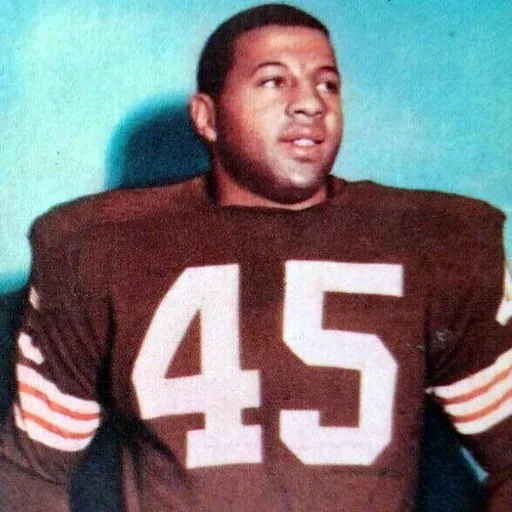
About Ernie Davis
Lived 1939 – 1963 (aged 23). Ernie Davis was an American american football player and basketball player.
Ernest R. Davis (December 14, 1939 – May 18, 1963) was an American college football player who was a halfback for the Syracuse Orangemen and won the Heisman Trophy in 1961. He was the award's first black recipient. Davis was selected first overall by the Washington Redskins in the 1962 NFL draft but was almost immediately traded to the Cleveland Browns. He was diagnosed with leukemia that same year, and died shortly after at age 23 without ever playing in a professional game. At 14 months, he was cared for by his maternal grandparents, Willie and Elizabeth Davis. At age 12, he went to live with his mother and stepfather in Elmira, New York, where he excelled in baseball, basketball, and football in grade school. He attended Elmira Free Academy, where he earned two All-American honors. At the end of his senior season he was recruited by numerous colleges, and chose to attend Syracuse University after being persuaded by Jim Brown, a Syracuse alumnus.
College career
Davis played football for coach Ben Schwartzwalder at Syracuse University from 1959 to 1961, and went on to national fame in each of those three seasons, twice winning first-team All-American honors. As a sophomore, Davis led the 1959 Syracuse team to a national championship, capping an 11–0 season with a 23–14 win over the Texas Longhorns in the 1960 Cotton Bowl Classic, where Davis was named Most Valuable Player. That same season, Elmira Star-Gazette sports writer Al Mallette coined the nickname for Davis, the "Elmira Express". In his junior year, 1960, he set a record of 7.8 yards per carry and was the third leading rusher in the country with 877 yards, having rushed for 100 yards in six of nine games. The 1960 Syracuse Orangemen finished with a record of 7–2 and did not play in a post-season bowl game. In Ernie's senior year, the 1961 Orangemen finished with a record of 8–3, closing the season with a 15–14 victory over the Miami Hurricanes in the Liberty Bowl, played at Philadelphia's Franklin Field. College football used limited substitution rules at the time and players played both offense and defense.
Discrimination was prevalent in the American South and during Davis' Cotton Bowl visit to host city Dallas, Texas. Author Jocelyn Selim writes that at the banquet following the 1960 game, Davis was told he could only accept his award and then would be required to leave the segregated facility. Davis and his black teammates were allowed to finish their meals at the banquet. When dessert was brought, a gentleman quietly approached them and told them they would have to leave when the doors were opened to the public for a dance. The three got up to leave and when the teammates found out, they wanted to leave too, but were told that it would only cause a bigger problem, so they stayed.
A different account of the banquet is given by John Brown. He was Davis' teammate at Syracuse and on the Cleveland Browns, his roommate and a close friend. According to an article in the Houston Chronicle, all the players from the game attended the banquet. Brown recalls that the teams sat on opposite sides of the room. After everyone ate and the trophies were handed out, the three black Syracuse players, Brown, Davis and Art Baker were asked to leave and were taken to another party in Dallas by local NAACP representatives. One Syracuse player, Gerhard Schwedes, recommended that the whole Syracuse team leave the banquet to show solidarity with their black teammates, but the suggestion was overruled by Syracuse officials. When the Chronicle asked Brown whether the film The Express is a truthful portrayal of his friend, Brown said " ... in short, no."
Davis became the first black athlete to be awarded the Heisman Trophy (the highest individual honor in collegiate football) and he also won the Walter Camp Memorial Trophy following his 1961 senior-year season at Syracuse University. President John F. Kennedy had followed Davis' career and requested to meet him while he was in New York to receive the trophy. Later in 1963, when Elmira chose February 3 to celebrate Davis' achievements, Kennedy sent a telegram, reading:
Seldom has an athlete been more deserving of such a tribute. Your high standards of performance on the field and off the field, reflect the finest qualities of competition, sportsmanship and citizenship. The nation has bestowed upon you its highest awards for your athletic achievements. It's a privilege for me to address you tonight as an outstanding American, and as a worthy example of our youth. I salute you. He was also a candidate in the university's Army ROTC program and was commissioned as a second lieutenant following graduation.
Davis was posthumously inducted into the College Football Hall of Fame in 1979.
Davis was a member of The Pigskin Club of Washington, D.C. National Intercollegiate All-American Football Players Honor.
In 1999, Sports Illustrated included him on its All-Century Team for college football.
Professional football career Davis was the first overall pick in the 1962 NFL draft on December 4, 1961. he was then almost immediately traded to the Cleveland Browns.
Redskins founder and owner George Preston Marshall was an avowed racist who kept the Redskins entirely white long after the other teams had integrated. He openly admitted that his unwillingness to sign a black player was an effort to appeal to his mostly Southern fan base (they had been the southernmost team in the league for a quarter century). The signing only came when Interior Secretary Stewart Udall issued an ultimatum to Marshall: sign a black player by the start of the 1962 season, or he would revoke the Redskins' 30-year lease on D.C. Stadium (now Robert F. Kennedy Memorial Stadium). The stadium was a city-owned facility, and the Washington city government has long been legally reckoned as a branch of the federal government (given that the Constitution gives Congress ultimate authority over the capital). Marshall could not bring himself to draft a black player, so he left the decision to general manager and head coach Bill McPeak, who picked Davis. Davis refused to play for the Redskins and demanded a trade. A deal with Cleveland was engineered by Browns coach Paul Brown without the knowledge of the owner Art Modell. This had been standard operating procedure with the Browns from their inception in 1946; Brown served as his own general manager, and had enjoyed a free hand in football matters. The Redskins traded the rights to Davis to the Cleveland Browns for Bobby Mitchell and first-round draft pick Leroy Jackson. Davis chose to go to the Cleveland Browns where his classmate John Brown would be his roommate and Jim Brown, whom he admired, was already playing.
Davis signed a three-year, $200,000 contract with the Browns in late December 1961 in San Francisco while preparing for the East-West Shrine Game. Originally reported at $80,000, the contract, according to Davis's attorney, Tony DeFilippo, consisted of $80,000 for playing football, including a $15,000 signing bonus; $60,000 for ancillary rights, such as image marketing; and $60,000 for off-season employment.
Death
While preparing to play in the College All-Star Game against the Green Bay Packers in Chicago in July during the summer of 1962, He was diagnosed with acute monocytic leukemia on August 1, and he had the deadly blood disease since April of 1962. He then began receiving medical treatment. Davis went to Johns Hopkins in Baltimore when he was dying —three months after being diagnosed— and, through chemical treatments, experienced a four- to five-month remission. The disease was then incurable, and Davis died at age 23 at Cleveland Lakeside Hospital at 2:00 A.M. on Saturday, May 18, 1963. and was released on October 10, 2008. Rob Brown plays Davis, with Dennis Quaid portraying Davis' Syracuse University coach, Ben Schwartzwalder.
In 2011, rival schools Southside High School (Elmira, New York) and Elmira Free Academy combined their athletic teams, which together were renamed the Elmira Express, named after Ernie Davis.
Don’t just read it —
keep it.
Full-length biographies made to live with: read them, listen on the way to work, watch them tonight.
- E-book
- Audio
- Video
Instant download · yours to keep · every purchase keeps this site free
Important facts
People in Ernie Davis's life
Named in this biography and alive at the same time





Related people
Same field, nearest in time


Contemporaries
People whose lives overlapped Ernie Davis's





Frequently asked questions
Who was Ernie Davis?
American football player (1939–1963)
When was Ernie Davis born?
Ernie Davis was born on 14 December 1939 in New Salem-Buffington.
When did Ernie Davis die?
Ernie Davis died on 18 May 1963 in Cleveland.
What was Ernie Davis's occupation?
Ernie Davis was an american football player and basketball player.
What nationality was Ernie Davis?
Ernie Davis was American.
Sources & further reading
Cite this page
APA: Biography.guide. (2026). Ernie Davis. https://biography.guide/ernie-davis/
MLA: "Ernie Davis." Biography.guide, https://biography.guide/ernie-davis/.
Chicago: "Ernie Davis." Biography.guide. https://biography.guide/ernie-davis/.
Data last updated: 2026-09-22 · Spot an error? Report a correction.
Portrait: Wikimedia Commons · author & licence
Page generated 2026-09-27 05:04 UTC