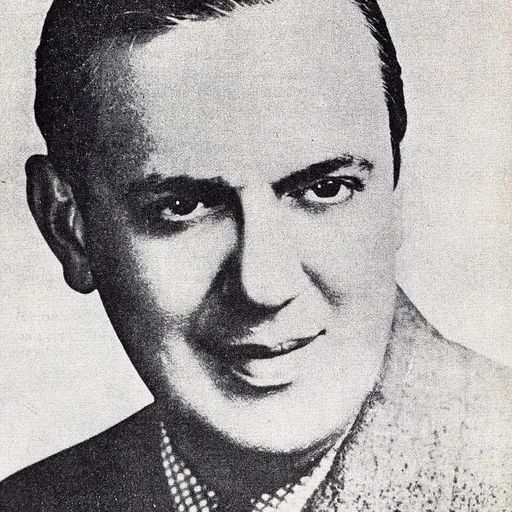
About Ernesto Lecuona
Lived 1896 – 1963 (aged 67). Ernesto Lecuona was a Spanish pianist, composer, songwriter, film score composer, actor and artist.
Ernesto Lecuona y Casado (; August 7, 1896 – November 29, 1963)
In the 1930s, he helped establish a popular band, the Lecuona Cuban Boys, which showcased some of his most successful pieces and was later taken over by Armando Oréfiche. In the 1950s, Lecuona recorded several LPs, including solo piano albums for RCA Victor. He moved to the United States after the 1959 Cuban Revolution, and died in Spain in 1963.
Early years Lecuona was born in Guanabacoa, Havana, Cuba, Kingdom of Spain, to a Cuban mother and a Canarian father. There are inconsistencies surrounding his birthdate, with some sources indicating the year 1895, and others still giving the day as August 6. He started studying piano at the age of five, He later studied at the Peyrellade Conservatoire under Antonio Saavedra and Joaquín Nin. Lecuona graduated from the National Conservatory of Havana with a gold medal for interpretation when he was 17 years old. The entire musical score of the film Carnival in Costa Rica was penned by Lecuona. He was interred at Gate of Heaven Cemetery in Hawthorne, New York, but his will instructed that his remains be repatriated after the Cuban régime changes. A great deal of Lecuona's music was first introduced to mass American audiences by Desi Arnaz, a fellow Cuban and Lucille Ball's spouse.
Lecuona's talent for composition has influenced the Latin American world in a way quite similar to George Gershwin in the United States, in his case raising Cuban music to classical status.
Ernesto and Ernestina's cousin Margarita Lecuona was another accomplished musician and composer. She was the author of the song "Babalú", made popular in the Latin American world by Miguelito Valdés, and in the United States by Desi Arnaz.
Selected compositions
For piano Ante El Escorial Aragón Aragonesa San Francisco El Grande Siboney Suite Andalucía Córdoba Andalucía Alhambra Gitanerías Guadalquivir Malagueña Preludio En La Noche Valencia Mora Zambra Gitana
Waltz Apasionado Crisantemo La bemol Maravilloso Poético Romántico Si menor (Rococó) Vals Azul
Others Afro-Cuban suite Ahí viene el chino Al fin te vi Amorosa Andar Aquí está Arabesque Bell Flower Benilde Burlesca Canto del guajiro Cajita de música Como arrullo de palmas Como baila el muñeco Dame tu amor Danza de los Ñáñigos Danza Lucumí Diario de un niño Ella y yo ¡Échate pa'llá María! El batey El miriñaque El sombrero de yarey El tanguito de Mamá (también llamada A la Antigua) En tres por cuatro Eres tú el amor Futurista Gonzalo, ¡no bailes más! Impromptu Jungle Drums La 32 La primera en la frente La Comparsa La conga de medianoche La habanera La danza interrumpida La mulata La negra Lucumí La Cardenense Los Minstrels Lola Cruz Lola está de fiesta Lloraba en sueños Mazurka en glissando Melancolía Mientras yo comía maullaba el gato Mis tristezas María la O Muneca de Cristal Muñequita Negra Mercé Negrita ¡No hables más! No me olvides No puedo contigo Noche Azul Orquídeas Pensaba en ti Polichinela ¿Por qué te vas? Preludio en la noche ¡Que risa me da! Mi abuela bailaba así Rapsodia Negra Rosa, la china Siempre en mi corazon Tú serás Tres miniaturas ¡Y la negra bailaba! ¡Y sigue la lloviznita! Yo soy así Yumurí Zapateo y guajira Zenaida
Recordings Lecuona Interpreta A Lecuona (RCA Victor, 1955, reissued in 1986 as Virtuoso), Lecuana performing on the piano Lecuona Plays for Two (RCA Victor, 1955), Lecuana performing on the piano
Don’t just read it —
keep it.
Full-length biographies made to live with: read them, listen on the way to work, watch them tonight.
- E-book
- Audio
- Video
Instant download · yours to keep · every purchase keeps this site free
Important facts
People in Ernesto Lecuona's life
Named in this biography and alive at the same time



Related people
Same field, nearest in time

Contemporaries
People whose lives overlapped Ernesto Lecuona's


Frequently asked questions
Who was Ernesto Lecuona?
Cuban composer (1896-1963)
When was Ernesto Lecuona born?
Ernesto Lecuona was born on 6 August 1896 in Guanabacoa.
When did Ernesto Lecuona die?
Ernesto Lecuona died on 29 November 1963 in Santa Cruz de Tenerife.
What was Ernesto Lecuona's occupation?
Ernesto Lecuona was a pianist, composer, songwriter, film score composer, actor and artist.
What nationality was Ernesto Lecuona?
Ernesto Lecuona was Spanish.
Sources & further reading
Cite this page
APA: Biography.guide. (2026). Ernesto Lecuona. https://biography.guide/ernesto-lecuona/
MLA: "Ernesto Lecuona." Biography.guide, https://biography.guide/ernesto-lecuona/.
Chicago: "Ernesto Lecuona." Biography.guide. https://biography.guide/ernesto-lecuona/.
Data last updated: 2026-09-20 · Spot an error? Report a correction.
Portrait: Wikimedia Commons · author & licence
Page generated 2026-09-27 04:58 UTC