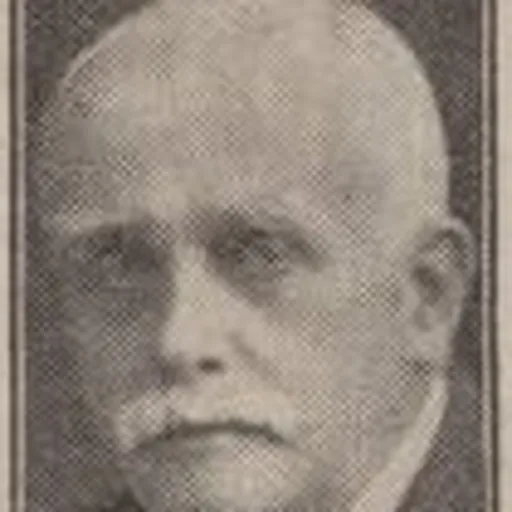
About Ernest MacBride
Lived 1866 – 1940 (aged 73). Ernest MacBride was a British marine biologist and zoologist.
Ernest William MacBride FRS (12 December 1866, in Belfast – 17 November 1940, in Alton, Hampshire) was a British Irish marine biologist, one of the last supporters of Lamarckian evolution.
Life
MacBride was the eldest of the five children of Minnie Browne of Donegal and Samuel MacBride, a linen manufacturer in Belfast. MacBride was educated at the Academic Institute of Belfast. He then spent a year in Neuwied on the Rhine before returning to continue his education at Queen's College, Belfast, as an external student at London University and at St John's College, Cambridge as an exhibitioner, where he became a Foundation Scholar in 1891 and Fellow in 1893. He spent a year at the Zoological Station in Naples in 1891/92 engaged in research under Anton Dohrn. and a Fellow of St John's in 1893. In 1893 he was awarded the Walsingham Medal for Biological Research.
In 1897 he was elected as the first Strathcona Professor of Zoology at McGill University. In Canada he married Constance Harvey Chrysler, daughter of Francis Henry Chrysler K.C. He was elected as a Fellow of the Royal Society in 1905 for his work on echinoderm morphology. In 1909 he resigned and returned to the United Kingdom. From 1909 to 1913 he was assistant professor of Zoology under Adam Sedgwick at Imperial College London. On Sedgwick's death in 1913, MacBride became professor at Imperial, holding the chair until his retirement in 1934.
A defender of Lamarckian evolution, MacBride's specialism was the morphology and embryology of the Echinoderms. MacBride supported Paul Kammerer’s claims to have demonstrated Lamarckian inheritance in the Midwife toad.
MacBride took an active part both in the affairs of the Linnean Society which he served as a member of its council and as vice-president and the Zoological Society where he also served on the council for over thirty years and acted as vice-president.
Works Text-book of embryology. Vol. I: Invertebrates, London: Macmillan, 1914 (with A. E. Shipley) Zoology; an elementary text-book, Cambridge: University Press, 1915. An introduction to the study of heredity, New York: H. Holt & Co., 1924. (tr.) Biological memory by Eugenio Rignano. London: K. Paul, Trench, Trubner & Co.; New York: Harcourt, Brace & Co., 1926. The International Library of Psychology, Philosophy and Scientific Method Evolution, London: Ernest Benn, The idea of memory in biology, 1928 (with H. R. Hewer) ‘Zoology’, in Alfred Piney, ed., Recent advances in microscopy; biological applications, 1931 ‘The oneness and uniqueness of life’, in Frances Baker Mason, The great design; order and progress in nature, New York: Macmillan Co., 1934 Huxley, London: Duckworth.
Don’t just read it —
keep it.
Full-length biographies made to live with: read them, listen on the way to work, watch them tonight.
- E-book
- Audio
- Video
Instant download · yours to keep · every purchase keeps this site free
Important facts
People in Ernest MacBride's life
Named in this biography and alive at the same time




Related people
Same field, nearest in time


Contemporaries
People whose lives overlapped Ernest MacBride's



Frequently asked questions
Who was Ernest MacBride?
marine biologist
When was Ernest MacBride born?
Ernest MacBride was born on 12 December 1866 in Belfast.
When did Ernest MacBride die?
Ernest MacBride died on 17 November 1940 in Alton.
What was Ernest MacBride's occupation?
Ernest MacBride was a marine biologist and zoologist.
What nationality was Ernest MacBride?
Ernest MacBride was British.
Sources & further reading
Cite this page
APA: Biography.guide. (2026). Ernest MacBride. https://biography.guide/ernest-macbride/
MLA: "Ernest MacBride." Biography.guide, https://biography.guide/ernest-macbride/.
Chicago: "Ernest MacBride." Biography.guide. https://biography.guide/ernest-macbride/.
Data last updated: 2026-09-21 · Spot an error? Report a correction.
Portrait: Wikimedia Commons · author & licence
Page generated 2026-09-27 04:59 UTC