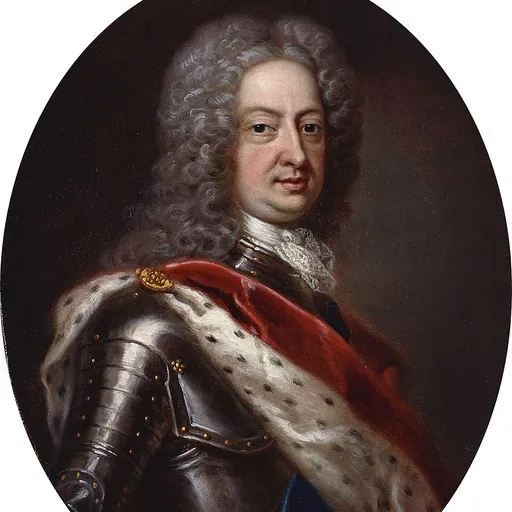
Ernest Augustus, Duke of York and Albany
Prince-Bishop of Osnabrück
About Ernest Augustus, Duke of York and Albany
Lived 1674 – 1728 (aged 53). Ernest Augustus, Duke of York and Albany was a German catholic priest, catholic bishop and bishop.
Ernest Augustus, Duke of York and Albany (17 September 1674 – 14 August 1728), was the younger brother of George I of Great Britain. and the first five years of his life were spent in Osnabrück, until his father became Duke of Brunswick-Lüneburg and the family moved to Hanover.
His education followed the customs of the time, by which German princes were expected to travel to foreign courts to make contacts and learn how to conduct diplomatic relations. In summer 1687, he visited the French court at Versailles via Amsterdam. While there, the two brothers were popular with the French royal family.
Military career
After his visit to France, he trod the well-worn path for young German princes of those times and served as a soldier. His family interests were aligned with those of Emperor Leopold I and so he fought against the French in the Nine Years' War and was present at the Battle of Neerwinden in 1693. He continued his military career during the War of Spanish Succession and was actively engaged in the Siege of Lille (1708).
Dynastic role After his father's death, his eldest brother George inherited all his lands and titles, including the electorate. His father, as part of the conditions he had to fulfil to acquire an electorship, had adopted primogeniture, thus disinheriting younger sons. Unlike his four elder brothers, Ernest Augustus did not oppose this change; consequently he got on well with George, who trusted him.
Ernest Augustus was a prominent member of his brother's court at Herrenhausen, in Hanover, receiving diplomatic visitors and taking an active role in the cultural interests of the court. His influence may have helped secure the position of Kapellmeister for Handel at court.thumb With his accession to the British throne, George moved to London and Ernest Augustus took on the mantle of the senior head of the family in Brunswick-Lüneburg. In this capacity, he became regent in all but name, and took on the duty of care for George's seven-year-old grandson, Frederick Lewis, the future Prince of Wales and father-to-be of George III. Frederick was left in Germany as a diplomatic move, to reassure the populace and any ambitious neighbouring states of the family's continuing commitment to its German lands.
Prince Bishop Upon the death of Charles Joseph, Elector of Trier, in 1715, under the terms of the 1648 Treaty of Westphalia, it was the turn of a Protestant to become Prince-Bishop of Osnabrück. This position—as a Prince of the Holy Roman Empire and ruler of an independent principality—had to alternate between Catholics and Lutherans according to the treaty. Usually a member of the House of Welf held the office whenever the turn came to Protestants. As Ernest Augustus's elder brother Maximilian William of Brunswick-Luneburg had become a Catholic, King George nominated Ernest Augustus to be elected by the Osnabrück cathedral chapter. The position was not just an honorific, and so Ernest Augustus had to divide his time between his duties at Schloss Osnabrück and his role at the court in Herrenhausen.
In 1716, Ernst visited England where, on 29 June 1716, he was created Duke of York and Albany, and Earl of Ulster. On 30 April 1718 (OS), he was created a Knight of the Garter together with his grand-nephew Frederick, later Prince of Wales.
Death
After his sojourn in Great Britain, Ernest Augustus returned to his previous life and continued to divide his time between Schloss Osnabrück and the court at Herrenhausen, while actively managing the affairs of both states. He died in Osnabrück on 14 August 1728 (NS), aged 53, and was buried there. One year earlier his brother George I had also died there on a journey. Believed to be homosexual, Ernest Augustus never married. Upon his death, his British and Irish peerages became extinct.
Arms
Don’t just read it —
keep it.
Full-length biographies made to live with: read them, listen on the way to work, watch them tonight.
- E-book
- Audio
- Video
Instant download · yours to keep · every purchase keeps this site free
Important facts
Family & relationships
Related people
Same field, nearest in time




Contemporaries
People whose lives overlapped Ernest Augustus, Duke of York and Albany's





Frequently asked questions
Who was Ernest Augustus, Duke of York and Albany?
Prince-Bishop of Osnabrück (1674-1728)
When was Ernest Augustus, Duke of York and Albany born?
Ernest Augustus, Duke of York and Albany was born on 17 September 1674 in Osnabrück.
When did Ernest Augustus, Duke of York and Albany die?
Ernest Augustus, Duke of York and Albany died on 14 August 1728 in Osnabrück.
What was Ernest Augustus, Duke of York and Albany's occupation?
Ernest Augustus, Duke of York and Albany was a catholic priest, catholic bishop and bishop.
What nationality was Ernest Augustus, Duke of York and Albany?
Ernest Augustus, Duke of York and Albany was German.
Sources & further reading
· Wikipedia: Ernest Augustus, Duke of York and Albany
· DBpedia: Ernest Augustus, Duke of York and Albany
Cite this page
APA: Biography.guide. (2026). Ernest Augustus, Duke of York and Albany. https://biography.guide/ernest-augustus-duke-of-york-and-albany/
MLA: "Ernest Augustus, Duke of York and Albany." Biography.guide, https://biography.guide/ernest-augustus-duke-of-york-and-albany/.
Chicago: "Ernest Augustus, Duke of York and Albany." Biography.guide. https://biography.guide/ernest-augustus-duke-of-york-and-albany/.
Data last updated: 2026-09-23 · Spot an error? Report a correction.
Portrait: Wikimedia Commons · author & licence
Page generated 2026-09-27 05:07 UTC