
About Epictetus
Lived AD 50 – 138 (aged 87–88). Epictetus was a Roman philosopher and writer.
Epictetus ( ; , Epíktētos; 50 135 AD) was a Greek Stoic philosopher. He was born into slavery at Hierapolis, Phrygia (present-day Pamukkale, in western Turkey) and lived in Rome until his banishment, after which he spent the rest of his life in Nicopolis in northwestern Greece.
Epictetus studied Stoic philosophy under Musonius Rufus and after manumission, his formal emancipation from slavery, he began to teach philosophy. When philosophers were banished from Rome by Emperor Domitian toward the end of the first century, Epictetus founded a school of philosophy in Nicopolis. He taught that philosophy is a way of life and not simply a theoretical discipline. To Epictetus, all external events are beyond our control; he argues that we should accept whatever happens calmly and dispassionately. However, he held that individuals are responsible for their own actions, which they can examine and control through rigorous self-discipline. His teachings were written down and published by his pupil Arrian in his Discourses and Enchiridion. They influenced many later thinkers, including Marcus Aurelius, Rabelais, Pascal, Montesquieu, Diderot, and Samuel Johnson.
Life Having described himself as old in AD 108, Epictetus is presumed to have been born around AD 50, at Hierapolis, Phrygia. The name given by his parents is unknown. The name by which he is known is derived from the word epíktētos (ἐπίκτητος) that in Greek, simply means "gained" or "acquired"; the Greek philosopher Plato, in his Laws, used that term to mean property that is "added to one's hereditary property". Epictetus spent his youth in Rome as a slave to Epaphroditus, a wealthy freedman who was secretary to Nero. Epictetus's social position was thus complicated, combining the low status of a slave with the high status of one with a personal connection to imperial power.
Early in life, Epictetus acquired a passion for philosophy and, with the permission of his wealthy master, he studied Stoic philosophy under Musonius Rufus. Becoming more educated in this way raised his social status. At some point, he became disabled. Celsus, quoted by Origen, wrote that this was because his leg had been deliberately broken by his master. Without citing a cause, Simplicius wrote that Epictetus had been disabled from childhood.
Epictetus obtained his freedom sometime after the death of Nero in AD 68, and he began to teach philosophy in Rome. Around AD 93, when the Roman emperor Domitian banished all philosophers from the city, Epictetus moved to Nicopolis in Epirus, Greece, where he founded a school of philosophy.
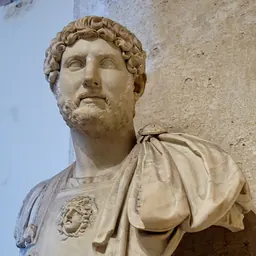
His most famous pupil, Arrian, studied under him as a young man (around AD 108) and claimed to have written his famous Discourses based on the notes he took about lectures by Epictetus. Arrian argued that his Discourses should be considered comparable to the Socratic literature. Arrian described Epictetus as a powerful speaker who could "induce his listener to feel just what Epictetus wanted him to feel". Many eminent figures sought conversations with him. Emperor Hadrian was friendly with him, possibly having heard Epictetus speak at his school in Nicopolis.
Epictetus lived a life of great simplicity, with few possessions. but in his old age, he adopted the child of a friend who otherwise would have been left to die, and raised him with the aid of a woman. It is unclear whether Epictetus and she were married. He died sometime around AD 135. After his death, according to Lucian, his oil lamp was purchased by an admirer for 3,000 drachmae.
Thought
Epictetus maintains that the foundation of all philosophy is self-knowledge; that is, the conviction of our ignorance and gullibility ought to be the first subject of our study. Logic provides valid reasoning and certainty in judgment, but it is subordinate to practical needs. He also maintained that the first and most necessary part of philosophy concerns the application of doctrine, for example, that people should not lie. The second concerns reasons, e.g., why people should not lie. The third, lastly, examines and establishes the reasons. This is the logical part, which finds reasons, shows what is a reason, and that a given reason is a correct one.
Legacy
No writings by Epictetus are known. His discourses were transcribed and compiled by his pupil Arrian . Arrian also compiled a popular digest, entitled the Enchiridion, or Handbook, of Epictetus. In a preface to the Discourses that is addressed to Lucius Gellius, Arrian states that "whatever I heard him say I used to write down, word for word, as best I could, endeavouring to preserve it as a memorial, for my own future use, of his way of thinking and the frankness of his speech".
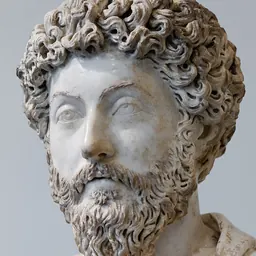
The philosophy of Epictetus influenced the Roman emperor Marcus Aurelius (AD 121 to 180), who cites Epictetus in his Meditations. Epictetus also appears in a second or third century Dialogue Between the Emperor Hadrian and Epictetus the Philosopher. This short Latin text consists of seventy-three short questions supposedly posed by Hadrian and answered by Epictetus. Blaise Pascal listed Epictetus as among those philosophers he was most familiar with, describing him as a "great mind" who is "among the philosophers of the world who have best understood the duties" of an individual.
In the sixth century, the Neoplatonist philosopher Simplicius wrote an extant commentary on the Enchiridion.
Don’t just read it —
keep it.
Full-length biographies made to live with: read them, listen on the way to work, watch them tonight.
- E-book
- Audio
- Video
Instant download · yours to keep · every purchase keeps this site free
Important facts
People in Epictetus's life
Named in this biography and alive at the same time


Related people
Same field, nearest in time




Contemporaries
People whose lives overlapped Epictetus's


Frequently asked questions
Who was Epictetus?
Greek Stoic philosopher (c. 50–c. 138)
When was Epictetus born?
Epictetus was born in AD 50 in Hierapolis.
When did Epictetus die?
Epictetus died in 138 in Nicopolis.
What was Epictetus's occupation?
Epictetus was a philosopher and writer.
What nationality was Epictetus?
Epictetus was Roman.
Sources & further reading
Cite this page
APA: Biography.guide. (2026). Epictetus. https://biography.guide/epictetus/
MLA: "Epictetus." Biography.guide, https://biography.guide/epictetus/.
Chicago: "Epictetus." Biography.guide. https://biography.guide/epictetus/.
Data last updated: 2026-09-20 · Spot an error? Report a correction.
Page generated 2026-09-27 05:18 UTC