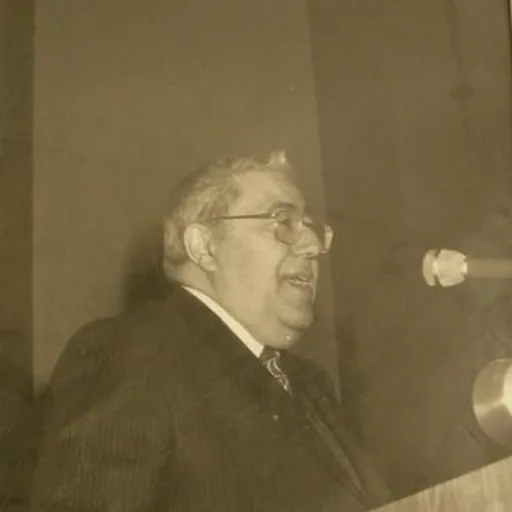
About Enzo Giudici
Lived 1920 – 1985 (aged 65). Enzo Giudici was an Italian writer, literary critic and literary historian.
Enzo Giudici (24 September 1920 – 4 October 1985) was an Italian academic who specialized in French Renaissance literature, particularly Louise Labé and Maurice Scève. Giudici was also a publicist often compared with fascism.
Biography Enzo Giudici was born in Mussomeli. He was the son of Isabella Sorce, a teacher, and Paolo Giudici, who was a writer. His mother died when he was 3 years old. At the age of 10, he left Sicily to live with his father in Piacenza, Pavia, Potenza, and Rome.
During World War II, Giudici was not enrolled in the army due to health conditions. fascist weekly publication directed by Vito Videtta, a member of the extremist Pietro Koch's "gang".
In an article of December 1943, Giudici claimed that fascism was the negation of classes and individuals, and was characterized by totalitarianism and corporatism. In April 1943, Giudici wrote an article in Universalità e nazionalità delle guerre (Universality and nationality of the wars), published by Libro e moschetto. In this article, Giudici wrote: "The present war is together a universal and national war, in which the values and the fate of the world are being determined - through our Italian national conscience. This fight is clearly between two centuries and two ideas, but though it is a fight between peoples, peoples do implement and represent ideas."
In 1944, during the Italian Social Republic, he debated with Roberto Farinacci on reforms in the magazine Repubblica fascista. He wrote an article in the Repubblica Sociale - a monthly review directed by - on "socialized and corporative economy." The same year, Giudici also wrote a book on the socialization of corporations.
In 1946, he was the vice president of the executive board (vicepresidente dell consiglio direttivo) of the newly founded Movimento Italiano di Unità Sociale, which gathered the fascist elit and preceded the MSI.
In 1947, he collaborated with a magazine directed by with an aim to gather "ex fascists leaning to the left". Giudici's passion for chess resulted in his travel to chess tournaments, which led the movement for the introduction of the Elo rating system in Italy. Giudici also wrote an article on the figurative use of such in literature.
Giudici died in Rome on 4 October 1985. Following his death, his collection of over 20,000 books was passed on to the university of Salento.
University positions Teaching assistant at the University of Toulouse 1957-1962. academic interest centered on a French literary movement of the Renaissance called particularly Louise Labé and Maurice Scève, the possible discoverer of Laura de Noves' possible tomb, highlighting, maybe exaggeratedly, Petrarch's influence. In 1958 he published a critical edition of Scève's minor works and in 1976, "the first proper critical edition" - though considered today partial and dated - of Microcosme, Scève's last work. In 1981, he published an erudite edition of Louise Labé works, considered "solid" and "luxuriant", though it has been since deemed incomplete. His sometimes "exceedingly footnotish" editor work and search for documents have been more appreciated by some specialists, who praise his "density of information", than his literary analyses. In recognition of his contribution the renewal of interest in these poets, he was awarded for this work a prix d'honneur by the .
Essays Giudici was subject to criticism for his protracted relationship with fascism. In Memorie e pensieri di un cattedratico (Memories and Thoughts of a Professor), he considers such evocations as false and vile confusions of culture with politics. He claims that fascism is a "controversial" term and that he does not trust "contemporary -isms". Though the Italian historian Carlo Vallauri noted that Giudici "never identified himself" with the MSI, an affinity, sometimes considered as the expression of a "new right" "non-conformism", transcures from his later positions on the student movements and on the culture of fascism. and Contestatori alla sbarra (Protesters at the Bar) he criticizes the student movement, which had started in Italy in 1967. His point of view has been considered by the historian Carlo Vallauri as "the clearer and most organic expression of the wholesome refusal to understand" this movement. The expression avvento dell'asinocrazia was first used in 1968 by Giovanni Sartori in an article published by the Corriere della Sera to characterize the student movement as a "triumph of the donkeys". In La scuola inutile (The ineffective school), initially entitled Asini allo spiedo per il pasto del barone (Jackass on the spit for big shots convenience), Giudici critics not only the "protestive" students, but also the "faint-hearted" political class.
In the late 1970s, Giudici contributed in the Secolo d'Italia, the newspaper of the MSI, to an ongoing debate on the culture of the fascist period. He questioned whether "fascism was only respectful of culture or itself productive of culture" and underlined the link between "fascist culture and the tradition of Risorgimento and ancient Rome". and in Riflessioni sulla cultura del periodo fascista – published posthumously by 's Istituto di studi corporativi, a "reference point of studies and strategy for MSI's economical policy" – where Giudici refers to Robert Michels' analysis on Mussolini's syncretism.
In this last book, Giudici blames the fascist antisemitism. The Italian historian Gianni Rossi notes Giudici, though he does not deny or minimize the Mussolinian antisemitism, finds it "reluctant".
Awards Commander of the Order of Merit of the Italian Republic. Primevère d'argent de l'.
Works by Giudici
Don’t just read it —
keep it.
Full-length biographies made to live with: read them, listen on the way to work, watch them tonight.
- E-book
- Audio
- Video
Instant download · yours to keep · every purchase keeps this site free
Important facts
People in Enzo Giudici's life
Named in this biography and alive at the same time


Related people
Same field, nearest in time



Contemporaries
People whose lives overlapped Enzo Giudici's




Frequently asked questions
Who was Enzo Giudici?
Italian academic (1920-1985)
When was Enzo Giudici born?
Enzo Giudici was born on 24 September 1920 in Mussomeli.
When did Enzo Giudici die?
Enzo Giudici died on 4 October 1985 in Rome.
What was Enzo Giudici's occupation?
Enzo Giudici was a writer, literary critic and literary historian.
What nationality was Enzo Giudici?
Enzo Giudici was Italian.
Sources & further reading
Cite this page
APA: Biography.guide. (2026). Enzo Giudici. https://biography.guide/enzo-giudici/
MLA: "Enzo Giudici." Biography.guide, https://biography.guide/enzo-giudici/.
Chicago: "Enzo Giudici." Biography.guide. https://biography.guide/enzo-giudici/.
Data last updated: 2026-09-23 · Spot an error? Report a correction.
Portrait: Wikimedia Commons · author & licence
Page generated 2026-09-27 05:06 UTC