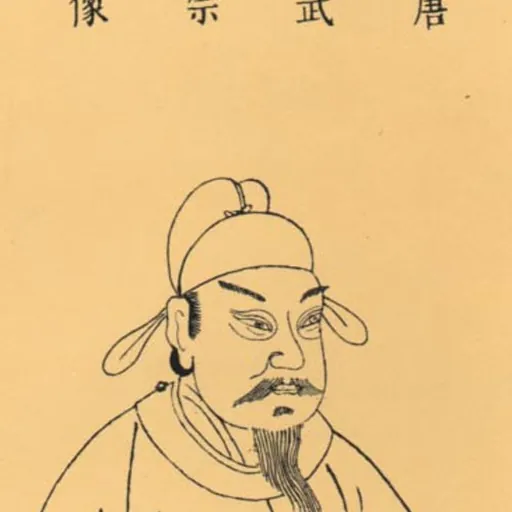
Emperor Wuzong of Tang
Emperor of the Tang Dynasty
About Emperor Wuzong of Tang
Lived 814 – 846 (aged 31). Emperor Wuzong of Tang was a Chinese.
Emperor Wuzong of Tang (July 2, 814 – April 22, 846), né Li Chan, later changed to Li Yan just before his death, was an emperor of the Tang dynasty of China, reigning from 840 to 846. Emperor Wuzong is mainly known in modern times for the religious persecution that occurred during his reign. However, he was also known for his successful reactions against incursions by remnants of the Uyghur Khanate and the rebellion by Liu Zhen, as well as his deep trust and support for chancellor Li Deyu.
Background Li Chan was born in 814, as the ninth son of Li Heng at least, who was then Crown Prince under Li Chan's grandfather Emperor Xianzong. He was born at the Eastern Palace (i.e., the Crown Prince's palace). His mother was Consort Wei, whose rank was lost to history. Little is known about Li Chan's activities during the reigns of Emperor Muzong or Li Chan's older brothers Emperor Jingzong (Emperor Muzong's oldest son) and Emperor Wenzong (Emperor Muzong's second son), other than that during the middle of Emperor Wenzong's Kaicheng era (836–840), Emperor Wenzong bestowed the honorary title of Kaifu Yitong Sansi on him, as well as the title of honorary minister of civil service affairs (吏部尚書, Libu Shangshu). During this first phase, Confucian arguments for the reform of Buddhist institutions and the protection of society from Buddhist influence and practices were predominant.
The religious persecution reached its height in the year 845 CE, ultimately confiscating the Buddhist temple properties, destroying 4,600 Buddhist temples and 40,000 shrines, and removing 260,500 monks and nuns from the monasteries. Emperor Wuzong's reasons for doing so were not purely economic. A zealous Taoist, Wuzong considered Buddhism a foreign religion that was harmful to Chinese society. One notable victim of the persecution was the Japanese Tendai monk Ennin.
Among its purposes were to raise war funds and to cleanse China of foreign influences. As such, the persecution was directed not only towards Buddhism but also towards other foreign religions, such as Zoroastrianism, Nestorian Christianity, and Manichaeism. Only the native Chinese ideologies of Confucianism and Taoism survived the upheaval relatively unaffected. He all but destroyed Zoroastrianism and Manichaeism in China, and his persecution of the growing Nestorian Christian churches sent Chinese Christianity into a decline from which it never recovered.
At the same time, Wuzong went far to promote Taoist worship in China through religious regulations and the construction of the Temple for Viewing Immortals in the Imperial court. (Emperor Wuzong was one of the last Tang emperors and ruled China during a long period of decline; despite his reforms, he was unable to revive the empire through his religious persecutions. After his death, with the help of his uncle Emperor Xuānzong, Buddhism was able to recover from the persecution; but Christianity, Manichaeism, and Zoroastrianism never again played as significant a role in Chinese religious life.)
Dealing with the Uyghur incursions By the time that Emperor Wuzong took the throne, his mother Consort Wei had already died, and he posthumously honored her as an empress dowager. Also, knowing that Yang Sifu and Li Jue had not supported him as Emperor Wenzong's successor, he had them removed from their offices. He instead installed Li Deyu, former chancellor under Wenzong, as a chancellor and effectively put most of the responsibilities of governance in his hands. (In 841, Emperor Wuzong further ordered Liu Hongyi and Xue Jileng to commit suicide and planned to order Yang and Li Jue to do so as well, but Yang and Li Jue were spared (and only demoted) after the intercession by Li Deyu and the other chancellors, Cui Gong, Cui Dan, and Chen Yixing.)
The Zhaoyi campaign Immediately after the dissipation of the Uyghur threat, however, Emperor Wuzong faced a crisis of a different kind. In 843, Liu Congjian the military governor (Jiedushi) of Zhaoyi Circuit (昭義, headquartered in modern Changzhi, Shanxi), who had governed Zhaoyi in de facto independence from the imperial government and who had a strident rivalry with Qiu Shiliang, was seriously ill, and Liu wanted his adoptive son (and biological nephew) Liu Zhen to succeed him, and set up the power structure at the circuit to facilitate the transition. He submitted petitions requesting that Liu Zhen be allowed to take over the circuit. When Liu Congjian thereafter died, Liu Zhen sought to inherit the circuit. Li Deyu, believing that this would be a prime opportunity for the imperial government to seize control of Zhaoyi Circuit, advocated a campaign against Liu Zhen, and Emperor Wuzong agreed.
Late in Emperor Wuzong's life, he began taking pills made by Taoist alchemists, which were intended to lead to immortality, and it was said that his mood became harsh and unpredictable as a side effect. By late 845, he was seriously ill. In early 846, in an attempt to ward off the illness, he changed his name to Li Yan—under the theory that under the Wu Xing cosmology, his original name of Chan contained two instances of earth while only containing one instance of water , which meant that he was getting suppressed by the dynasty's own spirits (as Tang beliefs included that the dynasty was protected by earth), while Yan contained two instances of fire , which was more harmonious with earth. Despite this change, his conditions did not get better. The eunuchs, believing that Emperor Wuzong's uncle Li Yi the Prince of Guang to be simple-minded, decided to make him Emperor Wuzong's successor; they therefore had an edict issued in Emperor Wuzong's name creating Li Yi crown prince (and changing Li Yi's name to Li Chen). Soon thereafter, Emperor Wuzong died after drinking an elixir of immortality, and Li Chen took the throne as Emperor Xuānzong.
Chancellors during reign Yang Sifu (840) Li Jue (840) Cui Dan (840–841) Cui Gong (840–843) Li Deyu (840–846) Chen Yixing (841–842) Li Shen (842–844) Li Rangyi (842–846) Cui Xuan (843–845) Du Cong (844–845) Li Hui (845–846) Zheng Su (845–846)
Family Empress, of the Zheng clan (皇后 郑氏/鄭氏), not recorded in "Old Books of Tang" Worthy Consort of the Wang clan (; d. 846) Virtuous Consort, of the Liu clan (德妃 刘氏/劉氏) Pure Consort, of the Wang clan (淑妃 王氏) Worthy Consort, of the Liu clan (贤妃 刘氏/賢妃 ) Consort, of the Yang clan (妃 杨氏/楊氏) Zhaoyi, of the Wu clan (昭儀 吴氏/昭仪 ) Zhaoyi, of the Shen clan (昭儀 沈氏/昭仪) Zhaoyi, of the Zhang clan (昭儀 張氏/昭仪 张氏) Zhaoyi, of the Zhao clan (昭儀 赵氏/昭仪 趙氏) Zhaoyi, of the Dong clan (昭仪 董氏/昭儀) Cairen, of the Meng clan (才人孟氏) Unknown Li Jun, Prince Qi , first son Li Xian, Prince Yi , second son Li Qi, Prince Yan , third son Li Yi, Prince De , fourth son Li Cuo, Prince Chang , fifth son Princess Changle , first daughter Princess Shouchun , second daughter Princess Yongning , third daughter Princess Yanqing , fourth daughter Princess Jingle , fifth daughter Princess Lewen , sixth daughter Princess Changning , seventh daughter
Don’t just read it —
keep it.
Full-length biographies made to live with: read them, listen on the way to work, watch them tonight.
- E-book
- Audio
- Video
Instant download · yours to keep · every purchase keeps this site free
Important facts
Family & relationships
People in Emperor Wuzong of Tang's life
Named in this biography and alive at the same time



Contemporaries
People whose lives overlapped Emperor Wuzong of Tang's



Frequently asked questions
Who was Emperor Wuzong of Tang?
emperor of the Tang Dynasty
When was Emperor Wuzong of Tang born?
Emperor Wuzong of Tang was born on 2 July 814 in Chang'an.
When did Emperor Wuzong of Tang die?
Emperor Wuzong of Tang died on 22 April 846 in Chang'an.
What nationality was Emperor Wuzong of Tang?
Emperor Wuzong of Tang was Chinese.
Sources & further reading
· Wikipedia: Emperor Wuzong of Tang
· DBpedia: Emperor Wuzong of Tang
Cite this page
APA: Biography.guide. (2026). Emperor Wuzong of Tang. https://biography.guide/emperor-wuzong-of-tang/
MLA: "Emperor Wuzong of Tang." Biography.guide, https://biography.guide/emperor-wuzong-of-tang/.
Chicago: "Emperor Wuzong of Tang." Biography.guide. https://biography.guide/emperor-wuzong-of-tang/.
Data last updated: 2026-09-20 · Spot an error? Report a correction.
Portrait: Wikimedia Commons · author & licence
Page generated 2026-09-27 04:57 UTC