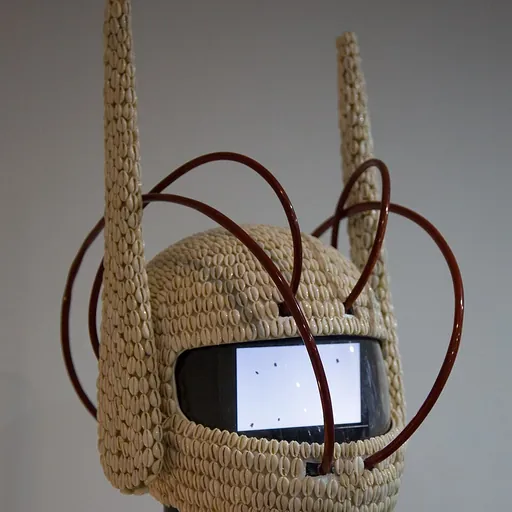
About Emo de Medeiros
Born 1979. Emo de Medeiros is a French and Beninese artist.
Emo de Medeiros (born 1979) is a Beninese artist living and working in Paris, France and in Cotonou, Benin.
His work explores themes of transculturalism, transforming identities, post-colonial representations, and globalization as a worldwide hybridization and mutation. He also questions the African continent's transformations in the context of the digital revolution and the occurrence of a Pan-African 21st-century TransAfrica in transition between tradition and accelerated innovation.
Background and education After spending his childhood and teenage years in Cotonou, Benin, he moved to France to pursue an academic education. He graduated from Ecole Normale Supérieure in Paris where he studied history, sociology and anthropology, after which he continued his training at the Ecole Nationale Supérieure des Beaux-Arts also in Paris.
While in Beaux-arts he started focusing on digital arts: digital photography, graphic design, 3D modeling, digital video and interactive devices, and specifically explored the relationship between time and memory through the notion of instensity (intensity of the instant), linked to his experimental and electronic musical practice. After finishing art school he directed musical videos and experimental short films while pursuing his practice as a composer and producer of electronic music in Paris. He then moved to Boston, where he attended classes at the Massachusetts College of Art and Design, before returning to France and finally to Benin.
Work Emo de Medeiros' work crosses a variety of mediums, including photography, video, textile, painting, performance, and sculpture, and investigates themes of social and symbolic interactions, of the relationship to the digital civilization, of ethnicity and Panafricanism in a post-colonial context. He is sometimes associated with afrofuturism.
His practice is based on the notion of contexture, defined as the creation of artefacts based on interconnections between cultures, materials, concepts techniques and practices from diverse areas, eras, and uses. In particular his pieces often mix technological elements (such as connected devices) and forms from classical African art, notably from Benin, or fuse art genres such as installation and performance resulting for instance in the notion of performative installation in which the public represents a semantic element in its own right, such as Kaleta/Kaleta presented in Palais de Tokyo in 2014.
In 2015 he presented Pavillon du Bénin during the 56th Venice Biennale, a clandestine installation located next to the French Pavilion in the Giardini, the main site of the biennale. The ephemeral piece was an ironic political commentary about the clandestine African vendor figure's absence in the works presented at the biennale, despite their highly visible presence in touristic towns in Italy, about the economic and symbolic power balance that makes the presence of national pavilions of African countries difficult, and about the controversy regarding the Kenyan Pavilion where most of the artists presented were Chinese.
His work has been shown in several solo and group shows in Benin, France, United Kingdom and South Africa. It was also presented at the Salon de Montrouge in 2013, at the Palais de Tokyo in Paris in 2014, at the Dakar Biennale and at the Arts in Marrakech (AiM) International Biennale in 2016.
Exhibitions 2021 13th Gwangju biennale. Curators: Defne Ayas and Natasha Ginwala. Gwangju, South Korea Ex Africa. Curator: Philippe Dagen. Musée du Quai Branly, Paris, France. XXII Paiz Art Biennial. Curators: Gabriel Rodriguez et Alexia Tala. Guatemala City, Guatemala. Comme de longs échos. Curators: Jean-Michel Jagot et Julie Pellegrin. Garenne- Lemot/Musée Dobrée, Nantes, France. Rhizomes. Curator: Paula Nascimento. La Base Sous Marine, Bordeaux, France Ce qui s’oublie et ce qui reste. Curator: Meriem Berrada. Musée National de l'Histoire de l'Immigration, Paris, France. 2020 Now Look Here (The African Art of Appearance). Curator : Renny Ramakers. New North, Amsterdam, Netherlands. Maison de Force. Curators : Marynet J. et Cléophée Moser, le Collectif Eaux Fortes. Aedaen Gallery, Strasbourg, France. 2019 Cosmopolis #2.0: Rethinking the Human. Curator : Kathryn Weir. Centre Pompidou, Paris, France. 21st Contemporary Art Biennial Sesc_Videobrasil, Imagined Communities. Artistic Director : Solange Farkas. Curator : Gabriel Bogossian. Sao Paulo, Brasil. São Tomé Art Biennale VIII. Curator : Renny Ramakers. São Tomé and Principe, Brasil. TIIT, performance. Goethe Institut, Salvador de Bahia, Brasil. 2018 Cosmopolis #1.5: Enlarged Intelligence, Curator : Kathryn Weir. Centre Pompidou, in collaboration with Mao Jihong Arts Foundation, Chengdu, China. Biennale de Casablanca 4th edition, Récits des bords de l’eau (Tales of water margins). Artistic director : Christine Eyene. Casablanca, Morocco. LagosPhoto Festival 2018. Curators : Eva Barois De Caevel, Wunika Mukan, Charlotte Langhorst et Valentine Umansky. Lagos, Nigeria. Chromatics, solo show, 50 Golborne Gallery, London, United Kingdom. Les pouvoirs des émotions. Curators : Laure Kaltenbach et Armelle Pasco. Centre Pompidou, Paris, France. Dak'art Biennale 13th edition, L’heure rouge / Une nouvelle humanité (The red hour / A new humanity). Artistic director : Simon Njami. Palais de Justice, Dakar, Senegal. Do Disturb, Festival of performing arts. Curator : Vittoria Matarrese. Palais de Tokyo, Paris, France. 2017 Africa Aperta II, group show. Galerie Dominique Fiat, Paris, France. Videobrasil Contemporary Art Festival. Artistic director : Solange Farkas. Sao Paulo, Brasil. Digital Africa, group show. Curator : Christine Eyene. OGU MAG gallery, Tokyo, Japan. Die Schönheit im Anderen, group show. Curatour : Mark Gisbourne. Lieberose Castle, Germany. The Black Sphinx, group show. Primo Marella gallery, Milano, Italy. Flow of Forms/Forms of Flow, group show. Curators : Kerstin Pinther and Alexandra Weigand. Galerie Karen Wimmer, Munich, Germany. Afriques Capitales, group show. Curator : Simon Njami (installation proposal by Dominique Fiat), Grande Halle de La Villette, Paris, France. Vers le Cap de Bonne-Espérance, group show. Curateur : Simon Njami. Gare Saint-Sauveur, Lille, France. Le Havre - Dakar, partager la mémoire, group show. Curator : Cédric Crémière. Muséum d'histoire naturelle, Le Havre, France. 2016 Transpositions, 50 Golborne gallery, London, United Kingdom Transmutations, Backslash gallery, Paris, France 12th Dakar Biennale, Witnesses of the Invisible, Dakar, Senegal 6th Marrakech Biennale, "Not New Now", Marrakech, Marocco 2015 All things magic, RSF gallery, Paris, France Venice Biennale Off, Benin Pavilion, Venice, Italy Vodunaut, Centre Arts et Cultures, Abomey-Calavi, Benin 2014 Kaleta/Kaleta, Palais de Tokyo, Paris, France 2013 Black Light Sanctuary, 58th Salon de Montrouge, Montrouge, France
Don’t just read it —
keep it.
Full-length biographies made to live with: read them, listen on the way to work, watch them tonight.
- E-book
- Audio
- Video
Instant download · yours to keep · every purchase keeps this site free
Important facts
People in Emo de Medeiros's life
Named in this biography and alive at the same time





Related people
Same field, nearest in time



Contemporaries
People whose lives overlapped Emo de Medeiros's

Frequently asked questions
Who is Emo de Medeiros?
Beninese artist
When was Emo de Medeiros born?
Emo de Medeiros was born in 1979 in Cotonou.
What is Emo de Medeiros's occupation?
Emo de Medeiros is an artist.
What nationality is Emo de Medeiros?
Emo de Medeiros is French and Beninese.
Sources & further reading
Cite this page
APA: Biography.guide. (2026). Emo de Medeiros. https://biography.guide/emo-de-medeiros/
MLA: "Emo de Medeiros." Biography.guide, https://biography.guide/emo-de-medeiros/.
Chicago: "Emo de Medeiros." Biography.guide. https://biography.guide/emo-de-medeiros/.
Data last updated: 2026-09-22 · Spot an error? Report a correction.
Portrait: Wikimedia Commons · author & licence
Page generated 2026-09-27 05:04 UTC